 Retro Replay Retro Gaming History, Reviews & Emulation
Retro Replay Review
Gameplay
Mouse: P.I. for Hire looks built for the moment when a basic first-person firefight stops being enough and you start looking for a way to move through it with some flair. Jack Pepper has a generous mobility kit, including double jumps, wall-running, grappling, and dashing, so the action is about staying airborne, changing angles, and escaping a crowded floor before it becomes a trap. That should give its arena battles a welcome sense of momentum instead of reducing every encounter to circling enemies with a shotgun.
The weapon lineup understands the assignment. Pistols and shotguns cover the familiar shooter ground, while cartoon nonsense like the Devarnisher, which strips foes down to skeletons, pushes the combat toward gleeful slapstick. Falling anvils and explosive props fit that tone nicely. You are not just mowing through enemies with pistols and shotguns. You are looking for the fastest, messiest way to turn a packed encounter in your favor.
Vertical levels and hidden secrets give the movement abilities a purpose beyond combat. Streets, movie studios, sewers, and swamps promise a broader run of spaces than the premise initially suggests, and collectibles such as newspapers, comic pages, and baseball cards give you a reason to search off the obvious route. Weapon upgrades, alternate fire modes, and new traversal abilities should keep the tool set growing rather than handing you every trick at once.
The main caveat is that the detective angle is not where the interaction lives. Clue collection and the case board mostly move the narrative along automatically. If you want to personally connect evidence, interrogate leads, and solve the case through deduction, this will feel thin. If you want a fast shooter wrapped in detective fiction, that choice is easier to forgive.
Graphics
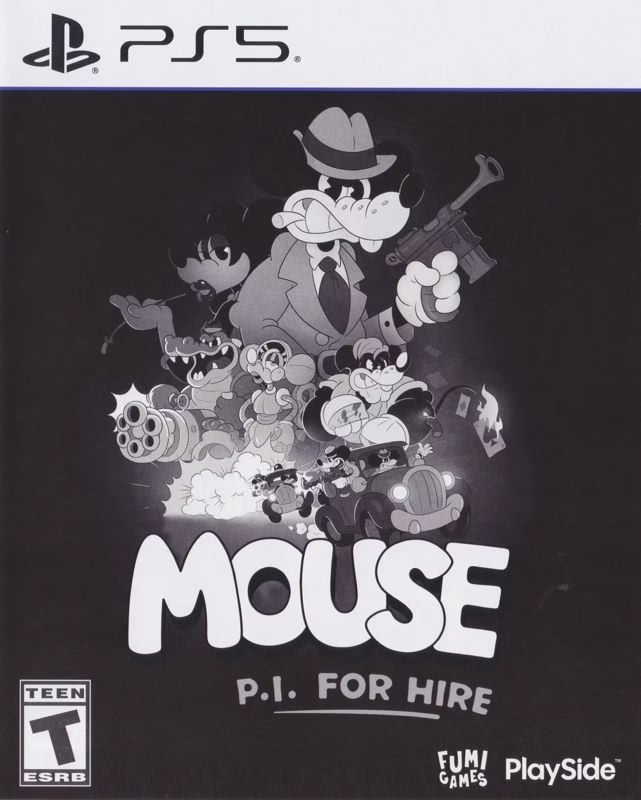
Mouseburg is rendered in black and white with the rounded, elastic character designs associated with 1930s rubber-hose cartoons. That visual direction gives its urban streets, sewers, swamps, and film studios a far more distinctive look than the average crime-game city, while the exaggerated weapons and skeletal enemy transformations keep the violence playful rather than grim.
The monochrome art has a natural noir fit, especially for a private-eye story about corruption and organized crime. More importantly, it makes the silly hazards feel at home: an anvil dropping into a gunfight sounds like a joke only this world could tell without breaking its mood.
Story
Jack Pepper starts as a former war hero working as a private investigator, pulled into a missing-persons case that opens onto corruption, organized crime, and political intrigue. It is a sturdy noir setup, and the contrast between hardboiled stakes and rubber-hose cartoon imagery is the hook. The game is not asking you to take every gag seriously, but it gives the case enough weight to make the city feel like more than a themed combat course.
The story’s strongest role is likely to be momentum between action scenes. A conspiracy gives the trips through Mouseburg’s different districts a reason to connect, while Pepper’s detective identity makes the setting more specific than a generic retro-shooter backdrop. The case board and gathered clues reinforce that through-line even if they do not ask you to do much actual sleuthing.
That is worth knowing before you commit. This is detective fiction with an action-game center, not an investigative adventure that happens to have guns. Come for Pepper’s descent into a crooked cartoon city, but expect the answers to arrive through the campaign rather than your own deductions.
Overall Experience
Mouse: P.I. for Hire earns attention because it does not stop at a clever coat of paint. The classic-cartoon noir angle is memorable, but the mobility-first shooting is what gives it a chance to last beyond the first impression. Dashing through vertical arenas, grappling to safety, and setting off absurd environmental hazards sounds like the kind of chaos that rewards aggression and quick thinking.
It will land best if you enjoy modern retro shooters that treat movement as part of the offense. The arsenal, upgrades, alternate fire, secrets, and collectible hunt offer enough texture for someone who likes clearing every corner, while the automated investigation systems avoid bogging down the pace. The tradeoff is clear: the game borrows the language of private-eye work without delivering a deep mystery-solving layer.
For you, the deciding question is simple. Do you want a detective game, or do you want a breakneck cartoon shooter with a detective story riding shotgun? Choose the latter, and Mouse: P.I. for Hire has the makings of a wildly entertaining trip through a black-and-white city where every gunfight can end in a punchline.


Reviews
There are no reviews yet.