 Retro Replay Retro Gaming History, Reviews & Emulation



Retro Replay Review
Gameplay
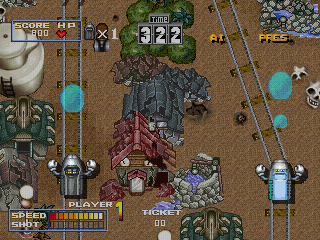
TRL: The Rail Loaders earns attention quickly because it makes an unlikely idea feel immediately gameable. Your train is not simply a vehicle carrying you through a shooter; the tracks define your movement, and switches become part of the moment-to-moment survival puzzle. When a trap is ahead or a power-up sits on another line, you have to make a route decision under pressure rather than merely slide around the screen.
That limitation is the game’s strongest idea. Traditional shoot-em-ups often turn survival into a test of positioning in open space; here, positioning begins with the rail network. You are committed to a line until a switch offers an escape, so an incoming threat can feel more urgent than usual. If you enjoy arcade games that make you work within a clear restriction, this is where TRL has its best chance of winning you over.
Two-player support also suits the premise well. Each player controls a train, while solo play hands the second train to the AI. The setup gives the game a cooperative angle without changing its central focus: follow the tracks, shoot through danger, and choose the safer or more rewarding route when the rails split.
Boss battles deliberately break the rules. The trains grow wings and can fly around the boss, attacking from all sides in a style closer to a standard scrolling shooter. It is a smart change of pace on paper, and it keeps the bosses from being trapped by the same lane-based constraints as the regular stages. The trade-off is that you need to enjoy both halves of the concept: the tactical rail routing and the looser boss encounters.

Graphics
TRL uses 2D, top-down shooter imagery centered on trains, rail lines, traps, power-ups, and enemy encounters. The rail-focused stages should be easy to parse at a glance because the track layout is such an important part of play, while the winged train boss sequences offer a notably different image from the usual train-bound action.

Story
TRL’s strongest fiction is its basic image: armed trains racing along rails and fighting their way through hostile courses. It is an unusual enough starting point that the game does not need a grand setup to be memorable.
The train-and-track premise gives the action a distinct character. A switch is not just a level-layout device; it feels naturally tied to the world, because changing lines is exactly what a rail vehicle should be doing.
The boss transformation pushes that strange premise further, letting trains take flight for all-direction attacks. It is playful arcade logic, and it helps the game stand apart from a more conventional military vehicle shooter.
Overall Experience
TRL: The Rail Loaders is a compactly appealing shooter concept built around one meaningful constraint. The first hour’s pull comes from learning to read the rails as both path and hazard, then realizing that a split in the track can matter as much as the enemies in front of you. That is a stronger hook than simply putting a train sprite into an otherwise ordinary shooter.
Frustration is likely to set in if you want constant freedom of movement. Being locked to rails means bad timing or a poor route choice can feel harsher than in a shooter where you can dodge anywhere. But that same rigidity is the point, and it should click for you if you like games that turn level navigation into a pressure-filled part of combat.
The boss fights help prevent the concept from becoming one-note by opening the action up and letting the trains fly. Add optional local-style cooperation through the second train, and TRL has a clear audience: shooter fans who want an offbeat arcade game with a genuine movement gimmick rather than another straightforward scrolling blaster. It is not a broad recommendation, but its central idea is unusual enough to deserve a chance from anyone intrigued by trains, shooters, and route-based challenge.


Reviews
There are no reviews yet.