 Retro Replay Retro Gaming History, Reviews & Emulation

Retro Replay Review
Gameplay
The first few minutes of Beats are about settling into the basic rhythm-game contract: watch for the prompts, hit the matching buttons at the right time, and turn accuracy into points. That directness works in its favor. You can pick it up quickly, but the urge to improve a messy run is immediate once you start missing inputs by a fraction and realize the score is slipping away.
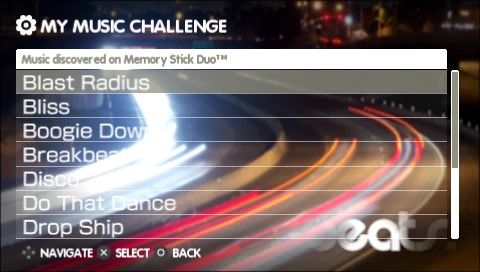
What makes Beats more interesting than a fixed-song challenge is the chance to use your own MP3 collection. A favorite track changes the feel of the whole exercise; you are no longer just learning the game’s playlist, you are testing your timing against music that already means something to you. That personal connection is the strongest reason to give it a look, though it also means your enjoyment will depend heavily on how much you like experimenting with your own library.
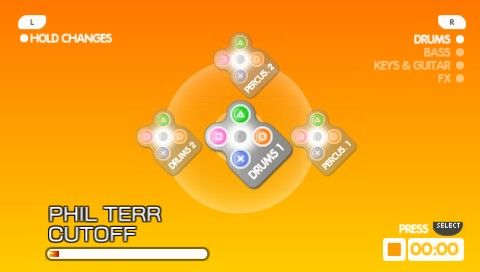
Jamming is the other half of the package, and it prevents the game from being only about chasing points. You can assemble tracks from preset instruments and loops, then save and share the results online. It is not a substitute for full music-production software, nor does it need to be: the fun is in arranging ideas quickly and hearing them take shape. Bring a friend or three for Ad Hoc multiplayer and Beats has a welcome group-game angle too.
Graphics
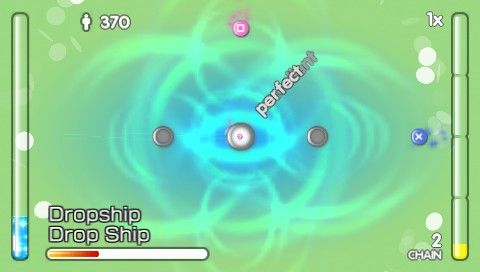
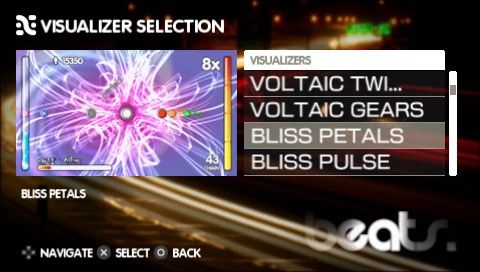
The key images are the button prompts that guide every music challenge. They need to be watched closely while the track is playing, and that simple on-screen focus suits a game built around timing rather than sightseeing.

Story
Beats is not trying to carry you through a character-driven tale. Its momentum comes from a far more personal arc: an unfamiliar track becomes readable, awkward inputs become reliable, and a score you were happy to finish with becomes one you want to beat.
The jamming mode creates its own small sense of authorship. Starting with preset sounds and loops, you decide what belongs together, save the session, and can share it online. That gives your time with Beats a record of what you made instead of a plot checkpoint.
Your MP3 collection also supplies much of the personality. The game has its own music, but using songs you chose makes each challenge feel connected to your tastes. If you need cutscenes and a scripted campaign to stay invested, this is a thin proposition; if music itself is enough context, it has a more individual pull.
Overall Experience
Beats is at its best when you treat it as two complementary music toys in one PSP game. The challenge mode gives you the immediate tension of timed button presses and points, while jamming lets you slow down, combine loops, and make something of your own. Neither side feels like a distraction from the other; together they give the game a useful amount of variety.
Frustration will come from the usual rhythm-game truth: close is not the same as on time. If you do not enjoy repeating a song to tighten your performance, the score-chasing side will wear out quickly. But anyone who likes the moment when a difficult rhythm finally settles into their hands will understand the payoff.
The recommendation is straightforward. Give Beats a chance if you want a portable rhythm game that lets your own MP3s matter and offers a simple route into arranging music with loops. The ability to save and share jams, plus four-player Ad Hoc multiplayer, gives it more life than a solitary high-score exercise. It is a focused game, but a nicely flexible one for PSP owners who want to interact with music rather than merely listen to it.


Reviews
There are no reviews yet.