 Retro Replay Retro Gaming History, Reviews & Emulation
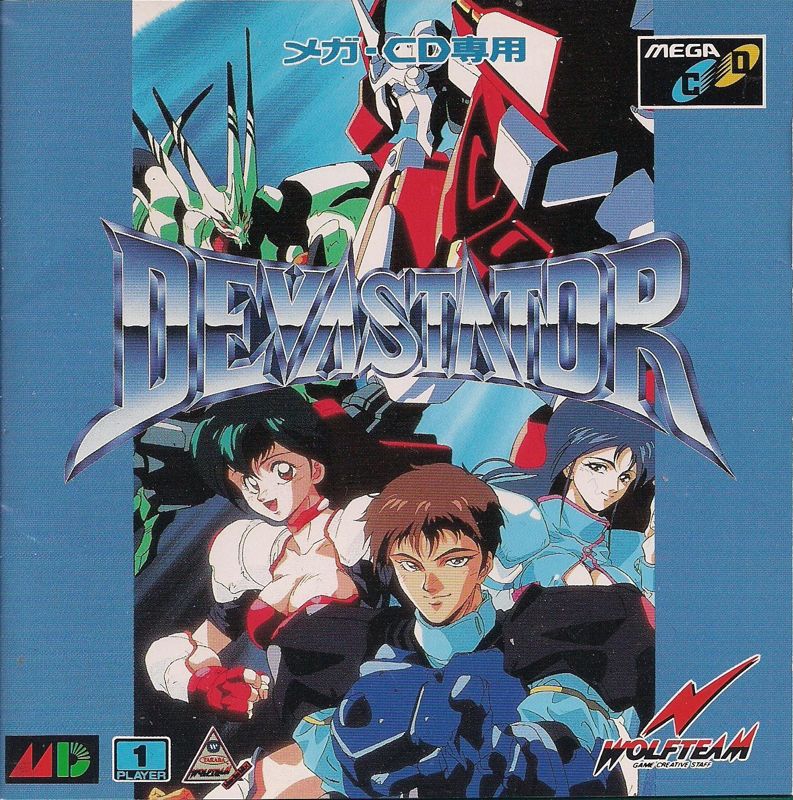
Retro Replay Review
Gameplay
The first stretch of Devastator has an immediate hook: you are a humanoid mech cutting through enemies with a chain sickle while hunting for a useful ranged weapon. That is a stronger starting point than the game’s simple objective—reach the end of a stage and beat its boss—might suggest. The mid-range sickle gives combat a little more character than a standard blaster-only platform shooter, especially when enemies crowd your path and you need to keep moving.
The catch is that Devastator asks you to commit to your weapon pickups. You can carry only one long-range weapon at a time, so grabbing a new one means discarding the one you have. Worse, choosing the weapon you want means shooting the power-up until its symbol cycles around. It is an awkward interruption in a game where enemies and forward momentum are already demanding your attention. The Turrican-like upgrades are welcome, but there is only one standard upgrade item, so your build never becomes as flexible or satisfying as the basic idea promises.
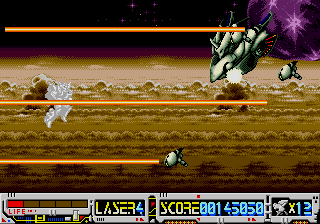
Most stages stick to side-view platform shooting, with shoot-’em-up sections breaking up the routine through horizontal scrolling. Those shifts help Devastator avoid feeling like one long corridor of jumps and enemy fire. Still, the two styles do not transform the game; they mainly offer a change of tempo. Expect a straightforward, old-school action challenge built around getting through a level cleanly enough to face the boss with a weapon you actually want.
Frustration is most likely to set in when a replacement pickup appears at the wrong moment. You may know exactly which weapon symbol you need, yet still have to stand there firing at the item while the stage carries on around you. If you can accept that bit of 1993 design friction, the mix of melee reach, ranged fire, upgrades, and bosses has enough bite to remain playable. If you want smooth weapon handling and deep progression, Devastator will feel limited fast.
Graphics
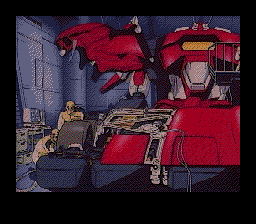
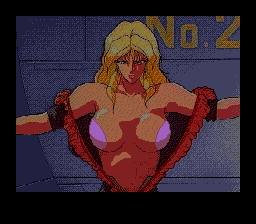
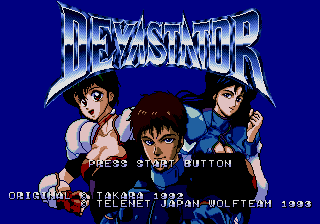
The game pairs side-view mech action with anime extracts between levels, so Ryo’s journey has more personality than a bare mission briefing. The cutscenes are the clearest visual payoff: they connect the playable mech combat to the story of Yaesu, the other dimension, and the Devastators.
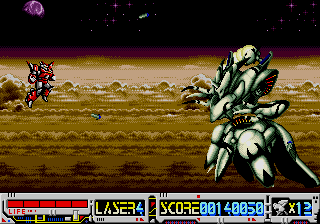
During play, the camera stays side-on for the platform stages and shifts into horizontally scrolling views for the shooter segments. That makes the genre changes immediately clear, even when the action itself remains direct and uncomplicated.
Story
Ryo starts out replacing his friend Masato at Yaesu, then a test ride in a new machine throws him into another dimension. It is a clean anime-action setup, and Devastator wisely does not bury it under complicated setup before sending you into combat. Mecha pilots rescue Ryo from the creatures called Devastators, and he soon learns that someone is trying to connect their world with his own.
The story’s best contribution is motivation. Ryo is not simply clearing stages because the game needs enemies to shoot; he is trying to stop a threat that crosses dimensions. The anime clips placed between levels should help the campaign feel more connected than its simple stage-to-boss structure would on its own.
That said, this is still an action game first. The plot gives the fighting a recognizable sci-fi frame, but the real payoff comes from seeing the next battle and boss rather than from expecting a richly developed drama. If you enjoy compact licensed anime stories that move briskly between confrontations, it does its job.
Overall Experience
Devastator is a decent Sega CD action game with a good central image—a mech fighter wielding a chain sickle—and a few smart attempts to vary its rhythm. The platform stages and scrolling shooter detours stop it from becoming totally repetitive, while the anime scenes give its dimensional-war premise some welcome flavor.
Its limitations are harder to ignore once you settle in. Weapon upgrades exist, but the one-weapon restriction and shoot-to-select pickup system make them more cumbersome than exciting. The campaign also stays close to a basic formula: advance, fight, and take down a boss. That can be perfectly satisfying in short bursts, but it does not leave much room for the game to build momentum beyond its immediate combat.
Give it a chance if you have a soft spot for Sega CD anime action, simple run-and-guns, and games that reward patience with old-fashioned weapon management. Go in for the mech-and-anime atmosphere rather than expecting a lost classic. Devastator has enough personality to be worth a look, but its clunky upgrade handling keeps it from becoming a stronger recommendation.


Reviews
There are no reviews yet.