 Retro Replay Retro Gaming History, Reviews & Emulation
Retro Replay Review
Gameplay
The first few minutes of Kendo Rage make a strong case for its uncomplicated charm. You jump, duck, and swat supernatural enemies with a bamboo sword while moving steadily through side-scrolling stages, and the controls are built around keeping that momentum going. It is the kind of action game that invites you to push ahead instead of stopping to puzzle over its systems.
What starts to click is the psychic-energy meter. Your projectile recharges, and its strength changes with your available energy, so there is a small but welcome decision behind each fight. You can take the safe shot when the meter is ready, or save energy for the flame-surrounded rushing attack when you need to force your way through danger. Neither option turns the game into a deep brawler, but they keep the swordplay from feeling completely one-note.
With only seven stages and a boss at the end of each, Kendo Rage is best when you want a focused run rather than a long campaign. The structure can also expose its limits: repeated enemy encounters and straightforward platforming do not leave much room for the game to grow beyond its central trick. Still, the brisk length works in its favor. It rarely asks you to commit long enough for the formula to wear completely thin.
Give it a shot if you like direct 16-bit action and can enjoy a game for its weird tone as much as its challenge. Go in expecting a solid, compact platformer rather than a lost masterpiece. The charged shots and energy-spending rush provide enough texture to make each stage feel like more than a simple march from left to right.
Graphics
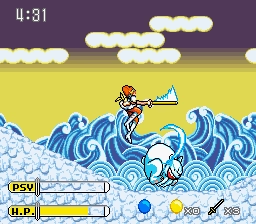
The action uses bright, goofy cartoon imagery that suits the game’s comic-book kendo premise. Josephine’s orange hair and turquoise-and-white outfit stand out as she leaps over curling blue-and-white waves, while a long-necked blue creature rising from the ocean gives one encounter a suitably ridiculous shape against the yellow-green sky and pale clouds.
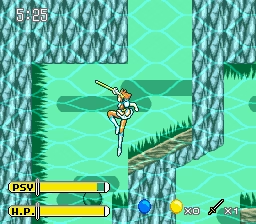
Underwater areas trade the open coast for a glowing mint-green pool boxed in by dark, sharply patterned rock walls and spiky plants. The colors stay lively, but those repeated angular rock patterns make the scenery feel less varied than the enemy designs.
Story
Kendo Rage does not linger over its plot, but its localization gives the action a specific, playful frame: Josephine is an American student at a comic kendo school facing supernatural enemies. That is a light setup, and the game wisely treats it as a reason to throw strange threats at a sword-wielding heroine rather than a reason to slow the pace.
The North American version is notably not a simple naming pass over the Japanese game. It is the localized form of Makeruna! Makendo, whose heroine is Mai Tsurugino and whose setup involves a transforming artifact given to her by the spirit detective Doro. The differences are substantial enough that the regional versions of Kendo Rage are worth reading about if you come away curious about the original context.
For the actual play experience, the story is mostly seasoning. The supernatural theme matters because it lets the bosses and foes be broad and bizarre, and that comedy helps the straightforward stage-by-stage structure feel less dry. Do not expect a character-driven adventure, but the premise has enough flavor to carry a short action game.
Overall Experience
Kendo Rage is a good example of how far personality can carry a modest action platformer. The platforming and sword combat are not especially complicated, yet the psychic meter, charged shots, and costly rush attack add just enough pressure to keep you engaged. The bright colors and deliberately absurd enemies give the whole thing a cheerfully offbeat tone.
Frustration is most likely to set in if you need every stage to introduce a major new idea. This is a seven-stage game that leans on a dependable core loop, and its environments can look repetitive. But if you meet it on those terms, its short length feels more like restraint than a deficiency. It is an easy recommendation for a single relaxed retro session, especially if ordinary fantasy platforming has started to blur together for you.
The payoff is not a dramatic finale to a sprawling quest. It is the pleasure of a strange, colorful SNES game committing to its joke while giving you a dependable set of action tools. If you want to see where the series went afterward, Makeruna! Makendo 2 takes the follow-up in a very different direction, shifting to fighting-game competition instead of repeating this platforming format.


Reviews
There are no reviews yet.