 Retro Replay Retro Gaming History, Reviews & Emulation
Retro Replay Review
Gameplay
The first stretch makes a clear case for its central hook: Zenki is not always the destructive demon you want him to be. In his reduced state, you are working with punches, jumps, and a dash, so enemy encounters and platforming feel more exposed. When Chiaki restores his power, the pace changes immediately. Zenki hits harder and gradually gains a much more entertaining set of attacks, turning the action from scrappy survival into a chance to cut loose.
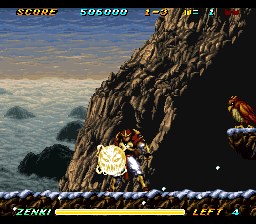
That contrast is what keeps Battle Raiden from feeling like a completely routine side-view platformer. The powered-up kit includes an energy pillar, an electrified punch, and a dashing attack, giving you more options as the game moves along. The Rudora attack is especially interesting: a scroll lets you hit every enemy on screen, but Zenki takes damage too. It is not a panic button you can throw around thoughtlessly; use it when clearing the screen is worth paying for.
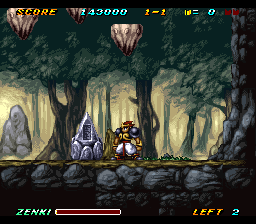
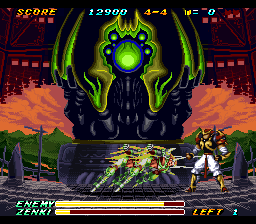
Stages ask more than simply reaching the exit. Hidden stone monuments can drop items and, more importantly, alter the level or remove obstructions. That makes exploration practical rather than ornamental. If you are stalled by a blocked route, slow down and search instead of assuming you missed a jump. The repeated pattern of platform stage, midboss, another platform stage, then boss is predictable, but it gives each area a useful rhythm and frequent tests of the combat.
Graphics
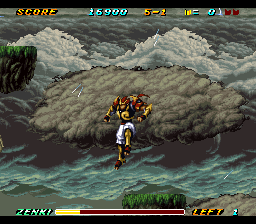
The side-view action keeps Zenki and the enemies front and center, and the anime source comes through most clearly in the contrast between his reduced and powered-up forms. His expanding attack set also gives the combat a livelier look as energy-based moves enter the mix.
Story
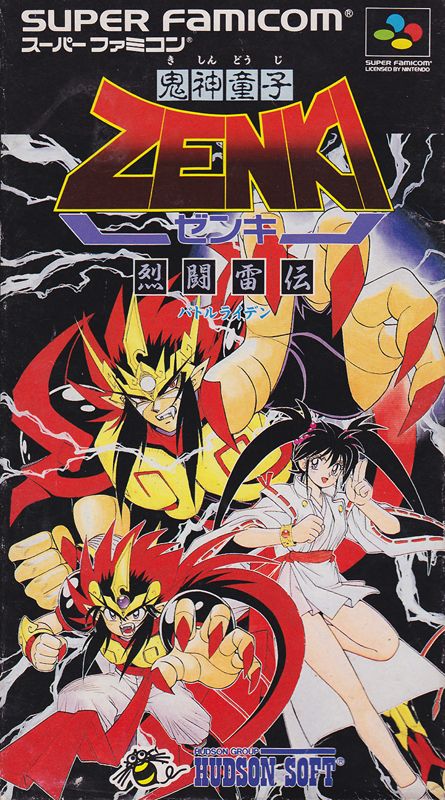
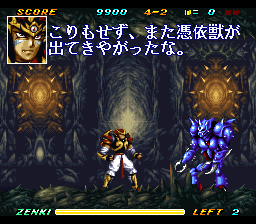
The story wastes little time setting up another supernatural crisis. Chiaki sees five cloaked figures, identifies them as a threat, and heads out with her reluctant demon servant to find the demon leaders. It is a direct excuse for the journey, but the established partnership gives the premise more personality than a generic lone-hero quest.
Zenki’s reluctance matters because the game’s central transformation structure echoes that relationship. Chiaki is the person who can return him to fighting strength, while Zenki is the one doing the dangerous work on the ground. Even without a complicated plot, that dependency gives the action a thematic through-line.
Do not come in expecting the narrative to overshadow the platforming. Battle Raiden treats its five cloaked antagonists and world-saving mission as a clean framework for successive stages and confrontations. Fans of the Zenki anime and manga will get the most out of seeing this duo carry the adventure; everyone else can take it as brisk fantasy motivation.
Overall Experience
Battle Raiden’s strongest idea is also its simplest: being weak for stretches makes being powerful feel better. The limited moveset can be frustrating when you want access to Zenki’s full arsenal, yet that frustration is deliberate and pays off whenever Chiaki enables his stronger form. The added attacks make later combat feel like growth rather than mere repetition.
The hidden monuments are another smart touch. They give you a small exploratory task inside linear platforming, and they can directly change the route ahead. That is enough to encourage attention without turning every stage into a maze. You will have a better time if you enjoy checking walls and corners rather than racing straight to the finish.
This is worth a chance for fans of SNES-era anime action and for anyone who likes a platformer with a combat system that develops over time. Its stage structure is familiar, but the power-state shifts, risky Rudora attack, and obstacle-changing secrets give the adventure enough character to rise above a plain licensed tie-in.


Reviews
There are no reviews yet.