 Retro Replay Retro Gaming History, Reviews & Emulation



Retro Replay Review
Gameplay
Ultra Seven’s hook is easy to understand and surprisingly unforgiving in play: draining an enemy’s life bar does not automatically end the match. Once you have the foe on the ropes, the game calls for a finish, and Ultra Seven needs his power meter at L4 to deliver it. That turns the final stretch of every battle into a small test of preparation rather than a routine victory lap.
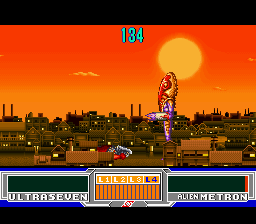
You are juggling three visible bars at once. Ultra Seven’s own energy sits on one side, the opponent’s on the other, and the center gauge tracks four levels of power from L1 through L4. That is a cleaner idea than it may sound on paper. You can always tell that survival, opponent health, and finishing power are separate concerns, so the game asks you to fight with an eye on the end condition instead of blindly chasing damage.
The drawback is that the L4 requirement can make the rules feel restrictive. A battle can seem won, only to demand more work because your power has not reached the necessary level. Some players will enjoy that tension: the finish feels earned rather than handed over. Others will see it as an awkward interruption to a fighting game that already lives or dies on repeated one-on-one encounters.
Give it a chance if the thought of managing a meter for a decisive final move sounds more interesting than simply emptying a health bar. Go in expecting a compact, older fighting-game structure, not a deep competitive fighter with endless layers to uncover. Its best moments come when you have the opponent weakened, your own energy is holding, and that L4 finish is finally within reach.

Graphics
Ultra Seven uses side-view fighting stages and keeps the focus on its licensed combatants: Ultra Seven faces enemies from the television series, including Pitt, Eleking, and Gutts. The three energy displays remain on screen throughout the action, making the match state easy to track even when the finish requirement becomes tense.
Story
This is a straightforward hero-versus-monster setup rather than a story-heavy adventure. You control Ultra Seven, an alien from Planet M-78, and face a run of enemies associated with the television series. That is enough to give each encounter a recognizable bit of franchise flavor, especially if these opponents already mean something to you.
Do not come here looking for a long narrative arc or character drama. The story mainly supplies a reason for Ultra Seven to enter another fight, and the individual enemy names carry much of the game’s personality. For a 1993 SNES licensed fighter, that directness fits the format.
Fans of Ultra Seven will get more out of the setup because recognition is doing important work. Seeing Pitt, Eleking, and Gutts framed as successive threats gives the battles a familiar monster-of-the-week energy. Without that attachment, the narrative is functional background rather than a reason to keep playing.
Overall Experience
Ultra Seven is most interesting when it refuses to treat victory as simple damage output. The need to preserve your energy, reduce the opponent’s, and reach L4 before the finishing moment gives its fights a distinct pressure. It is a modest twist, but it changes how you approach the last part of every bout.
That same idea is also where frustration can set in. If you dislike having a win held up by meter requirements, the game’s defining rule will feel like a chore instead of suspense. This is not a fighter that eases you in with broad variety; it asks you early on whether that finish-focused rhythm works for you.
The payoff is strongest for Ultra Seven devotees and for retro fighting fans who enjoy a game with one firm, unusual win condition. The license gives the matchups their charm, while the L4 finish gives them a reason to be more than ordinary exchanges of hits. If either half of that equation appeals, it is worth a look; if neither does, its limited structure will wear thin quickly.


Reviews
There are no reviews yet.