 Retro Replay Retro Gaming History, Reviews & Emulation



Retro Replay Review
Gameplay
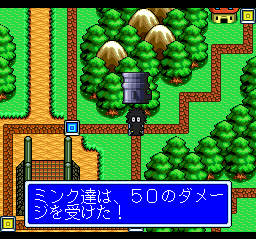
The first hour’s pull comes from the mismatch of familiar parts. You roll dice to travel a large board, yet you are not simply following a single track: crossroads and alternate paths let you decide where a roll will take you. That little bit of agency matters. A low roll can be annoying, but choosing between routes gives you a reason to think ahead instead of treating every turn as dead time.
Landing spaces keep the board from becoming a mere travel screen. Red spaces start enemy encounters, while other spots can hurt the party, offer shops, trigger character meetings, or lead to recovery at pools and hotels. That makes route choice more than a matter of reaching the next objective. You may want healing, you may want to avoid danger, or you may decide the potential rewards of a fight are worth the risk.
Combat is turn-based, but its attacks ask for timely button presses to select a party member’s move and determine its strength. That sounds simple, yet it gives battles a more immediate feel than a fully menu-driven RPG. Experience and level-ups provide a familiar incentive to keep fighting. The possible frustration is obvious: dice control your distance, and the board can send your plans sideways. Still, the branching layout is enough to make the luck feel like part of a game-night contest rather than empty randomness.
With support for up to four players competing with parties drawn from the manga, Dragon Half is at its most interesting as a shared, unpredictable tactical race. Solo-minded RPG fans may find the board-game framing too dependent on chance, but a group willing to enjoy detours, traps, and rival progress has a more distinctive reason to play.

Graphics
The game uses a top-down view for its board-based travel, with red spaces clearly identifying the locations that lead to enemy battles. The large board and its crossroads are the important images here, because they show where a roll might send your party and where route choices open up.

Story
Mink’s quest has a clean fantasy-RPG spine: she learns she has dragon blood, is destined to seal the demon Azetodeth, and must gather three sacred artifacts to create the sacred Gourd needed for the job. It is a direct objective, which suits a game built around moving from space to space toward a final goal.
Lufa, Pia, and Princess Vina join Mink on the journey, giving the adventure a recognizable party structure. Character meetings can also be triggered on the board, tying the manga cast into the game’s movement rather than leaving the quest entirely disconnected from its licensed source.
The story is best taken as a playful framework for the board-game journey, not as a sprawling role-playing epic. If you already enjoy Dragon Half’s characters, the chance to guide their parties through a competitive artifact hunt is the strongest draw. Newcomers still get a clear enough mission to understand why every detour and battle matters.
Overall Experience
Dragon Half earns its curiosity value by refusing to settle into one genre. It is an RPG where leveling comes through board-game travel, a strategy game where dice rolls create the immediate problem, and a multiplayer contest where your route decisions can matter as much as combat success.
That blend will not suit everyone. You need some tolerance for chance, since a die determines how far you move, and you need to enjoy a lighter, more stop-start quest rhythm than a conventional Japanese RPG offers. The payoff is in adapting: taking the route that fits your current condition, using healing stops when needed, and accepting that a bad landing can become the next problem to solve.
Give it a chance if you want a strange 1990s licensed RPG experiment that works better as a lively session with friends than as a solemn fantasy campaign. Its ideas are more memorable than seamless, but the mix of branching board navigation, timed battle input, and party progression has enough personality to make the trip worthwhile for the right group.

Reviews
There are no reviews yet.