 Retro Replay Retro Gaming History, Reviews & Emulation

Retro Replay Review
Gameplay
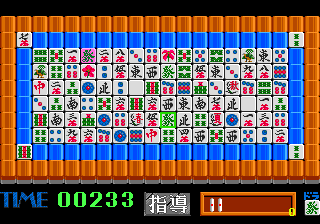
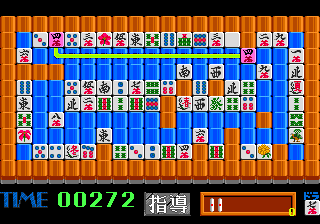
The first few minutes invite a mistake that Gyuwambler Jiko Chūshinha is happy to punish: you see matching mahjong tiles, spot a clear path, and start removing pairs as fast as possible. Then the board changes. New tiles arrive on squares next to the ones you cleared, so every disappearance also reshapes the problem. A move that feels tidy can close off the pair you needed later, and that is where this small puzzle starts to bite.
It is not mahjong in the usual sense. You are not building hands or learning the rules of a card game; you are studying a board, tracing unobstructed routes between identical tiles, and trying to preserve enough space for the next several moves. That makes the game more deliberate than its title may suggest. The best moments come when you pause, identify the dangerous clusters, and remove pairs in an order that leaves the board flexible rather than merely emptier.
There are nine board patterns, and their different tile arrangements matter because the layout determines how quickly a careless clear can turn into a dead end. Four difficulty settings alter the time limit, with an untimed option at the easy end. Start there. Without a clock pushing you into bad decisions, you can learn how newly placed tiles alter your plans; once that clicks, the timed settings give the same careful logic a much sharper edge.
The frustration is real when a run becomes unwinnable after what looked like a reasonable choice. Yet that consequence is also the point. This is a puzzle game for someone who likes recovering from mistakes and gradually reading a board more intelligently, not someone looking for a loose, relaxing tile-matching distraction.
Graphics
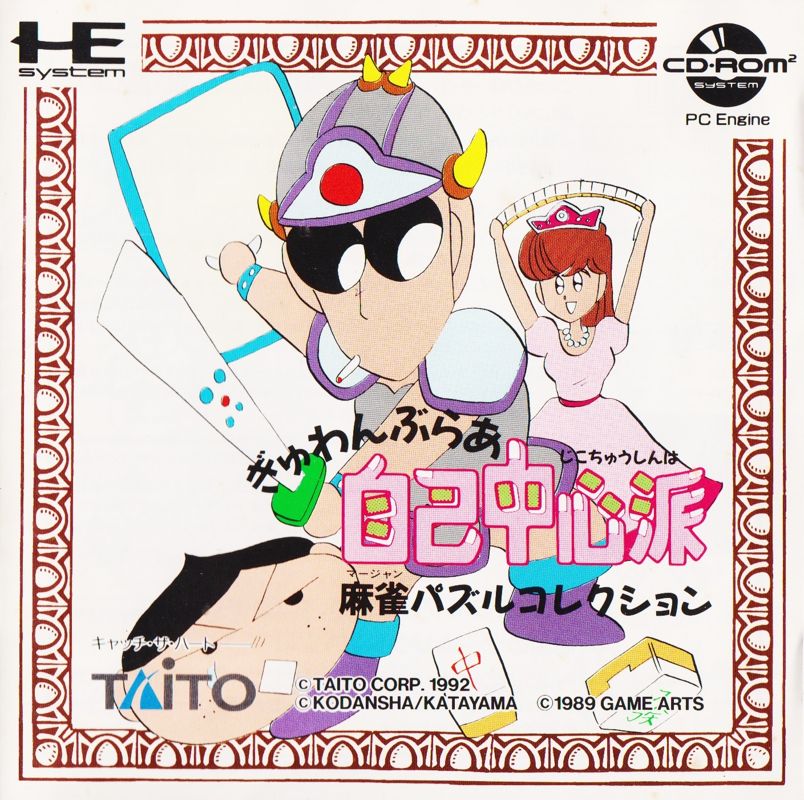
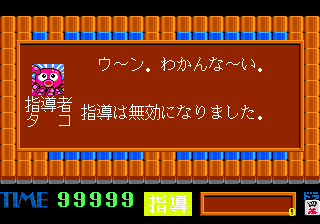
The view stays focused on the board full of mahjong tiles, with the fixed puzzle layouts keeping attention on which pairs can connect and which are blocked. The manga connection also appears through the Gyuwambler Jiko Chūshinha characters you can call on for limited advice, giving the otherwise tile-centered screen a little character.

Story
Story is not what carries this one from puzzle to puzzle. The Gyuwambler Jiko Chūshinha manga license chiefly comes through the characters available to offer advice, and their limited help has a practical purpose: it can steer you when the board has become hard to read.
That light use of the cast fits the game’s priorities. You are spending your time with tile routes, obstructed paths, and the consequences of each removal, so the characters work better as a friendly nudge than as a reason to keep playing.
If the series is what brought you here, the connection is worth treating as a bonus rather than the main draw. For another stop in the same broader series, see Gyuwambler Jiko Chūshinha: Katayama Masayuki no Mahjong Dōjō.
Overall Experience
Gyuwambler Jiko Chūshinha: Mahjong Puzzle Collection is a more thoughtful game than its simple match-pair premise initially lets on. The moving parts are easy to understand, but the addition of new adjacent tiles means you cannot play purely by instinct. You need to think in sequences, and that gives even a small set of boards replay value.
Its narrow focus is a strength if you want a concentrated logic puzzle. There are no complicated rules to memorize before the interesting decisions start; the interesting decisions are already there in the first board, waiting for you to realize that clearing a pair is not automatically progress.
Give it a chance if you enjoy spatial puzzles that reward patience and punish greedy moves. The untimed difficulty makes it approachable, while the stricter limits offer a clean test once you understand the board behavior. It is a modest but clever tile puzzler whose best payoff is the satisfying shift from confusion to control.


Reviews
There are no reviews yet.