 Retro Replay Retro Gaming History, Reviews & Emulation
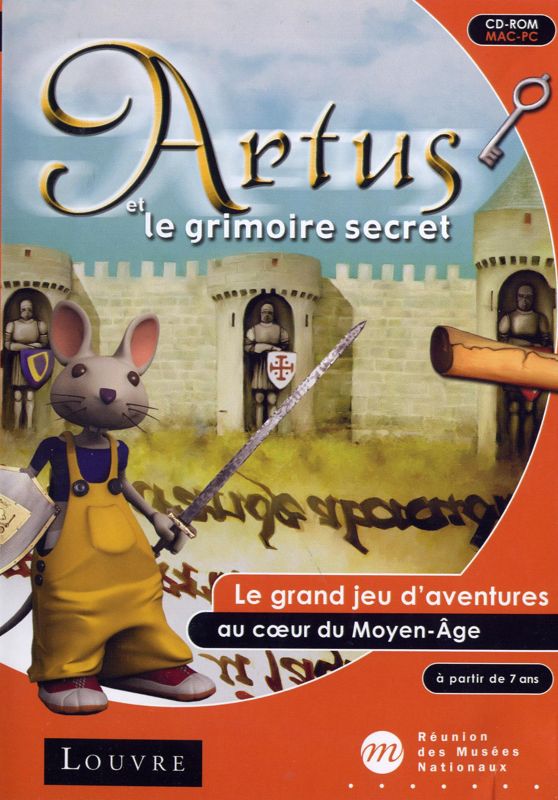
Retro Replay Review
Gameplay
The opening premise gives you an immediate reason to poke around: Artus is a mouse from the Louvre, a strange scroll appears, and suddenly you are headed into the Middle Ages. That is a stronger launch than many educational games manage. Rather than asking you to absorb history as a lesson first, it puts you in an adventure and lets the subject matter ride alongside the quest.
The basic loop combines point-and-select exploration, puzzles, travel, and fights with thieves. Each of the four stories asks Artus to locate a cup, sword, walking stick, and gold, so there is always a concrete set of goals in front of you. That structure should be especially welcome if you like adventure games with clear progress markers instead of aimless wandering.
Its RPG elements are modest but meaningful to the tone. Courage and charity points make Artus’s development feel tied to more than collecting objects, while his journey toward becoming a knight gives the repeated quests some forward momentum. The possible friction is that this is a broad mixture of ideas: anyone looking for deep combat or intricate role-playing systems may find the adventure and educational sides more central. Come for puzzles and historical discovery, not for a combat-heavy fantasy campaign.
Graphics
The imagery has a naturally storybook-friendly foundation: a small mouse from the Louvre moving through medieval European tales, with knightly objects such as swords and gold at the center of the search. The contrast between the museum-bound opening and the medieval journey is an appealing visual idea for a younger adventure.
Story
Artus’s story understands that history is easier to meet through a character than through a timeline. Sending a secret Louvre resident backward through a scroll gives the game an accessible fantasy doorway into medieval Europe, and the four separate stories promise variety without losing the larger thread.
The strongest part is Artus himself. He begins as a little mouse with an extraordinary discovery and grows toward knighthood, which gives the historical material a coming-of-age frame. Courage and charity are fitting concerns for that arc; they suggest a game interested in what kind of knight he becomes, not merely whether he reaches the next destination.
Do not expect the premise to behave like a dense historical drama. The story is built to carry puzzles, object hunts, and travel, with fantasy doing much of the connective work. Still, the Louvre endorsement lends the learning angle more weight, and the setting has enough natural romance to keep the lesson from feeling like homework.
Overall Experience
Artus et le grimoire secret is most appealing when you accept its hybrid nature. It is an adventure game first in how it moves you through mysteries and puzzles, but it also wants to teach, add light role-playing choices, and turn medieval Europe into a place worth visiting. That ambition is more memorable than a standard educational quiz format.
The payoff is likely strongest for younger gamers, families, and anyone who enjoys gentle point-and-select adventures with historical flavor. The repeated item goals keep the journey understandable, while Artus’s rise toward knighthood gives the broader trip a pleasant sense of progression. It may feel lightweight beside more demanding RPGs, but it has a distinctive, sincere hook.
Give it a chance if a mouse-in-the-Louvre setup, medieval tales, puzzles, and a little learning sound like a good afternoon. Skip it if you need fast action or a deep tactical challenge. For its intended blend of education and fantasy adventure, it is an imaginative detour with enough structure to carry you through its four stories.



Reviews
There are no reviews yet.