 Retro Replay Retro Gaming History, Reviews & Emulation

Retro Replay Review
Gameplay
The first hour of Emergency 2012 makes a strong case for its particular kind of pressure. You are not conquering territory or building an army. You are trying to stop a bad situation from becoming three worse ones: a fire needs attention, casualties need treatment and transport, traffic or criminal trouble needs police, and the aftermath still has to be cleared. When your response comes together, it feels less like winning a battle than successfully untangling a very expensive knot.
The campaign has 12 distinct catastrophe scenarios, each on its own map, and the preset forces keep the focus on responding rather than shopping for an ideal roster. Missions follow linear, event-triggered plots, but your performance still changes how smoothly and quickly objectives are handled. That balance works well. You know the scenario has a path, yet you still feel responsible for whether the operation stays orderly or spirals into frantic damage control.
Be ready to do the work yourself. Selecting an appropriate vehicle, unloading its crew, and equipping personnel for the job are routine parts of every response. Units can deal with nearby fires or revive victims within reach, but they have limited initiative beyond that. The resulting micromanagement is the game’s central pleasure for a patient strategist and its biggest obstacle for everyone else. A missed piece of equipment or the wrong vehicle choice can leave you clicking through logistics when you would rather be making bigger decisions.
Firefighters carry most of the game, covering everything from minor burning bins and traffic accidents to large blazes spreading through a neighborhood. Police incidents add variety through traffic jams, pickpockets, robberies, and sniper attacks. Medical rescue and technical relief have narrower supporting duties—reanimation, transport, cleanup, and specialist tasks—so they can feel more like necessary tools than equally rich divisions. Still, that unevenness fits the emergency-response fantasy: the fire service is usually where the immediate chaos is.
Free Play is where the management burden either clicks or curdles. You begin with a limited fleet at an all-in-one base, buy additional and more specialized vehicles as you go, and answer randomly generated incidents across three weather-themed maps. Storm, heat wave, and cold wave give each map a different frame, while the random calls keep you from simply memorizing a campaign sequence. It is replayable, but it asks you to enjoy repeated decisions about fleet composition and crew setup, not merely the surprise of the next emergency.

Graphics
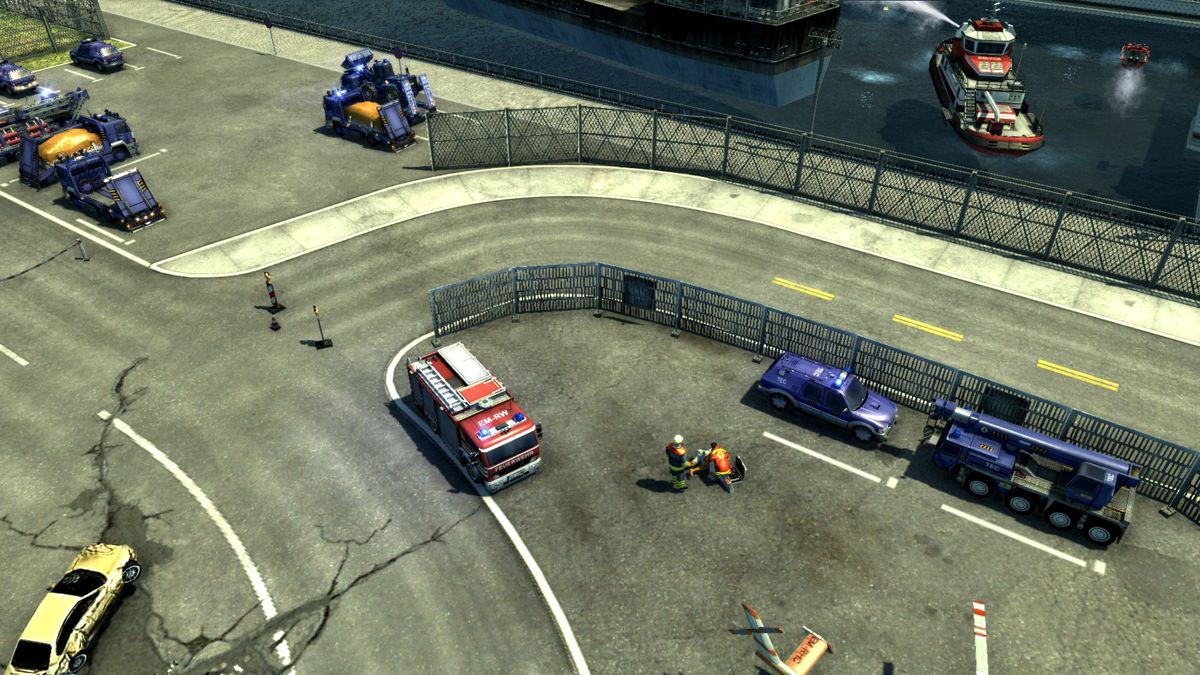
The diagonal-down viewpoint keeps a broad emergency scene in view, which matters when several vehicles and crews are moving around a single incident. Different maps in the campaign and the three weather-conditioned Free Play maps help prevent the game from feeling like every callout happens on the same patch of city.

Story
The campaign tells its stories through 12 fictive catastrophe scenarios rather than through an open-ended city simulation. Each mission has a linear plot and events that trigger as you proceed, so the narrative pull comes from seeing the next stage of a crisis unfold and responding before it worsens.
That structure is a mixed blessing. It gives every mission a clear dramatic shape and makes the campaign easy to grasp, but it limits the sense that you are writing your own rescue story. Your performance changes the pace and manner in which objectives are completed, not the basic route of the scenario.
There is enough variety in the emergencies to make the campaign feel like a sequence of different public-service disasters rather than a string of identical fires. Just do not come in expecting deep character drama or elaborate branching. The story is there to put you under pressure, and it does that job effectively.
Overall Experience
Emergency 2012 is rewarding when you enjoy being the person who notices what a crisis needs before it becomes obvious. It turns emergency response into a chain of practical judgments, and its best missions create a satisfying rhythm of dispatching, deploying, treating, clearing, and reassessing. The campaign’s fixed unit rosters make those judgments feel immediate, while Free Play gives committed players a longer-term reason to learn the vehicle roster.
Its rough edge is the amount of direct supervision required. This is not the kind of real-time strategy game where you issue a broad order and trust the squad to handle the details. You are frequently managing the details, including getting personnel out of vehicles and into the right gear. If that sounds like a chore, the game can feel fussy long before its emergencies feel exciting.
For the right player, though, that fussiness is the point. The game captures the satisfaction of restoring order through disciplined coordination, and the variety of fire, police, medical, and technical calls prevents it from becoming a one-note firefighting exercise. It lands as a solid but specialized rescue strategy game: engaging in short bursts, more rewarding with patience, and easier to recommend to micromanagement fans than to anyone looking for a breezier RTS.


Reviews
There are no reviews yet.