 Retro Replay Retro Gaming History, Reviews & Emulation


Retro Replay Review
Gameplay
The first hour has the rare confidence to make you feel both helpless and entertained by that helplessness. Arthur Dent wakes up hungover while his house, and shortly afterward the Earth itself, are due for demolition. From there, the remake asks you to solve problems that are logical only once you have accepted Douglas Adams logic: collect apparently trivial objects, test odd conversational leads, and treat every ridiculous detail as potentially essential.
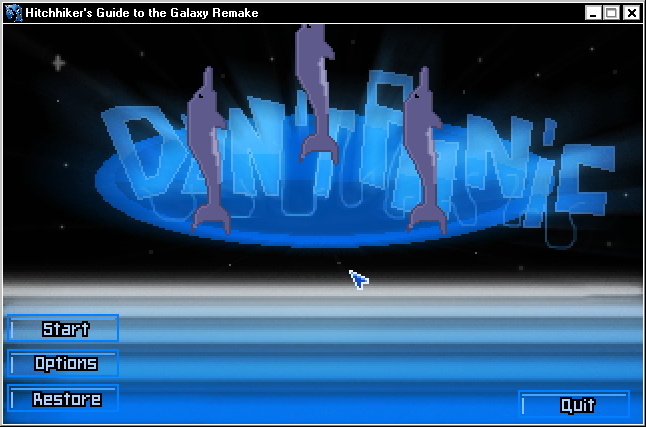
Moving from a text parser to a mouse-driven graphical adventure makes the journey easier to inhabit. You are still working through the original game’s situations, solutions, and descriptions, but you spend less energy wrestling with phrasing and more on untangling what the joke is asking of you. That is an important improvement for a game whose best puzzles often depend on noticing an absurd connection before the game states it outright.
Frustration can absolutely set in. The original design was notorious for unfair failures and “walking dead” states, and this remake preserves nearly all of that material. Start on the optional strag easy mode unless your idea of fun is carrying the consequences of a mistake for hours before discovering it. It removes many of those traps without removing the offbeat problem-solving that makes the adventure memorable.
When a solution clicks, the payoff is less a triumphant power fantasy than the satisfaction of finally being on the game’s wavelength. You will be dealing with the Babel Fish, a robotic screen door, the Ravenous Bugblatter Beast of Traal, assorted tools, fluff, and an object from Arthur’s aunt whose purpose is not immediately clear. It is demanding, occasionally perverse, and much better when you treat being stumped as part of the comedy rather than a personal insult.
Graphics
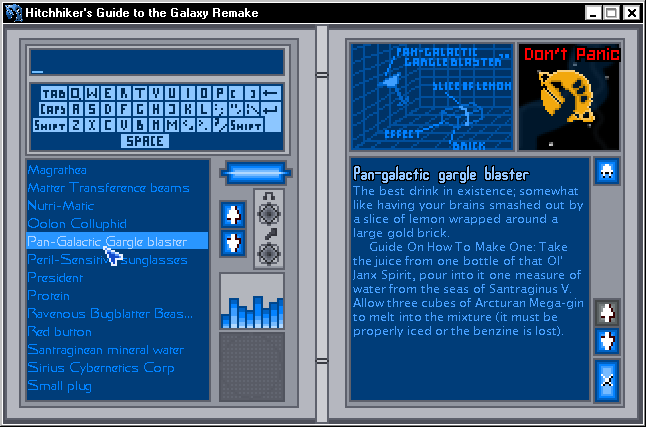
This is a graphical, mouse-driven take on a game once built around typed commands, so its pictures chiefly give Arthur’s strange itinerary a more direct, approachable form. The fixed-screen structure keeps attention on the immediate place and the objects or people tied to the next piece of nonsense.

Story
The story remains a tour through one of science fiction comedy’s great escalation machines. Arthur escapes Earth with Ford Prefect, finds himself subjected to Vogon poetry and the Babel Fish ordeal, then joins Zaphod Beeblebrox, Trillian, and Marvin after an appropriately improbable rescue. The plot never settles down long enough to become conventional, which is precisely why it works.
What makes the material endure is that the galaxy is full of huge concepts treated with the irritation of daily life. Planetary destruction is awful, naturally, but so is a missing cup of tea. Galactic presidents and cosmic machinery matter, but a towel and a bit of household clutter may matter more. The remake also incorporates humorous canonical dialogue that the original game did not include, giving fans more of the voices they came for.
Slartibartfast or the Great Green Arkleseizure can serve as narrator, immediately setting the tone: this is a story happy to interrupt itself for a joke, a digression, or an explanation that makes things less clear. If Adams’s blend of deadpan prose, cosmic scale, and petty inconvenience makes you laugh, the writing is more than enough reason to see Arthur through to Magrathea.
Overall Experience
Hitchhiker’s Guide to the Galaxy Remake is a loving conversion that understands the original’s strengths and its sharpest flaw. It keeps the situations, puzzle chain, and gleeful cruelty largely intact, while the graphical interface and easy mode make a famously forbidding adventure far easier to recommend to someone who did not grow up parsing text commands.
It is not a smooth, modernized adventure in the usual sense. You will need patience, notes, and a willingness to revisit assumptions. Some puzzles are deliberately hostile in spirit, and the humor does not always excuse that hostility. But the strag setting gives you a practical way to enjoy the brainteasers without constantly fearing that an earlier misstep has quietly ruined the run.
Give it a chance if you want a puzzle adventure that is funny because it refuses to behave sensibly, and because it expects you to meet it halfway. Veterans can appreciate how closely it preserves Infocom’s strange masterpiece; newcomers should pick easy mode, lean into the nonsense, and remember the only advice that really matters: don’t panic.


Reviews
There are no reviews yet.