 Retro Replay Retro Gaming History, Reviews & Emulation

Retro Replay Review
Gameplay
Klix! gets to the point fast. Blocks emerge at uneven intervals on conveyor belts and inch toward disaster; you move left and right around the edge to catch them. That irregular timing is important. You are not merely arranging a neat supply of pieces at your own pace, because the next block may arrive just when you are deciding where to put the handful you already carry.
Carrying a maximum of five blocks creates the central tension. Hold on too long and you risk losing incoming blocks, but dumping your stack too quickly can waste a chance to form a line. Once placed on the five fields below, blocks disappear only through horizontal, vertical, or diagonal groups of at least three of the same color. With seven colors in circulation, straightforward matches are not always sitting there waiting for you; you need to watch what you are building as well as what is approaching.
The first levels should click for anyone comfortable with color-matching puzzle games. Then the level objectives begin asking for specific accomplishments, such as a set number of combinations or, later, diagonal combinations. That is where Klix! stops being about clearing whatever is convenient. You start reserving space and shaping stacks toward the requirement, even while the conveyor speed rises.
Frustration comes from the same place as the excitement: space is tight and the pace does not wait for a perfect plan. A bad placement can leave you scrambling to rescue the board, particularly when a level wants diagonals rather than simple rows. Still, the rules are clean enough that failures point back to your decisions. Bigger-than-three matches award bonus points, giving skilled, patient placement a worthwhile payoff.

Graphics
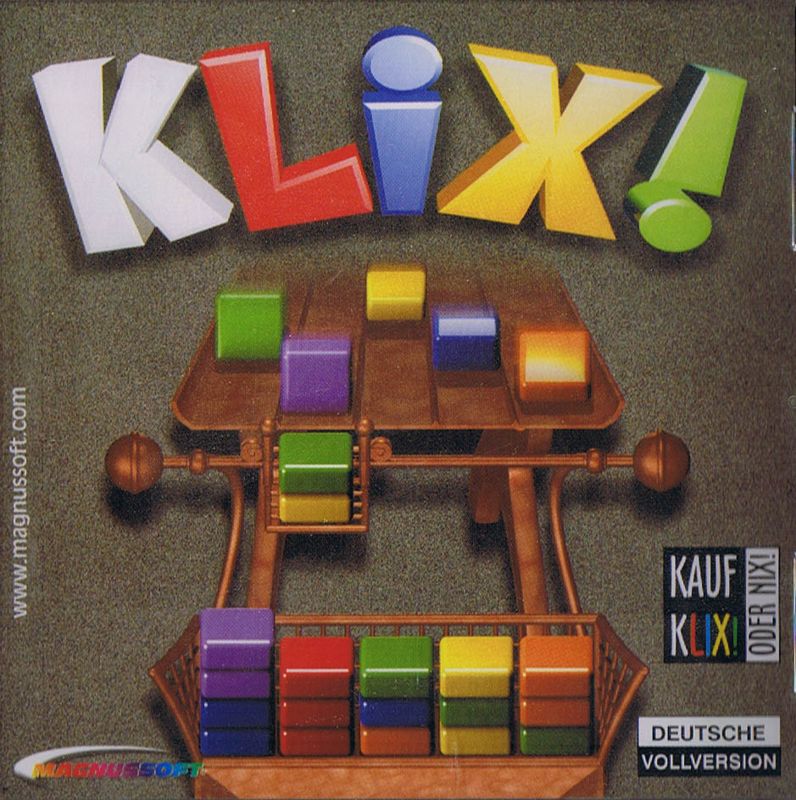
Klix! centers its playfield on colored blocks moving along conveyor belts toward the catch area, with five storage fields on the ground. The seven block colors do the practical work here: you need to spot possible horizontal, vertical, and diagonal runs quickly as the board fills.

Story
Klix! builds its momentum through escalation rather than narrative detours. One level asks you to hit a clear target; the next asks for a more demanding version of the same skill. That straightforward climb fits an arcade puzzle game well, because every goal tells you exactly what habit you need to improve.
There is a nice arc in moving from basic combinations to diagonal-focused goals. Early on, a three-block match feels like the whole point. Later, a diagonal is no longer a happy accident: it becomes something you must deliberately leave room to construct while managing the conveyor.
The result is a compact progression that keeps returning to the same question: can you stay organized when the speed rises? If you enjoy games whose drama comes from a board getting messier and your options narrowing, that is enough to keep pushing onward.
Overall Experience
Klix! is a lean arcade puzzler with a good pressure curve. Catching blocks before they fall adds urgency to a familiar matching formula, while the limited carrying capacity and five-field storage area prevent you from playing purely by instinct. It rewards you for seeing a few placements ahead without turning every move into a long calculation.
Give it a chance if you like puzzle games that make you balance immediate survival against board-building. The gradual acceleration and objective-based levels provide a solid reason to keep improving, and the diagonal requirements add a useful wrinkle once ordinary matches become routine.
It is less suited to anyone wanting a sprawling set of systems or a relaxed, endlessly spacious board. Klix! works because it stays concentrated: catch, stack, clear, and adapt before the conveyor gets the better of you. When that loop clicks, the bonus for a larger combination feels earned rather than accidental.



Reviews
There are no reviews yet.