 Retro Replay Retro Gaming History, Reviews & Emulation

Retro Replay Review
Gameplay
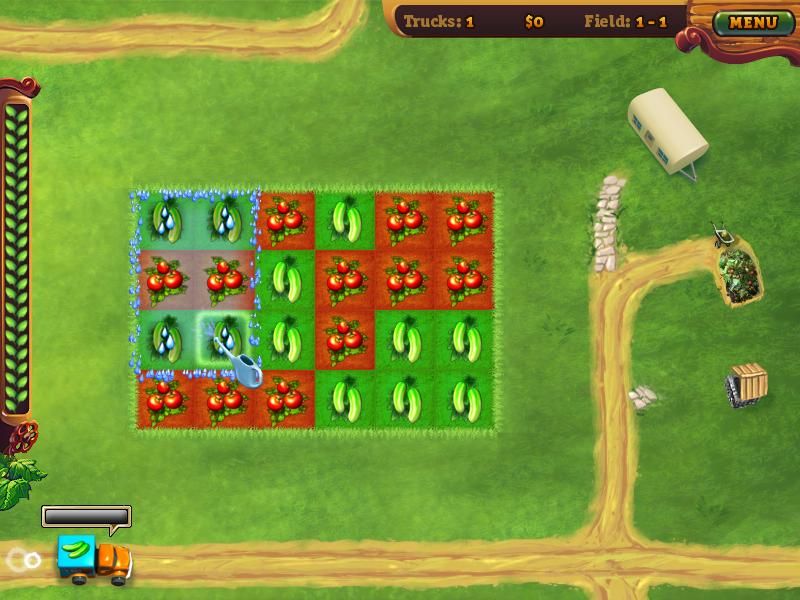
The first few boards teach you the central idea quickly: find four matching crops at the corners of a rectangle, remove them, and let new plants grow into the gaps. It is simple enough to understand immediately, yet it asks you to look at the entire grid in a different way from a standard tile matcher. You are tracing possibilities across distance, not just spotting clusters beside one another.
What makes the rule work is the produce truck. Each truck wants one crop type, so the smartest rectangle is not always the largest one on the board. When the truck needs a plant that is scattered in inconvenient places, you have to decide whether to take a smaller useful match now or clear other crops and hope the replacement growth creates a better setup. That tension gives the levels a welcome purpose.
The game also rewards strong matches with money, then lets you put that money back into farm upgrades that add abilities and improve your earnings. That is a good fit for a puzzle game with a light building theme: a productive board feels productive beyond the immediate score. Minigames after each set of levels offer extra cash and help break up the regular rhythm without replacing it.
Frustration can creep in when the crop you need is not lining up cleanly and a truck order turns every other match into a compromise. Still, that is usually the point where the rectangle system starts to click. You stop treating the board as a collection of easy squares and begin protecting distant matching corners for later.
Graphics
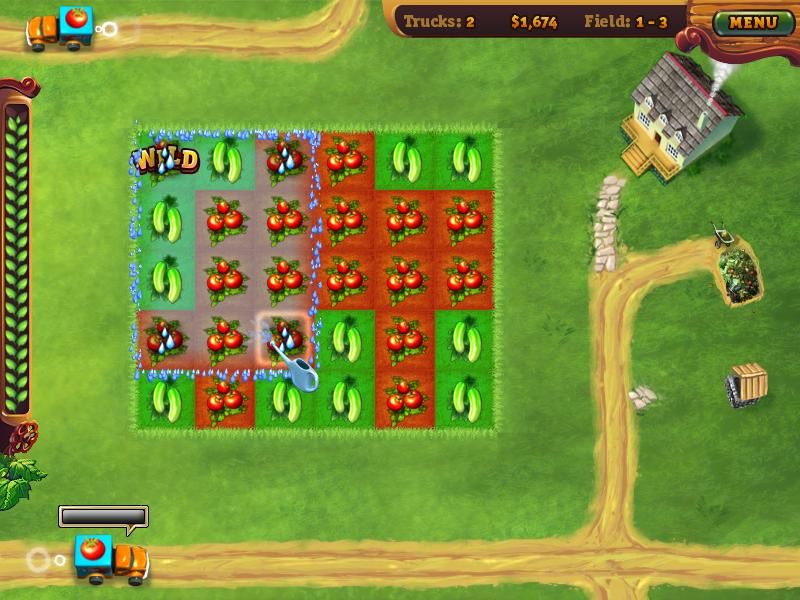
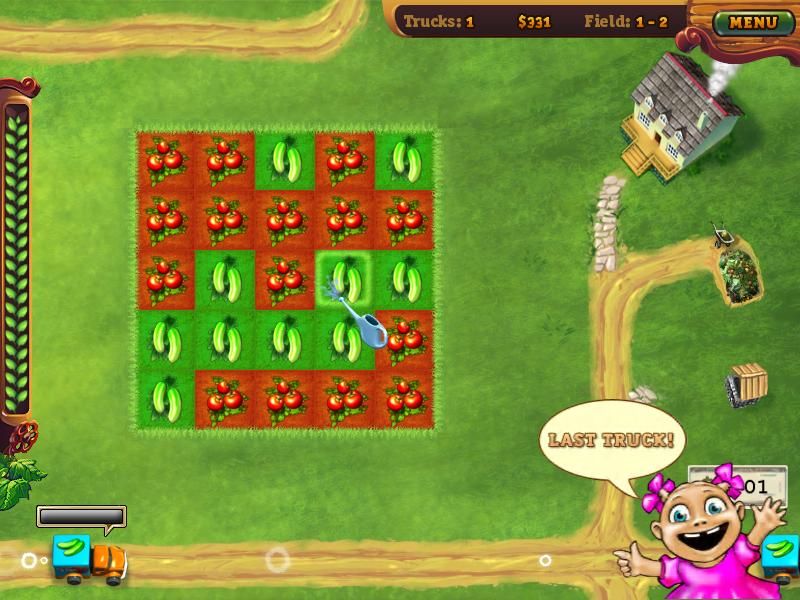
The game is viewed from above, with crop grids at the center of the action and a produce truck parked nearby to make the current delivery goal easy to keep in mind. That straightforward layout suits a puzzle game built around scanning rows and columns for matching corners.
Story
The Norman family wins a farm that is really just a weed-covered plot of land, then decides to turn it into something worthwhile with Uncle Nate’s help. It is a familiar fixer-upper setup, but it gives the matching and money-making a friendly reason to exist.
This is not a story-heavy game. The farm’s growth is the narrative reward: you fill orders, earn cash, invest in improvements, and watch the family move further from its rough starting patch. The premise stays out of the way, which is exactly what this kind of puzzle game needs.
If you want dramatic turns or a cast with deep arcs, this will not be the draw. If you like a simple theme that makes incremental progress feel warmer than a bare score counter, the Norman family’s little farming project does its job.
Overall Experience
Little Farm succeeds because it builds a whole game around one clean, slightly unusual matching idea and gives you a reason to care about each clear. The trucks turn the board into a series of small production problems, while farm upgrades make successful play feel cumulative rather than disposable.
It is especially easy to recommend if you enjoy relaxed puzzle games that still ask for a little foresight. You can settle into the pleasant routine of filling orders, but careless matching will leave you waiting for the crops you actually need. That balance keeps the game from becoming pure autopilot.
The payoff is not a grand reinvention of tile matching; it is a dependable loop that becomes more satisfying as you learn to see long rectangles before they disappear. Give it a chance if the idea of turning a messy field into a working farm sounds more inviting when you have to earn every harvest.



Reviews
There are no reviews yet.