 Retro Replay Retro Gaming History, Reviews & Emulation


Retro Replay Review
Gameplay
The first hour has an unusually strong pull because almost every action feeds the next idea. You remove blocks, turn wood into a workbench and basic tools, then realize better materials sit behind better equipment. Minecraft makes progression tactile without giving you a checklist: mining stone takes time, tools speed up the right jobs, and the world quietly teaches you that a wooden pick and a bare hand are not interchangeable.
Crafting is where the game becomes more than a block toy. A brick wall can mean finding clay, breaking it into balls, baking those in an oven, keeping that oven supplied with coal, and making the workbench needed to begin the chain. That level of dependency can feel fiddly when you only want to build, but it gives materials weight. You are not pulling structures from a menu; you are turning an expedition into something permanent.
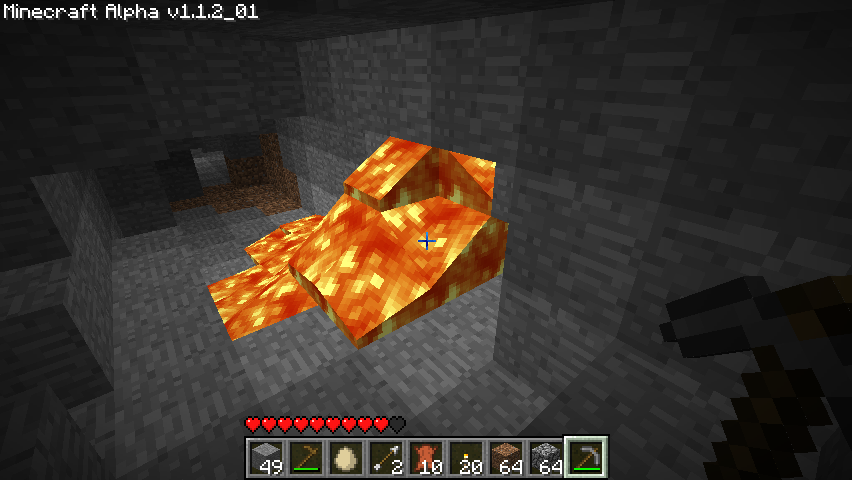
Exploration has teeth. Valuable resources are rare or lie far below ground, where dark caverns become dangerous territory. At night, and in unlit areas, monsters turn a casual outing into a scramble for safety. Creepers are especially effective at making you respect your surroundings, while skeleton archers and spiders keep straightforward fighting from becoming too comfortable. Mob spawners add another problem: leave them alone and they keep producing enemies until you light or destroy them.
Death is harsh in the useful kind of way. Your items stay at the death site, but you must return within five minutes before they disappear, and lava can erase the chance entirely. That system creates memorable recoveries and miserable mistakes in equal measure. If you enjoy games where a successful return from the depths feels like an accomplishment, it works brilliantly; if losing a haul after one bad encounter makes you furious, prepare for some rough moments.
Once basic survival stops consuming every decision, the building possibilities widen nicely. Rails and mine carts make distant routes practical, boats offer another way to cross the world, and pressure plates, switches, doors, and electrical circuits invite you to build contraptions rather than just houses. The game does not impose a final objective, so your own curiosity has to carry it. For many, that is the point; for others, the open-endedness will eventually feel like an empty notebook.

Graphics
Minecraft’s worlds are made entirely from chunky cubes, giving hills, caves, buildings, animals, and monsters a deliberately blocky look. The first-person and behind-view perspectives keep your attention on the terrain immediately around you, whether you are cutting into a cliff or looking across a hand-built structure.
The enemy designs are simple but easy to recognize: zombies, skeleton archers, spiders, gelatinous cubes, and the explosive creeper each read differently at a glance. Dark caverns also look appropriately threatening because danger can emerge from the unlit spaces you have not yet reached.
Story
There is no authored story to carry you from one set piece to the next. Minecraft instead lets a personal story emerge from practical decisions: the first shelter finished before nightfall, the mine that went deeper than intended, or the frantic attempt to reclaim dropped equipment after dying underground.
That approach suits the game’s randomly generated worlds. You are not following a hero’s journey so much as making a home in an unfamiliar place, then deciding how far beyond that home you are willing to go for better resources. A small boat ride, a newly connected mine-cart route, or a carefully defended base can become meaningful because you made it necessary.
The trade-off is clear. If you need characters, plot turns, and a directed ending to stay invested, Minecraft gives you little to hold onto. Its stories are campfire tales you create yourself, and they only become memorable if you enjoy setting your own stakes.
Overall Experience
Minecraft earns its high reputation by making labor satisfying. The building is open-ended, but survival and crafting stop that freedom from becoming thoughtless. Every wall can represent gathered materials, every tool can reflect a planned step forward, and every deep expedition carries the possibility of a costly return trip.
It is strongest when you alternate between modest plans and accidental adventures. Start by making a safe base, then follow a cave because it might hold something useful; come back with enough material to improve your tools; then notice that your next project needs a rail system or a circuit. The game’s best rhythm is this steady escalation from bare survival to self-directed invention.
You should give it a chance if you enjoy making your own goals and can accept setbacks as part of the story. The absence of preset objectives is not a flaw, but it is a real dividing line. Minecraft rewards patience, curiosity, and the urge to improve a place one block at a time—and when that urge takes hold, few games are better at turning “one more task” into an entire evening.


Reviews
There are no reviews yet.