 Retro Replay Retro Gaming History, Reviews & Emulation


Retro Replay Review
Gameplay
The best part of Mujintō Monogatari 4 is the pressure behind ordinary chores. You are not simply picking up supplies because the game says to fill a crafting list. Water, food, light sources, and materials are all part of keeping your survivors functional, and the fact that activity can drain HP gives every trip away from safety a cost. A beach find can feel important when your group is running low.
Unlike the earlier survival-sim approach it revisits, this entry asks you to directly move characters with the mouse and double-click things to collect them or enemies to attack them. That makes the island feel more immediate than a purely menu-driven survival game. You are actively sending a survivor to investigate wreckage, gather resources, or deal with danger, rather than only issuing broad orders from a distance.
Crafting is where patience starts to matter. A new tool requires both the right materials and the needed knowledge, so progress is not just about finding one lucky object. You have to establish a routine, look after basic needs, and make smart use of what the island gives you. That can be satisfyingly methodical, although the game is clearly aimed at someone willing to accept a slow buildup instead of immediate power.
The switch between three distinct pairs of survivors gives the game more scope than its opening would suggest. Finding others and managing separate pairs encourages you to think beyond one character’s immediate hunger or health. Their statistics can change according to their activities, which makes work assignments carry more weight. It is a dense survival game, and it expects you to learn through attention rather than hand you easy momentum.
Graphics
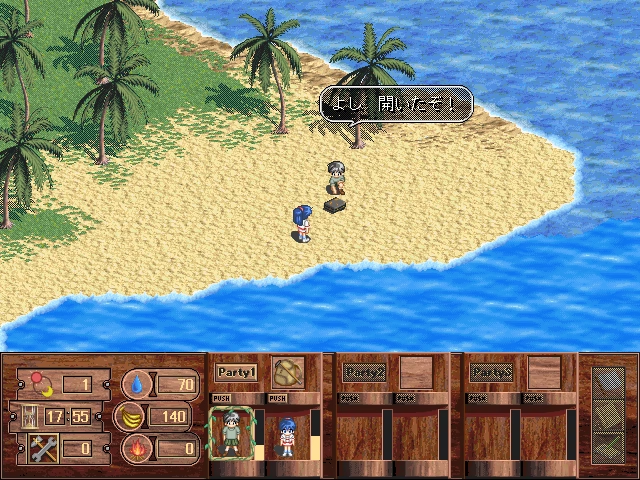
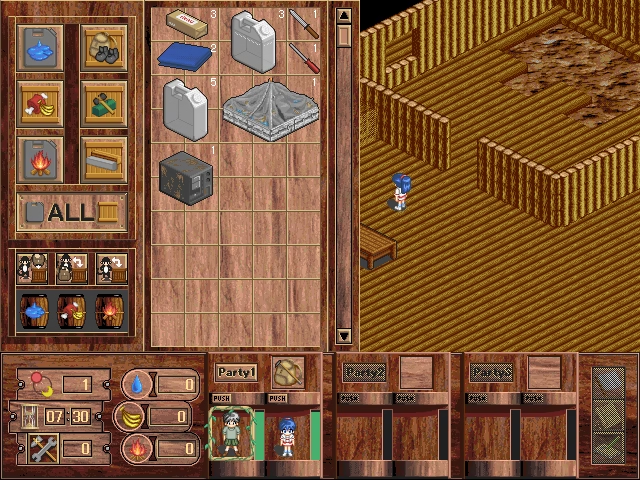
The top-down island areas have colorful, dense pixel scenery: bright blue water laps against pale sand, palms cast dark shadows, and grassy clearings break up the coast. The tiny character sprites are simple, but the beach and jungle make a convincing place to scavenge. Wooden cabin interiors have a warm, patterned look that nicely contrasts with the exposed shoreline.
The illustrated opening is more dramatic, with a passenger plane silhouetted against an intense orange sky. Later scenes use a clean gray cutaway of the cockpit, full of compact machinery and two small crew figures. These images give the crash setup more personality than the small exploration sprites can manage alone.

Story
A plane crashes into the sea, and a child wakes on what appears to be a deserted island. The first relief comes from meeting another survivor and finding a cabin with a few basic supplies. From there, the story is built around endurance: locating necessities, making tools, and figuring out whether the island really is empty.
That premise is familiar, but it fits the game unusually well because survival details are not separate from the plot. The crash explains the scattered supplies and the urgency of searching, while the cabin offers a fragile foothold rather than a comfortable home. The lengthy opening gives the disaster a more deliberate setup before the game turns you loose.
Other survivors gradually expand the situation beyond the original pair, and the three unique pairings suggest different ways to approach the island’s dangers and demands. Do not come in expecting a fast, character-heavy adventure. The story works more as a reason to persist through the daily hardships than as the main reward.
Overall Experience
Mujintō Monogatari 4 is most interesting when it makes survival feel inconvenient in the right way. The island is not just a backdrop for fighting or collecting. It is a place where a decision to go looking for materials can affect hunger, rest, health, and the next thing you are able to build. That interconnected pressure gives the game a distinctive edge.
Its demands will also be the dividing line. You need to be comfortable monitoring several basic needs and accepting that progress comes from preparation. Someone hoping for a breezy anime action RPG may bounce off the routine, especially when even regular activity wears characters down. The game asks for care, not speed.
Give it a chance if you like older survival games that make every resource feel earned and do not mind a deliberate mouse-driven pace. The action elements add direct involvement, but the real payoff is gradually turning a bad crash and a few supplies into a workable life for a growing group. It is a niche experience, yet a thoughtful one for gamers who enjoy survival systems with real consequences.



Reviews
There are no reviews yet.