 Retro Replay Retro Gaming History, Reviews & Emulation


Game Overview
Gameplay
Operation Flashpoint earns its tension before the shooting even starts. You move at a human pace across huge islands, and that means a distant treeline or a village road can feel like a serious commitment instead of scenery between firefights. Sprinting around with perfect aim is not an option, and crawling leaves you unable to shoot, so every approach asks you to think about exposure, cover, and whether you are about to walk into an ambush.
The real hook is how often the game changes your role without abandoning that grounded scale. You can fight as a regular soldier, command a tank, ride as a passenger while an AI teammate drives, or take control of aircraft and helicopters. The huge vehicle selection is more than a bragging point because it changes how you read the battlefield. A tank puts distance and firepower in your hands, while flying makes terrain, altitude, and a safe landing suddenly matter just as much as hitting a target.
That freedom creates memorable problems rather than tidy shooting-gallery solutions. Missions often leave room to choose your route and make your own plan, including deciding whether to follow an evacuation order or attempt something much harder alone. Expect friction: traveling takes time, aiming while moving is limited, and vehicles can turn a promising plan into a wreck. But that friction is why a successful extraction or hard-won advance feels earned. Multiplayer extends the same broad sandbox to two opposing teams, with all the opportunity for cooperation and catastrophic piloting that implies.

Graphics
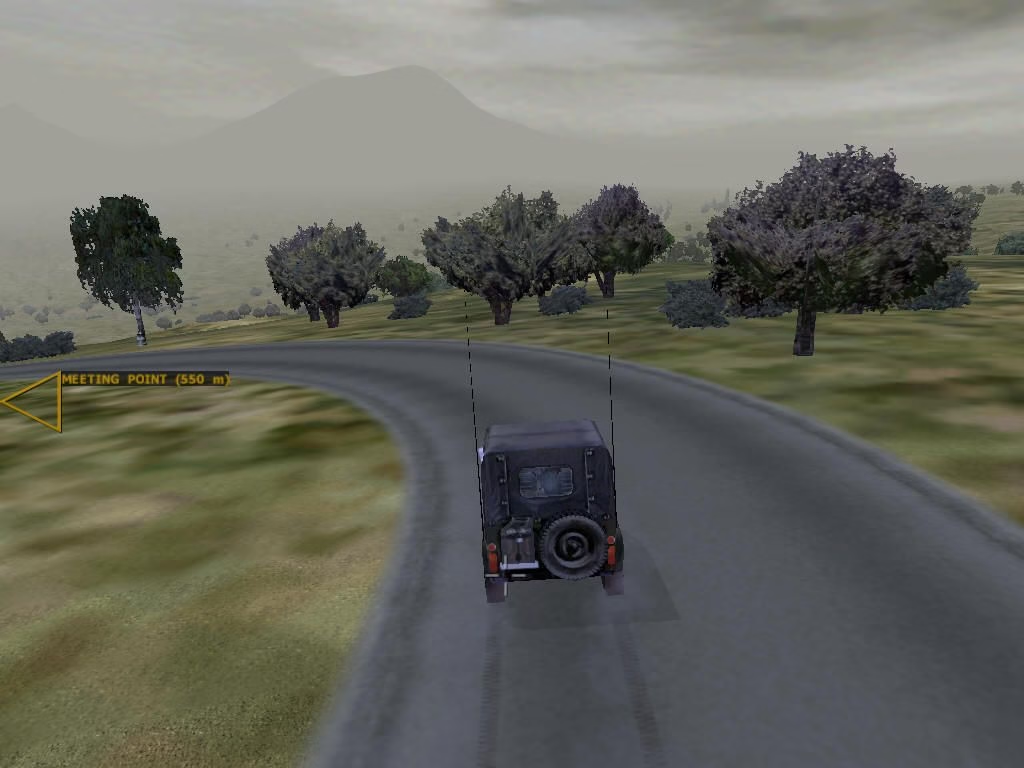
The island landscapes have an unmistakably early-2000s look, with soft, low-detail terrain and blocky buildings, but their scale still comes through. Curving roads disappear into rolling hills, scattered trees break up open fields, and villages sit naturally within the countryside instead of feeling like separate combat arenas.
Lighting does a lot of the heavy lifting. Gray weather gives the countryside a cold, hazy look, while the orange-pink sunset over a village and the dark, reddish view from a plane create stronger atmosphere than the dated models can manage on their own. Vehicle interiors and exterior views help sell the sensation of occupying a real place, even when the image quality is rough.
Story
The campaign places American forces, standing in for NATO in the region, against a renegade Russian general attempting to seize three islands and trigger a wider conflict. It is a straightforward Cold War escalation setup, but it fits the game because the focus stays on the consequences for soldiers moving through that conflict rather than on elaborate spectacle.
What gives the campaign weight is the way orders can collide with your instincts. An ambush and a requested helicopter evacuation are not just a setup for a cinematic moment. They put you in the uncomfortable position of deciding whether to regroup as ordered or gamble on an almost impossible solo effort. That kind of scenario suits a game built around vulnerability and unpredictable terrain.
In-engine cutscenes, speech, and filmic music give the campaign a more authored backbone than a pure military sandbox. The story is not the main reason to play, but it gives the changing roles, vehicles, and island battles a useful sense of momentum. You are not merely sampling equipment. You are pushing through a conflict that keeps finding new ways to put you at risk.

Overall Experience
This is a landmark military simulation because it makes scale feel consequential. Long walks are long. A road matters because it carries vehicles. A helicopter is valuable because it can solve a distance problem, but it can also become another dangerous machine you need to survive. Few games of its era make you feel so small within a battlefield while still letting you influence it in so many ways.
Its age and its stubbornness are inseparable from its strengths. The pacing can test your patience, especially when you want immediate action, and the simulation-minded limits can feel harsh if you arrive expecting a nimble first-person shooter. Give it time, though, and its awkward moments start to feel like the cost of a game that refuses to make war clean, fast, or convenient.
Give Cold War Crisis a chance if you enjoy planning, adapting, and telling yourself stories about the mission that nearly fell apart. The payoff is not a constant rush. It is the rare satisfaction of looking across a sprawling island, choosing a risky path, and realizing that a squad, a vehicle, or a patch of distant ground may decide everything.


Reviews
There are no reviews yet.