 Retro Replay Retro Gaming History, Reviews & Emulation


Retro Replay Review
Gameplay
Rooster starts from a sturdy bit of sci-fi action: you are a commando sent into a moon science base that terrorists from Mars have seized, and nearly everything armed in the facility wants you gone. The immediate job is satisfyingly clear—survive the base and wipe out its occupiers—but the game does not frame the station as a string of empty shooting galleries. Defense robots, mobile missiles, mines, generators, turbines, and scientists turn each area into something you have to assess before charging through it.
That mix is where Rooster earns its identity. A straight top-down shooter can become repetitive fast; here, the interactive parts of the base introduce a puzzle-game hesitation into the shooting. You are not only dealing with enemies, but considering what nearby machinery and hazards mean for your next move. It sounds like a small distinction, yet it gives the action a more deliberate rhythm than simply sweeping a room clean.
The tradeoff is that this kind of design can punish impatience. Hostile defense robots and mines are already enough to make careless movement costly, and the added environmental elements mean that stopping to read a situation is part of the challenge. If you want constant forward momentum, the puzzles may feel like interruptions. If you enjoy being asked to clear a dangerous area thoughtfully rather than blindly, Rooster’s four extensive levels have a stronger hook than its basic premise suggests.

Graphics
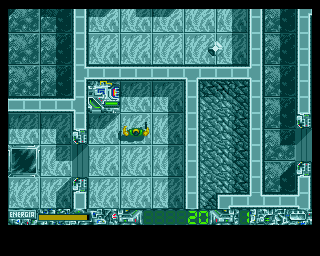
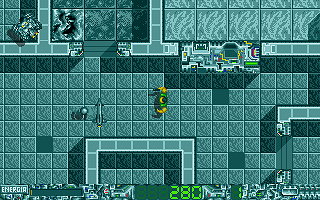
Rooster uses a 2D top-down view and closely resembles Alien Breed in its sci-fi look. You spend your time looking down on a space-station environment populated by a lone commando, terrorists, and turned defense robots, with mobile missiles, mines, generators, and turbines adding practical detail to the battlefield.
Story
The setup is pure pulpy space-action: Earth’s leading scientists were researching new weapons on a lunar base, terrorists from Mars took it over, and the installation’s defense robots now identify your commando as an enemy. It is an efficient excuse to put you in a hostile research station full of weaponized trouble.
What helps is the way the story premise feeds directly into the opposition. The robots are not just generic monsters placed in your path; they are the base’s own defenses turned against you. Generators, turbines, and missiles likewise fit the idea that this was an active scientific installation before it became a battlefield.
Do not come to Rooster expecting a character-driven space opera. The narrative is a mission framework, but it is a coherent one, and the Mars-versus-Earth angle gives the action a little more flavor than a nameless alien infestation would.
Overall Experience
Rooster is most interesting when the shooting and the base’s hazards overlap. Its Alien Breed-like viewpoint and hostile lunar-station setup are familiar territory, but the mix of terrorists, hijacked robots, and interactive objects gives the game a tactical edge. You are encouraged to treat rooms as problems to solve, not merely targets to erase.
The four large levels are a meaningful commitment for a game built around this style of action. That scale should suit you if you like learning your way through dangerous spaces and taking each encounter on its own terms. It will be less inviting if you only want a breezy arcade shooter with little friction between you and the next firefight.
Rooster is a solid recommendation for fans of compact, old-school sci-fi shooters who welcome puzzle pressure alongside their combat. Its ideas are familiar, but the interaction between enemy fire, station defenses, and environmental objects gives it enough texture to stand apart from a purely straightforward clone.


Reviews
There are no reviews yet.