 Retro Replay Retro Gaming History, Reviews & Emulation

Retro Replay Review
Gameplay
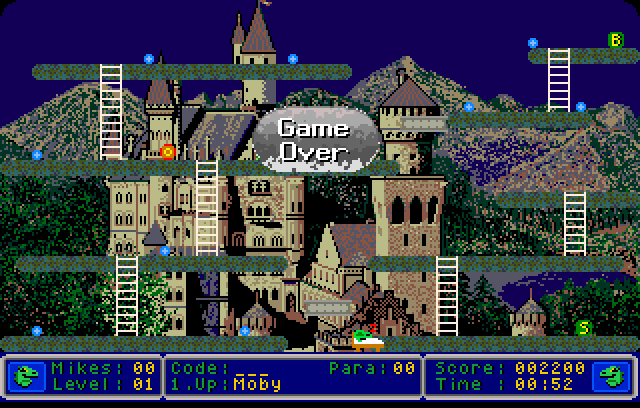
The first few rooms ask you to think before you leap. Mike’s goal is not merely to find the door; he needs the crystals for its key and the correct three-letter password to shut down its barrier. That simple requirement makes a fixed-screen level feel like a small puzzle. You scan for platforms, decide which route reaches a letter safely, and try to work out whether a tempting ledge is actually part of the path or a detour that will cost you a life.
The no-scrolling structure is a good fit for that design. Each screen can be studied as a self-contained obstacle course, and progress comes from understanding its layout rather than blindly charging forward. Ladders add vertical routes, with moving ones raising the stakes when timing matters. Enemies are hazards to avoid rather than targets to clear, so Mike’s escape has a cautious, deliberate rhythm.
Falling is where the game can turn from demanding to aggravating. A missed jump can be fatal, though Mike’s limited parachutes offer a useful emergency option when you recognize the mistake soon enough. Because that supply is finite, they create real tension instead of functioning as a free correction button. You will feel clever when you save one for a dangerous descent and foolish when a careless jump spends one or ends a promising attempt.
This is a game for patience more than pure reflexes. The crystal requirement means you cannot casually dash for the exit, and the password rule adds a memory and route-planning wrinkle that will either make the levels feel purposeful or make repetition sting. If you enjoy compact platform rooms that ask you to fully solve them, Mike has a sturdy hook. If you want momentum and quick forward progress, its stop-and-check structure may wear thin.
Graphics
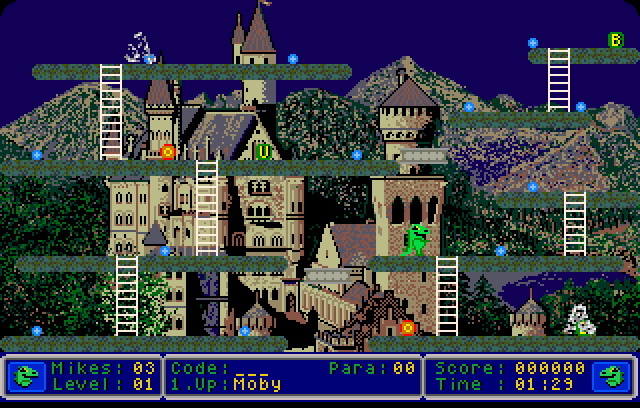
The game uses side-view, flip-screen platform stages, keeping the action focused on individual rooms of castle platforms and ladders. That confined view suits the level-by-level puzzle platforming: you are looking at a contained climbing problem, not navigating a sprawling scrolling world.
Story
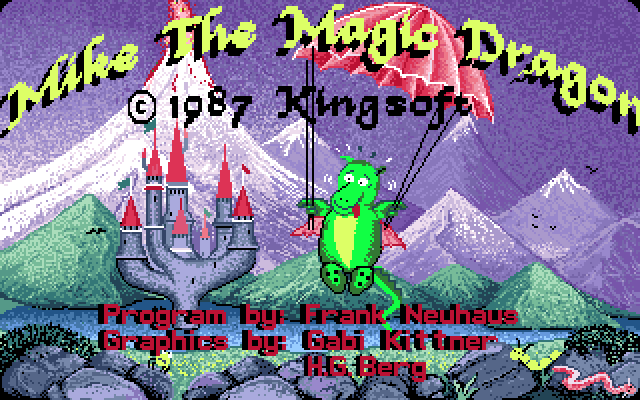
Mike’s setup is suitably direct for a fantasy platformer. Professor Dragan Drachenklau kidnaps the baby dragon for experiments, Mike escapes, and the rest of the game is about getting him out of the castle. There is immediate sympathy in playing a small creature fleeing a dangerous captor rather than embarking on a grand conquest.
The story’s real job is to give the castle escape urgency, and it does that neatly. Every blocked door, enemy, and fatal drop fits the basic idea that Mike is trapped somewhere hostile. The professor’s wonderfully villainous name supplies some light fantasy flavor without needing the game to pause for elaborate storytelling.
Do not come to Mike: The Magic Dragon for a narrative journey. Its tale is a frame around room-by-room survival and puzzle solving. Still, the escape premise is clear enough that the mechanical chores—finding letters, crystals, keys, and a way down safely—feel like steps toward freedom rather than arbitrary collectibles.
Overall Experience
Mike: The Magic Dragon has the kind of focused design that can win you over once you accept its terms. It is not about barreling ahead; it is about picking apart one dangerous little room at a time. Collecting everything required for the exit gives every screen a specific objective, while the correct password order prevents the hunt from becoming completely automatic.
Its frustration is also inseparable from that focus. Deathly falls and limited parachutes mean errors matter, and a level can demand another careful pass when you misread a route or take letters in the wrong order. That is satisfying old-school pressure when you are in the mood to learn layouts, but it can feel punishing when you simply want a breezier platformer.
For Amiga fans with a taste for methodical arcade platform games, this is worth a look. The strongest moments come when a room that first seemed awkward reveals a safe sequence of climbs, collectibles, and exits. Mike’s castle breakout is a modest but disciplined challenge, and its payoff is the pleasure of turning a confusing screen into a solved one.


Reviews
There are no reviews yet.