 Retro Replay Retro Gaming History, Reviews & Emulation

Your village is dying, your people have chosen you to save it, and your first great contribution to the expedition is missing a giant ant with a spear. Again. Somewhere beyond this temple is one of the richest worlds in PC role-playing. For the moment, the ant has other plans.
Fallout 2 makes you earn the open road. Once you reach it, the game becomes wonderfully difficult to leave. A missing person leads to a settlement. A settlement leads to an argument about electricity. Someone mentions a city where four crime families are competing for power, and suddenly the sacred mission has acquired a boxing career and some extremely questionable associates.
Black Isle’s 1998 sequel is bigger, funnier, messier, and often crueler than the first Fallout. It lets a conversation become an adventure, remembers the trouble you cause, and occasionally trips over its own ambition. Behind that sprawling wasteland was a team trying to follow a remarkable game on a punishing schedule, after several of its central creators had left.
Explore the history of Fallout 2 (click to expand)
- Fallout (1997): a difficult game to follow
- 1998: the people who left, and the team that stayed
- Arroyo, 2241: the world has moved on
- SPECIAL: the person you build changes the conversation
- Klamath and the Den: finding your feet, and losing your innocence
- Companions: a road trip with opinions and automatic weapons
- Vault City and Gecko: clean streets, dirty politics
- New Reno: the sacred quest takes a suspicious detour
- Redding, Broken Hills, and the NCR: everybody wants tomorrow
- The bridge, the movie jokes, and the problem of knowing when to stop
- San Francisco and the Enclave: the old world comes looking for you
- Small figures, unsettling faces, and a world you can hear
- Fall 1998: a remarkable game, and a troublesome one
- The years after release: fixing the wasteland, then expanding it
- What Fallout 2 left on the road
Fallout (1997): a difficult game to follow
The first Fallout began with a broken water chip and a person who had never needed to venture outside a vault. Its ruined California was frightening partly because it was unfamiliar. A friendly face could conceal something ugly. A monster could have an argument worth hearing. The game trusted players to find routes through problems, then sent them home with an ending that refused to hand out a comfortable reward.
For Interplay, that meant a new role-playing property with room to grow. For players, it meant a world they wanted to revisit. A sequel was already being considered before the first game reached the shops. The aim was to have the follow-up out roughly a year later, according to the creators’ Game Informer oral history. There would be no leisurely second expedition.
Reusing the engine helped. The overhead view, turn-based combat, character system, and battered interface were ready to carry another adventure. The difficult part was filling that adventure with people, alternatives, jokes, reactions, and consequences. A new gun could be placed in a room. A quest with several solutions had to survive the player finding all of them, often in the least convenient order.

1998: the people who left, and the team that stayed
Tim Cain, Fallout’s producer and a central programmer, had helped bring the original game into existence. Art director Leonard Boyarsky and artist and designer Jason Anderson had helped give it a recognizable face and a very particular sense of humor. All three contributed to the sequel’s early conception before leaving Interplay in 1998 and forming Troika Games.
They did not leave a blank page. Boyarsky told RPG Codex that the trio had designed the main story arc and several side quests. Much survived, although other parts changed. The team at Interplay would take those plans into production, change them, add to them, and somehow get the whole adventure finished.

Cain has since discussed his departure in his own video, Why I Left Fallout 2, describing exhaustion, interference, and a lack of motivation. His account puts a human face on a transition that can look tidy in a credits list. After years spent getting one difficult game finished, immediately doing another was a substantial request.
The sequel’s credits name Feargus Urquhart and Matt Norton as lead designers, with Eric DeMilt and Urquhart as producers. Their team inherited a recognizable world, some early plans, and a deadline that left little room for discovery. In a 2017 developer retrospective, Urquhart recalled that early planning was counted against the schedule, leaving roughly nine months for the main production push. That compressed schedule left little margin for a sequel intended to offer considerably more to do.

Different designers took responsibility for different settlements. That helped a large game get built quickly, and it gave those settlements distinct personalities. It also made consistency harder. The person writing one town could be following a different comic rhythm from the person writing the next. Fallout 2 would eventually feel like a collection of difficult neighbors sharing one map.
Designer Chris Avellone, whose areas included New Reno and Vault City, remembered the work as hectic and exciting in his 2006 GameBanshee interview. He also described the physical toll of working on Fallout 2 alongside Planescape: Torment. There is enthusiasm in that recollection, but exhaustion too. The towns did not populate themselves just because the engine already existed.
Arroyo, 2241: the world has moved on
Before the player reaches Arroyo, the opening film offers a particularly nasty welcome. Louis Armstrong’s A Kiss to Build a Dream On accompanies an old-world promise of life outside the vault. Then a vault door opens, people step toward the waiting soldiers, and the soldiers open fire. The cheerful sales pitch has delivered its customers to a firing squad.
The Enclave does not explain itself at this point. The player has seen enough to dread meeting those helmets again. Ron Perlman’s returning narration leads into the history of the Vault Dweller and the village that grew from that exile. Fallout 2 has both a family story and an approaching threat before you have successfully hit anything with a spear.
Fallout 2 moves its story forward eighty years, to 2241. The original Vault Dweller has become an ancestor and a legend. Their descendant, the Chosen One, lives in Arroyo, a village in trouble. Crops are failing. Survival depends on finding a Garden of Eden Creation Kit, or G.E.C.K., a piece of old-world technology with an almost fairy-tale promise.
It is a clever change of perspective. The first game sent someone from a sealed technological refuge into the ruins. The sequel sends someone from a small tribal community toward a world where other people have already started rebuilding. Your village’s treasured history is someone else’s half-remembered story. That blue vault suit has traveled a long way from being ordinary workwear.

The Temple of Trials gives this grand departure a famously awkward start. Its ants, scorpions, traps, and close combat can make a character built for talking or shooting feel particularly underqualified. The game has just offered a generous set of possibilities in character creation. Then it hands you a spear and asks how things are going.
There are alternatives even here, including ways past the final guard without simply winning a fight. Yet the opening still holds the player in a narrow space before revealing the freedom that makes the rest of the game attractive. It is an unfortunate introduction to a sequel whose best moments happen when the obvious approach fails and another one occurs to you.

Then the temple ends, the village sends you off, and the map opens. The Chosen One has a clear responsibility. The player has a much less respectable curiosity about every place name on the screen.
SPECIAL: the person you build changes the conversation
Before that first ant gets its turn, Fallout 2 lets you decide what sort of person will be missing it. Strength, Perception, Endurance, Charisma, Intelligence, Agility, and Luck form SPECIAL. Skills cover abilities such as shooting, sneaking, science, repair, and speech. Traits add benefits with catches. Perks acquired along the way can sharpen a build into something more individual.
The character screen looks dense, but its appeal becomes clear in ordinary situations. A locked door might invite a lockpick, a stolen key, or a conversation with its owner. A machine might be more useful repaired than destroyed. Someone who cannot win a straight fight may still have an excellent afternoon if everyone else can be persuaded to do the dangerous work.

Intelligence is especially memorable because it can change the dialogue you see. A very low-Intelligence character does not simply receive a worse percentage next to a speech skill. Conversations can become different exchanges, with other people responding to the person standing in front of them. It is funny, sometimes uncomfortable, and a substantial reason to build another character.
Avellone described the attraction of working with that system in our interview:
“The dialogue system especially, and the way it leveraged your character’s statistics (which was new to me) opened up all sorts of fun possibilities of showing how each character and build might have a “special path” through a dialogue.”
Chris Avellone, Retro Replay interview.

That is the pleasure hiding behind the numbers. The game can acknowledge the odd little person you assembled, rather than asking every possible hero to read the same speech. It does not do this in every conversation, and some paths are better supported than others. When it does, an investment made several hours earlier suddenly feels like a very good decision.
Klamath and the Den: finding your feet, and losing your innocence
Outside Arroyo, the heroic assignment quickly becomes practical. You need directions, equipment, experience, and enough money to keep traveling. Klamath offers small-scale trouble before the larger powers appear. People need help. Creatures occupy places people would prefer to use. A man named Sulik is stuck with a debt and could become considerably more useful beside you than behind a bar.
Sulik gives the early journey a companion with a distinctive voice and a very direct approach to violence. He also changes the shape of a fight. An enemy who seemed manageable when considered alone is a different proposition once a companion has run toward it, drawn another creature’s attention, and made a plan on your behalf.
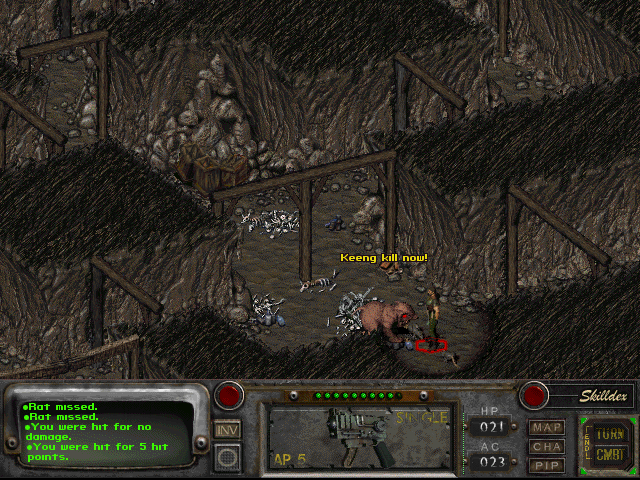
The Den makes a harsher introduction. Its slavery, drugs, and exploitation are not distant lore delivered by an official at the end of a quest. They are part of the town’s everyday business. You can resist that business, profit from it, or initially misunderstand how deeply it reaches. Fallout 2 is willing to let the player behave appallingly, and some of its most unpleasant material works because the game does not pretend those choices are harmless.
This is also where the fantasy of travel acquires four wheels. The Highwayman is a battered car that can turn a long walk across the map into something more manageable, once the required work and parts are in place. By the standards of modern open-world games, it is a modest vehicle. By the standards of someone who has spent hours crossing this wasteland on foot, it is practically a luxury yacht.
The trunk matters almost as much as the engine. Fallout 2 produces an endless supply of useful objects, potentially useful objects, and objects you refuse to abandon because a shop somewhere might buy them. A car gives that habit a home. The new convenience also brought bugs, including the notorious troublesome trunk. In the PCGamesN retrospective, programmer Dan Spitzley explained that it had been treated like a companion internally, with some very odd consequences.
Companions: a road trip with opinions and automatic weapons
Fallout 2’s companions are more than a supply of additional attacks. Traveling with Sulik, Cassidy, or Marcus changes the company you keep, the things people say, and the practical business of surviving a journey. Marcus, a super mutant, can make a particularly strong first impression. The equipment required to outfit him is not exactly pocket-sized.
Compared with the first game, the sequel gives players more control over companion behavior and equipment, and companions can improve as the adventure continues. These are welcome changes when your survival depends on someone else’s choice of weapon. They do not make the party entirely obedient. A burst weapon and a crowded room can still turn friendship into a matter for the loading screen.

The inventory retains a stubborn streak. Trading equipment, managing ammunition, and keeping track of who is carrying what can become its own expedition. The rewards are worth the fuss when a once-vulnerable party starts looking like a group capable of surviving the next region. You can see the journey in the weapons and armor you have managed to acquire.
Combat itself remains turn-based. Moving, firing, reloading, and other actions draw on a limited pool of action points. Aimed shots invite calculated risks; a failed attack can leave an enemy very much alive when your turn ends. The slow early fights can drag, particularly with a weak build. Later, when equipment and abilities begin working together, a short sequence of decisions can produce a startling amount of damage.
It is a peculiar rhythm: conversation, travel, preparation, then a sudden bloody mess. Afterward, everyone checks their pockets and resumes the conversation.
Vault City and Gecko: clean streets, dirty politics
Vault City looks like the sort of place a weary traveler should be delighted to find. There are orderly streets, advanced technology, and people who regard themselves as civilized. After the road, even basic cleanliness looks persuasive. Getting accepted by the people who control it is another matter.
The settlement’s hierarchy turns comfort into a privilege. Citizenship opens doors; outsiders and servants occupy a much less attractive position. A well-maintained city can still be cruel. The game lets that discovery happen through the business of trying to enter, work, negotiate, and get something done.
Nearby Gecko presents the opposite appearance. Ghouls live beside a damaged nuclear reactor, and the relationship with Vault City is poisoned by fear, prejudice, and a genuine environmental problem. Repairing machinery becomes tangled with the question of who deserves to benefit from it. The apparent monster town has people worth hearing. The neat town has reasons to be nervous, along with a great many reasons to distrust its leaders.
Avellone’s role here needs a little care. He told GameBanshee that he inherited Vault City after earlier work by Boyarsky and Urquhart, then developed it further. It was a shared production history, not a city that arrived fully formed from a single writer’s notebook.
“To make them meaningful, however, they need to be more than a cosmetic reaction – cosmetic reactivity is fine, but a decision should also have systemic or world consequences, and the player should not only be aware of the consequences, but also feel the impact.”
Chris Avellone, Retro Replay interview, discussing how he approaches consequences in role-playing games.
Vault City and Gecko make that concern tangible. The player is dealing with power generation, access, prejudice, and the future relationship between neighbors. It is possible to leave a region with something more consequential than an official’s gratitude and a payment. Later ending slides can bring the wider outcome into view, sometimes with an unpleasant distance between what you intended and what followed.
New Reno: the sacred quest takes a suspicious detour
New Reno has no interest in your village’s spiritual emergency. It has four crime families, a thriving appetite for vice, and plenty of opportunities for someone willing to carry out an unpleasant favor. The Bishops, Mordinos, Salvatores, and Wrights each offer a route into the city’s power struggles. Getting close to one family can make relations with another considerably more exciting.
Avellone was responsible for this area, and its appeal is easy to understand. New Reno is a place where a useful stranger can become an insider. You learn who wants what, which door needs opening, and which seemingly small job belongs to a much larger scheme. The temptation is to keep accepting work because the next favor might reveal something interesting.

The city also lets the Chosen One wander into boxing, gambling, and an adult film career. Some of this is funny. Some of it is juvenile. Some of it depends on the player enjoying a particular strain of late-1990s provocation. A history of Fallout 2 has to leave room for all three reactions. The game’s willingness to say almost anything can feel exhilarating, then wear out its welcome in the next exchange.
Yet Reno is more than a box of forbidden jokes. Its families connect to trade, drugs, weapons, and interests outside the city. A place that initially looks like a holiday from the main story turns out to have its hands in the surrounding region. You can leave with a reputation that belongs to this city rather than to the heroic role Arroyo gave you.
That is where the wandering becomes dangerous in a particularly enjoyable way. An errand can become a career before you notice how far you have traveled from the person who accepted it. Then an image of home interrupts the comfortable routine and reminds you that someone is still waiting for a G.E.C.K.
Redding, Broken Hills, and the NCR: everybody wants tomorrow
By the time the Chosen One reaches the larger settlements, the wasteland is no longer simply a collection of people hiding from yesterday’s disaster. People are building governments, running mines, competing for workers, and arguing over who will own the future. Money moves between these places. So do weapons and influence.
Redding’s gold makes it attractive to larger powers. New Reno, Vault City, and the New California Republic have reasons to care about what happens there. Local problems sit inside that contest. A player can become occupied with the immediate business of miners and rivalries while the region’s future direction hangs behind it.
Broken Hills gathers humans, ghouls, and super mutants around a mining town. Marcus, its super mutant sheriff, is an especially good answer to the idea that a creature’s silhouette tells you everything worth knowing about it. The community has practical needs and serious tensions. Cooperation exists, but so does a determination to wreck it.

The NCR makes the change in scale unmistakable. Shady Sands, a small settlement in the first game, has become the heart of something much larger. Tandi, whom returning players may remember from the original adventure, is now a leader with a state to manage. The years between the two games have produced institutions, ambitions, and new forms of power.
That continuity gives Fallout 2 a different flavor from its predecessor. The player is not merely picking through the remains of the United States. Another political world is growing among them. It has its own officials, exclusions, advantages, and appetite for expansion. Helping it can seem sensible without making every decision it takes admirable.
These settlements are also a reason the journey can absorb so many evenings. You begin by trying to solve one local difficulty. Before leaving, you have opinions about a town’s leadership and a strong desire to know what will happen after you go. The map has become a collection of unfinished arguments.
The bridge, the movie jokes, and the problem of knowing when to stop
Then Fallout 2 sends you toward a bridge and a joke wanders in from Monty Python. Other encounters borrow from films, television, and familiar bits of popular culture. Some arrive as rare surprises on the road. Others sit much closer to the ordinary business of a town.

A strange encounter can be a lovely interruption after an hour of inventory management and difficult decisions. It can also make a world feel less convincing when the writer seems determined to demonstrate that you both watched the same movie. Fallout 2 swings between those effects with very little concern for the player’s neck.
The first Fallout had jokes and references too. What changed was the density, the freedom with which different areas used them, and the amount of material competing for attention. Cain and Boyarsky’s later oral-history discussion connects the tonal variation to isolated area teams and the speed of production. The sequel had many people adding things and limited time to bring all of those things into one voice.
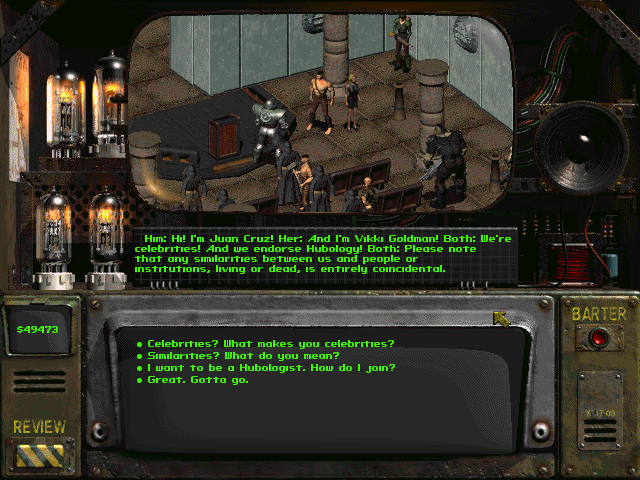
Avellone has become candid about that problem. Looking back in our interview, he described how a team still learning the series could miss its identity:
“Fallout 2 had a tight schedule, much like Fallout New Vegas, but often, it was developers’ first steps into Fallout, and there’s a lot you can get wrong if you don’t understand the core of the franchise”
Chris Avellone, Retro Replay interview, reflecting on the sequel’s tone.
He went on to contrast that experience with later work on New Vegas, including keeping the humor of Old World Blues rooted in its world. That is a developer’s retrospective judgment, rather than a requirement to stop enjoying Fallout 2’s ridiculous encounters. Plenty of players love its excesses. Others find themselves wishing somebody had taken away the reference book.
There is no Wild Wasteland switch in the original Fallout 2 to separate those tastes. That trait belongs to New Vegas. Here, the strange material is part of the journey you bought, alongside the slavery, political maneuvering, and dying village. Sometimes the collision is inspired. Sometimes it is just a collision.
San Francisco and the Enclave: the old world comes looking for you
Story spoilers follow for the later game and its ending.
Farther south, San Francisco brings another change of scenery, with the Shi and the Hubologists adding rival interests and unusual visions of the future. By now, the Chosen One may be well armed, well connected, and only loosely recognizable as the anxious traveler who left Arroyo. The game keeps offering new people to meet just as the original errand begins turning into something worse.
The Enclave makes the old world an active threat. Its soldiers do not look like scavengers who have assembled whatever equipment they could find. They possess advanced armor, military technology, and the confidence of people who believe the country still belongs to them. The helmet on the box has been making a promise about that power since before the game started.
Fallout 2 gives this menace a face in Frank Horrigan, an enormous enforcer whose brutality can be encountered before the final confrontation. Navarro offers another view of the organization through its base, personnel, and routines. The Enclave is frightening, but its people can also be officious, ridiculous, and susceptible to a stranger behaving as though they belong there.
The G.E.C.K. does not provide the comfortable ending the opening seemed to promise. Returning to Arroyo brings the discovery that its people have been taken. The rescue mission pushes outward toward the Enclave’s offshore headquarters, where the claim to represent America has become a plan to eliminate people it considers contaminated.
The progression is viciously effective. You have spent the game meeting the people who live in this world, including those who have been changed by it. Now an organization with the right equipment and an immaculate sense of entitlement proposes wiping them away. Its vision of recovery leaves almost everybody you know outside the definition of a person worth saving.
There are still opportunities for preparation, manipulation, and persuasion in the final stretch. They can change the support available when events turn violent. Horrigan, however, is not another conversation you can simply charm into a peaceful farewell. Fallout 2 eventually asks whether the character you have built can survive a very large problem in a very small amount of space.
Small figures, unsettling faces, and a world you can hear
Most of that adventure happens at a distance. A tiny figure walks across a settlement, pauses beside another tiny figure, and opens a text window. Then a major character receives a close-up and the atmosphere changes. The animated talking heads are strange, expressive, and sometimes thoroughly unpleasant company.
Their limited number gives them an event quality. Most people remain sprites and text, so a face moving above the dialogue box announces that someone has received special attention. The uneven textures and exaggerated expressions have aged into part of the game’s character. They look as though they belong beside that heavy, grimy interface.
The voice cast supplies some wonderfully contrasting company. Michael Dorn voices both Marcus and Frank Horrigan, giving the journey a companion and an enemy through very different performances. Cree Summer is Vault City’s Lynette, while Tress MacNeille voices the older Tandi. These are relatively small islands of voiced dialogue in a sea of written conversations, which makes the people who receive them especially easy to remember. The original credits preserved with the Restoration Project also record Perlman’s narration and the Armstrong recording.
The environments do a similar job through accumulation. A working terminal, a filthy bed, a fenced enclosure, and a patch of cultivated ground tell you what people are trying to keep functioning. Two-headed cattle stand beside buildings that have survived more than their original owners. The future is not waiting to arrive in one grand technological moment. Someone is already using it as a place to do business.
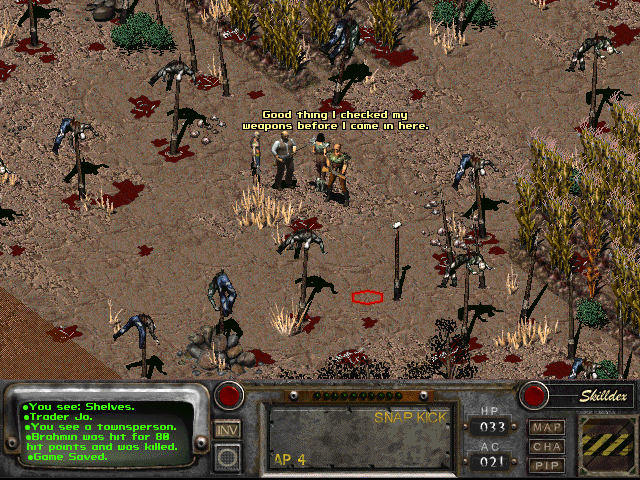
Mark Morgan’s score provides the unease underneath. Its drones, percussion, and industrial textures leave room for the player to read and explore while making a settlement feel older and less comfortable. The music is often difficult to separate from the imagined sound of the place. It can seem to be coming from somewhere behind the walls.
In a PC Gamer interview, Morgan described Fallout’s musical direction as dark and ambient, rather than conventionally orchestral. Listening while a character crosses an empty-looking street explains the choice rather well. The score does not have to announce an enemy to make you uneasy about what might be inside the next building.
Fallout 2’s personality comes from that combination as much as from its dialogue. The game can be noisy with jokes, then leave you reading an ugly conversation over a soundscape that offers very little comfort.
Fall 1998: a remarkable game, and a troublesome one
When Fallout 2 reached players in 1998, its size was an invitation and a warning. Anyone who had wanted more Fallout had an enormous journey waiting. Anyone expecting a polished sequel to smooth every awkward corner was about to make extensive use of the save menu.
Desslock’s contemporary GameSpot review praised its breadth and detail while cataloging problems with loading, saving, the car, equipment recognition, and quests. Some were irritations. Others could stop progress or crash the game. The review also noted that beta patches had already appeared, with the unwelcome complication of invalidating older saves.
The car’s usefulness made its faults particularly aggravating. You could become attached to an improvement and still have to worry about whether the improvement would behave itself. A lost vehicle in a game of long journeys was considerably harder to dismiss than a misplaced line of text.
Those reports belong beside the praise. Fallout 2 was not a flawless classic that later players unfairly judged by modern standards. Its roughness was visible when it was new. So was the extraordinary amount of freedom underneath it. Contemporary enthusiasm often came with an implicit agreement to save frequently and forgive more than seemed entirely reasonable.
The production accounts make the shortfall understandable without making it disappear. More branches meant more combinations to test. A player might arrive at a location with different companions, reputations, skills, and prior decisions. The deadline did not become more generous whenever a designer found another interesting possibility.
There were cuts as well as bugs. Avellone’s planned Environmental Protection Agency area did not make the shipped game. His GameBanshee recollection describes locations being reduced or dropped as time ran out. The Fallout 2 that reached the shops was already full to bursting, and it still carried traces of an even larger one that had not been finished.
The years after release: fixing the wasteland, then expanding it
A game this reactive gives dedicated players a great deal to discover, including what has gone wrong. Over the following years, fan patching became an important part of Fallout 2’s life. Killap’s Unofficial Patch and Restoration Project became familiar names to players returning to the original adventure.
Their descendants remain distinct choices. Unofficial Patch, updated builds on Killap’s patch work. Restoration Project, updated builds on the expanded project and includes additional content alongside fixes. Its documented locations include the EPA, an especially interesting connection to material discussed by Avellone years earlier.
Installing a restoration does not reveal a single, finished 1998 master version that had been hidden in a drawer. These projects involve research, reconstruction, and fan decisions. They can be excellent ways to return, but a first playthrough with expanded content is a different experience from the game that originally shipped. The distinction is useful when two people remember a quest differently and both are convinced they are right.
For a newcomer, buying the game through GOG or Steam supplies the commercial game data. Decide whether you want a closer-to-original run or an expanded one before installing community projects. The current patch and restoration documentation calls for installation onto a vanilla game and normally a new game, rather than assuming an existing save can carry on safely.
There is also Fallout 2 Community Edition, a reimplementation of the engine for multiple platforms. It requires your own game data. As checked in November 2026, its documentation specifically lists Restoration Project among the projects it does not yet support. It is an alternative way to run Fallout 2, not a reason to stack every available enhancement into the same folder.
The practical advice is pleasantly unheroic: keep a clean installation, read the documentation for the route you choose, and keep several saves. The last suggestion would have been useful in 1998 too.
What Fallout 2 left on the road
The later Fallout games would take different roads, and each deserves its own history. Fallout 2’s particular contribution was to show a world moving beyond immediate survival. Its communities could grow into states, build economies, fight over resources, and invent fresh ways to be cruel. The old disaster remained everywhere, but people were already busy making the next set of problems.
It also gave the series the Enclave, expanded the NCR’s place in its world, and filled the space between those powers with people who could not be reduced to a faction emblem. Later games would return to parts of that inheritance. New Vegas, in particular, would find plenty to argue about in the west.
Yet Fallout 2 remains worth playing for its own company. There is Sulik at the beginning of the journey, a city that will not let you in, an argument you can finally win because you invested in the right skill, and an inventory full of equipment that tells the story of where you have been. There is also a joke that should have been cut and a fight you will be attempting again in a moment.

The Chosen One leaves home looking for a machine. By the time the journey is over, the player has acquired a car, friends, enemies, and opinions about the government of towns that once looked like dots on a map. Saving Arroyo is still important. So is finding out what happened to everybody else.
More from Retro Replay
- Chris Avellone on Fallout, Planescape: Torment, and the Player’s Choices
- Fallout 2 in the Retro Replay Gamebase
- The original Fallout in the Retro Replay Gamebase
Sources and further reading
- Chris Avellone interview, Retro Replay. Original answers about character builds, consequences, the production schedule, and the sequel’s humor. Three excerpts appear above.
- World on Fire, David L. Craddock, Shacknews. Extensive creator interviews about both original games, team changes, production, and the sequel’s scale.
- An Oral History of Fallout, Part I, Game Informer. Tim Cain, Leonard Boyarsky, and Brian Fargo discuss the original game, the sequel’s schedule, and consistency between area teams.
- Leonard Boyarsky retrospective interview, RPG Codex. Boyarsky identifies the early story and side-quest work contributed by himself, Cain, and Anderson before their departure.
- Why I Left Fallout 2, Timothy Cain. Cain’s own 2023 retrospective video, embedded beside the departure of the original creators.
- Fallout 2 developer interview, GameBanshee. Avellone’s 2006 account of his areas, inherited Vault City work, production conditions, cut EPA material, and retrospective concerns about in-jokes.
- How Fallout 2’s wild wasteland came to define a series, PCGamesN. Firsthand interviews with Urquhart, DeMilt, Spitzley, and Avellone, including schedule pressure, companions, and the car trunk.
- Fallout 2 manual, Interplay. Original game documentation and team credits, distributed with the current Steam edition. The illustrated credits page is rendered from this PDF.
- Fallout 2 credits, preserved in Restoration Project. Original cast and music credits within the project’s credits file, including Dorn, Summer, MacNeille, Perlman, and the Armstrong recording.
- Fallout 2 review, Desslock, GameSpot. Contemporary December 1998 criticism, including the technical faults, early patch complications, and enthusiastic assessment of its role-playing.
- Mark Morgan interview, PC Gamer. The composer discusses the original games’ dark ambient musical direction.
- Fallout 2, Steam. Current commercial edition and the publisher’s screenshot gallery. Its storefront release date is not used as the original 1998 release date.
- Fallout 2, GOG. Current commercial availability for players returning to the game.
- Unofficial Patch, updated, BGforge. Current patch documentation, installation requirements, and connection to Killap’s work. Checked November 2026.
- Restoration Project, updated, BGforge. Expanded project documentation, included components, and new-game requirements.
- Restoration Project content list. The project’s own list of added areas and changes, including the EPA. Contains spoilers.
- Fallout 2 Community Edition. Engine reimplementation, required game assets, platform support, and the documented lack of Restoration Project support. Checked November 2026.
- Troika founders photograph, Sharon Anderson. Jason Anderson, Tim Cain, and Leonard Boyarsky, used under CC BY-SA 4.0. The upload date is not presented as the date the photograph was taken.
- Chris Avellone photograph, Luna Cruz. Portrait at e-Services 2009 in Manila, used under CC BY-SA 2.0 and shared with the companion interview.