 Retro Replay Retro Gaming History, Reviews & Emulation
Retro Replay Review
Gameplay
QuakeBlox opens with no mystery: shaped blocks fall from the top, and you rotate and place them before they land. That directness is its strongest quality. Within minutes, you are doing the familiar mental arithmetic of protecting a flat stack, leaving room for the next piece, and trying not to create a hole you will regret thirty seconds later.
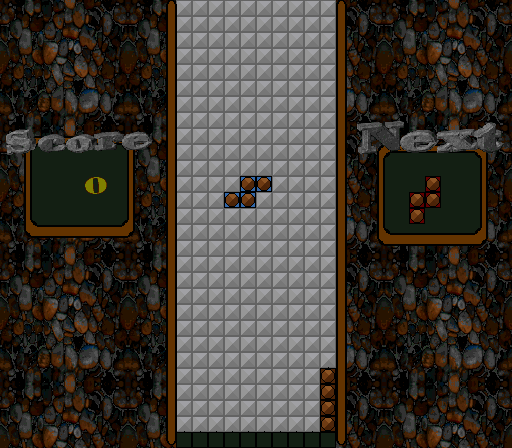
The preview in the upper-right corner matters because it lets you plan one move ahead. A useful early habit is to avoid treating every piece as an emergency. Look at what is coming, preserve open space, and resist plugging a shallow gap if it leaves the board uneven. Like any good falling-block game, it becomes more satisfying once you stop reacting to the current block and start setting up the next one.
Line clears are where QuakeBlox adds its own tiny flourish: the screen shakes when a continuous row disappears. It does not change the underlying rules, but it makes a clear feel more physical than a simple score increase. That is enough to add a little punctuation to the loop, though not enough to transform it. Frustration sets in for the same reason it does in every strict Tetris variant: one rushed placement can turn a tidy board into a difficult recovery job.
There is no escaping how close this stays to the original formula. If you want a clean, uncomplicated falling-block challenge, that restraint works in its favor. If you are hoping for radically different goals or a deeper reinvention, QuakeBlox has very little beyond the core stack-and-clear routine.
Graphics
The game uses a straightforward side-view playfield with falling block shapes and a next-piece display in the upper-right corner. Its clearest visual moment comes on a line clear, when the whole screen shakes; it is a simple effect, but it gives successful clears a bit of impact.
Story
QuakeBlox has no story to carry you from one session to the next. The motivation is entirely self-made: score more points, build a cleaner stack, and see how long you can keep the board under control.
That absence fits the format. You are not here for characters or plot turns; you are here for the small, repeatable drama of a falling piece and a narrowing set of options.
It also means the game has nowhere to hide. Without a narrative layer, every session lives or dies on your enjoyment of arranging shapes under pressure. For fans of the genre, that can be all the reason needed.
Overall Experience
QuakeBlox is a modest Tetris-style game with one noticeable bit of personality: line clears shake the screen. The first hour has the dependable pull of any competent falling-block puzzle, especially if you enjoy the constant push between short-term fixes and long-term board management.
The payoff is familiar rather than surprising. When a planned placement finishes a line and the board opens up again, the shake adds a welcome little burst of satisfaction. But the game does not substantially alter the formula around that effect.
Give it a chance if you want a stripped-down puzzle session and do not need much decoration around the essentials. QuakeBlox understands the durable pleasure of rotating, dropping, and clearing blocks; it simply chooses to keep that pleasure almost exactly as you remember it.


Reviews
There are no reviews yet.