 Retro Replay Retro Gaming History, Reviews & Emulation

Retro Replay Review
Gameplay
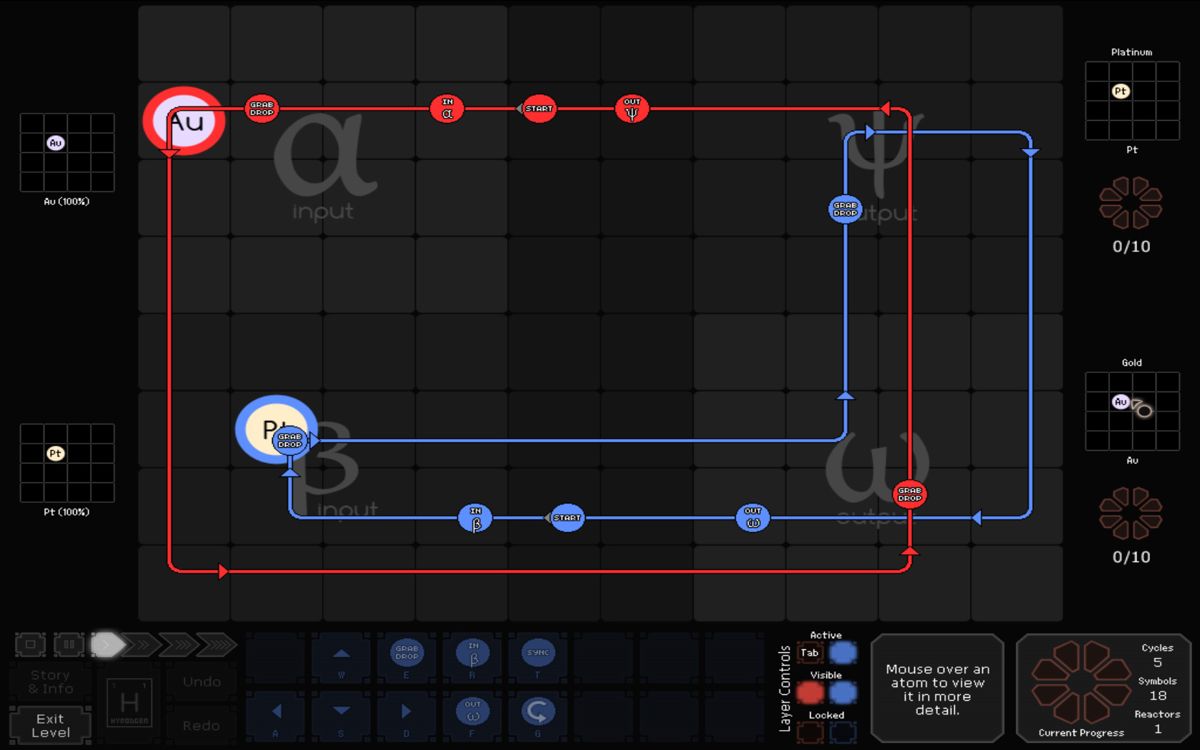
The first few reactors make you feel smart quickly. You draw routes for the Waldos, place instructions to grab, rotate, drop, and bond atoms, then hit test to see whether your little chemical assembly line actually works. There is an immediate, tactile pleasure in taking a loose pair such as Ag and F and getting a correct Ag-F molecule to the exit. It is a puzzle about planning, but the running simulation gives every decision a welcome sense of consequence.
Then SpaceChem starts asking the question that defines the whole game: can your solution work forever rather than once? A route that succeeds for the first molecule may collide with its own next cycle, leave an atom in the wrong place, or throw two Waldos out of sync. That repeated-operation requirement is what elevates the game beyond a straightforward matching puzzle. You are not merely finding an answer; you are debugging a process.
That process can be punishing. Trial and error is part of the intended rhythm, and you will regularly redraw sections that seemed perfectly sensible a minute earlier. Still, the failures are usually useful because the reactor makes the breakdown visible: a missed grab, a badly timed drop, an unwanted interference. When the logic finally clicks, frustration gives way to the rare satisfaction of seeing a complicated machine run without intervention.
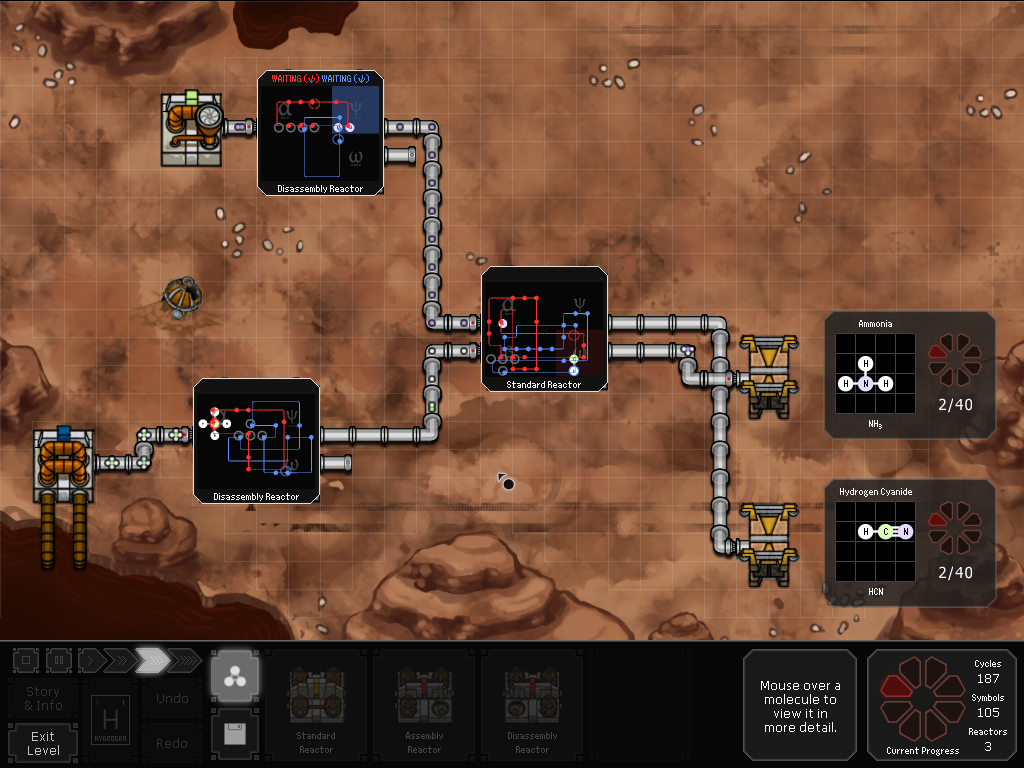
The later move into multiple linked reactors is a strong escalation. You must think about each individual board while also treating its output as the next reactor’s input, which makes the larger assignments feel like real production chains. Cycle counts, reactor counts, and symbol counts add a welcome efficiency chase for anyone unwilling to settle for a merely functional answer. The extra challenges give that perfectionist urge specific targets, including restrictions on cycles or reactor use.
Graphics
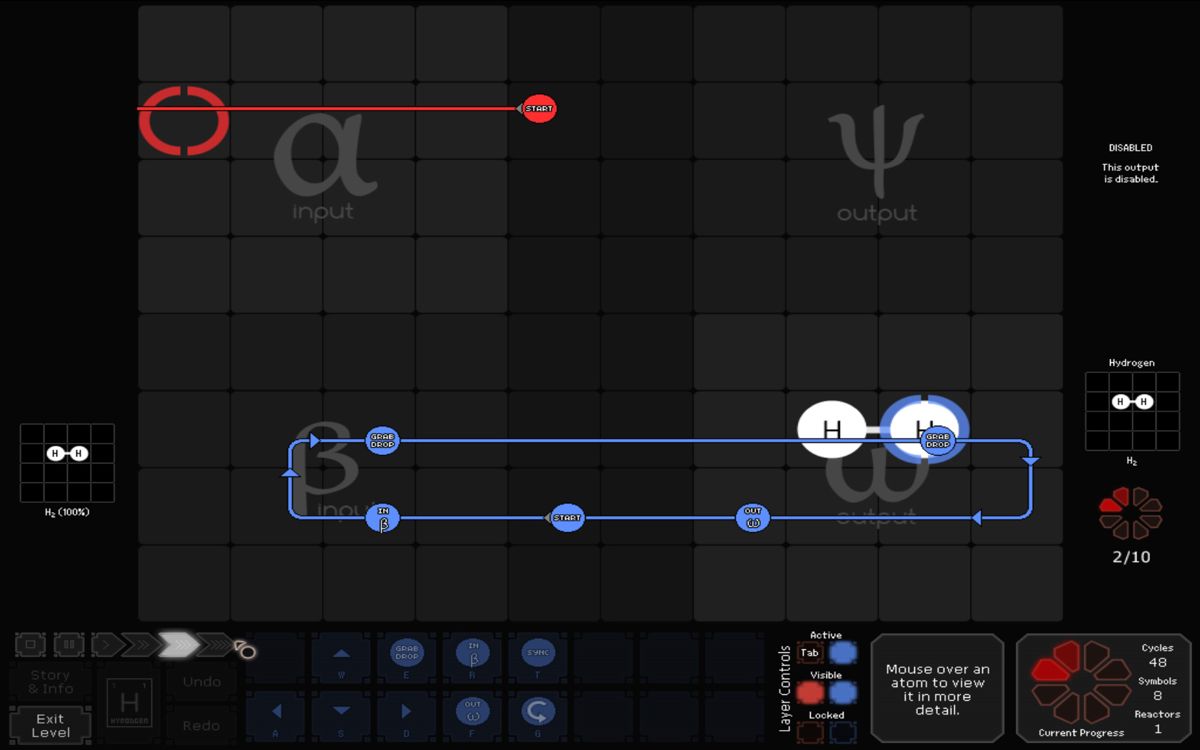
The view stays focused on compact 10-by-8 reactor boards, with input atoms on the left and the requested result on the right. Watching the Waldos trace the paths you drew and shuttle atoms around makes the moving parts of a solution easy to follow, especially when you are hunting the moment a routine goes wrong.
Story
The framing follows a reactor engineer employed by SpaceChem to synthesize materials for frontier colonies in space. Mission text delivers that thread between puzzles, giving the sequence of chemical jobs a shared destination rather than leaving them as unrelated brainteasers.
It is a light touch, and that is the right call. The text is there to move you from planet to planet and put a little sci-fi context around the next assignment, not to compete with the elaborate work happening inside each reactor. You will remember the solutions more vividly than the narrative details.
That modest story structure does help the progression. Each mission feels like another assignment in a growing industrial problem, and the shift toward linked reactors naturally reads as an increase in the scale of your work. It gives the campaign enough momentum to carry you through stretches where a puzzle has you stuck.
Overall Experience
SpaceChem is demanding in the best and worst ways. It asks for patience, careful observation, and a willingness to tear down an approach that nearly works. If you want puzzles you can solve on instinct and breeze past, its insistence on repeatable, synchronized routines will wear you down.
But for the right kind of gamer, that rigor is exactly why it lasts. Each completed reactor is proof that you understood a small system well enough to automate it, and efficiency scoring gives you a reason to revisit a solution after the relief of finishing it. The game turns optimization from a dry statistic into a tempting second puzzle.
Give it a chance if you enjoy building, testing, and revising under clear rules, especially if the thought of debugging a tiny factory sounds satisfying rather than tedious. The payoff is substantial: more than fifty puzzles that continually push from simple atom handling toward elaborate interconnected routines, with a clean loop of experimentation and hard-won mastery at their center.



Reviews
There are no reviews yet.