 Retro Replay Retro Gaming History, Reviews & Emulation


Retro Replay Review
Gameplay
Super Marisa Land starts from very familiar ground: run across side-view stages, clear gaps, jump on enemies, and break bricks. That familiarity makes it easy to settle into, but the game’s best idea is how unapologetically it twists the mushroom power-up. Marisa’s growth is tracked through her head-to-body proportions, turning each pickup into a visual gag as well as a step up in development.
The progression has a little more bite than a simple chain of mushrooms. Marisa can grow through several stages, but moving beyond four requires special mushrooms. That requirement gives the power-up chase a purpose beyond grabbing every item in sight, even if the underlying platforming remains intentionally close to the Mario template.
Alice’s mode is the real change of pace. She cannot gather mushrooms, so she skips the central growth routine altogether and attacks by shooting mini-Marisas. If the proportional-growth joke does not land for you, Alice offers a more straightforward way to deal with foes. That makes the second character feel worthwhile rather than like a minor replay option.

Graphics
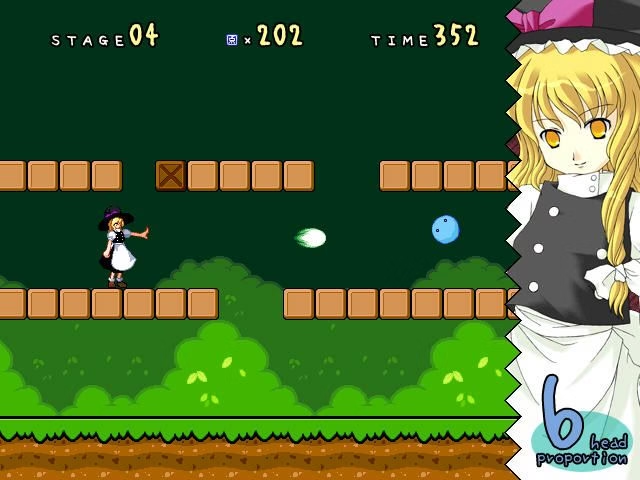
The stages use bright, chunky pixel art: vivid green grass caps sit over layered brown dirt, square tan blocks hang in simple formations, and dark green skies frame rows of soft, rounded bushes. Tiny character sprites and small fairy-like enemies stand out cleanly against that bold scenery, though the backgrounds are plain enough that the levels can look repetitive.
The funniest visual choice is the enormous character portrait fixed along the right side of the screen. Marisa and Alice are drawn in cute, oversized anime style, and the changing proportion count beside them makes the whole joke immediate. It is charming, but it also consumes a big portion of the view, so the playfield can feel narrower than it needs to be.

Story
This is a Tōhō fan game centered on Marisa Kirisame, with Alice Margatroid stepping in as a playable character in her own mode. The characters provide the hook more than any elaborate narrative setup, and the game is happy to let their recognizable personalities and imagery carry the premise.
Marisa’s status as an ordinary magician becomes part of the game’s broad comic spirit, particularly when the mushroom system turns her physical growth into the main running gag. The concept is silly in a deliberate, affectionate way rather than trying to make the platforming premise feel important or dramatic.
Alice adds a useful second angle because her rules differ from Marisa’s. Her inability to collect mushrooms and her mini-Marisa shots make her mode feel tied to her own character rather than simply repeating Marisa’s route with a different sprite. Come here for a light Tōhō-flavored joke, not a story-heavy adventure.
Overall Experience
Super Marisa Land is at its best when it leans into its absurdity. The familiar platforming framework gets you moving immediately, while the head-proportion system supplies the memorable hook that a straight Mario imitation would lack. It is not subtle, and that is largely the point.
There is also a limit to how far the joke carries the game. The core actions are deliberately conventional, and the simple outdoor stages do not do much to disguise their roots. If you need a platformer to constantly surprise you with new ideas, this will feel slight once the novelty of Marisa’s growth wears off.
Still, Alice’s alternate approach gives the package more replay value than its premise first suggests. Tōhō fans should get the most out of the character-specific humor, while anyone else should give it a chance only if a compact, eccentric take on old-school platforming sounds fun. It earns goodwill through commitment to one very strange idea.

Reviews
There are no reviews yet.