 Retro Replay Retro Gaming History, Reviews & Emulation
Retro Replay Review
Gameplay
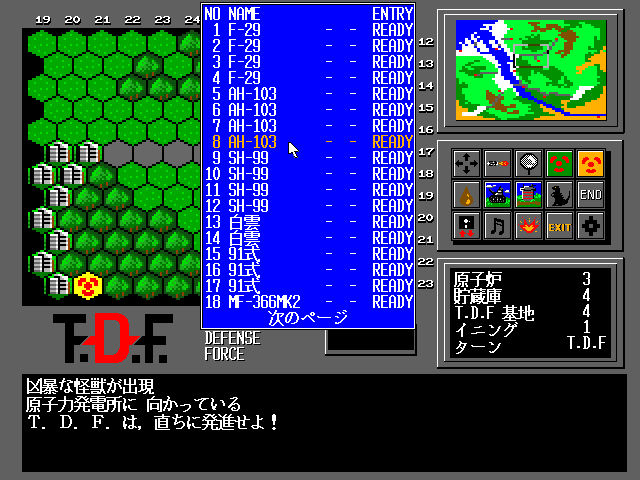
The first few turns have a clean, urgent rhythm. A monster threat is already on the board, populated ground needs protecting, and you have to work outward from the T.D.F. bases scattered across the map. That deployment restriction matters: units cannot simply appear wherever danger is greatest, so a bad early placement can leave the wrong part of the map exposed.
What starts to click is the relationship between your infrastructure and your forces. Atomic power plants produce fuel, while bases define where new units can be positioned. Planes, helicopters, mobile rocket launchers, ships, and trucks give you a varied defensive roster, but the game asks you to use that roster as a coordinated response rather than a pile of independent pieces. Terrain and map shape alter the problem from one scenario to the next, especially once water and different land types enter the equation.
Combat is automatic whenever a unit and monster fall within one another’s range, with the result shown in a small animated battle sequence. That puts the emphasis firmly on preparation. If you enjoy turn-based games where the tense part is arranging the board correctly before the shooting begins, T.D.F. has a satisfying logic. If you want to directly control every attack, the automatic resolution can feel detached and occasionally frustrating.
The nine to fifteen available maps, depending on version, give the game more staying power than a single defense puzzle. Still, the core loop does not radically change: establish a useful deployment network, manage the fuel-producing plants, and prevent the monsters from overrunning the area. Its payoff is the satisfaction of making an initially scattered defense hold together under pressure, not flashy tactical theatrics.
Graphics
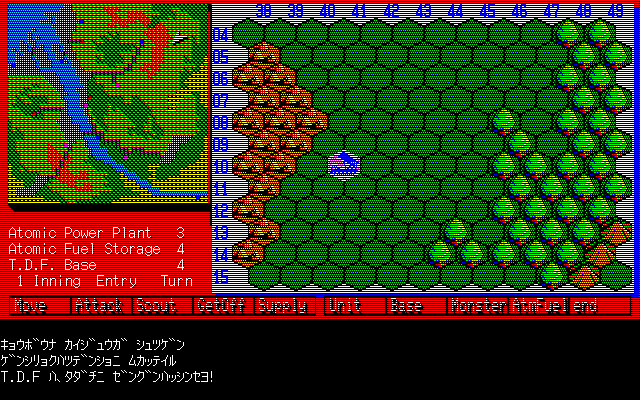
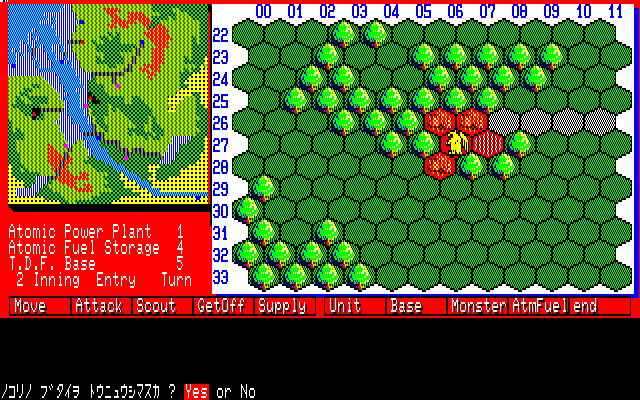
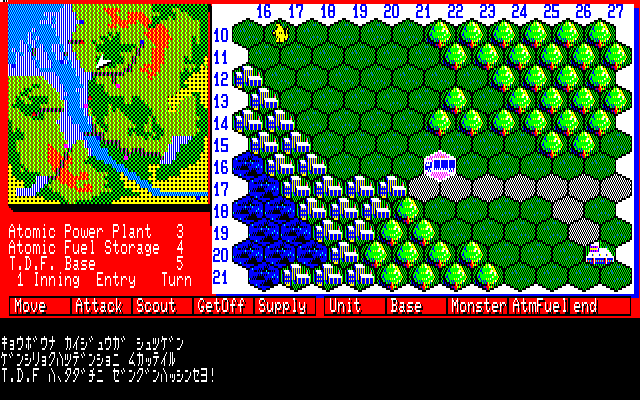
The main view is an overhead hex map, with grassland, desert, water, and other terrain shaping the battlefield. That perspective suits the game well: you can see where bases sit, where units can be placed, and how the monsters are approaching.
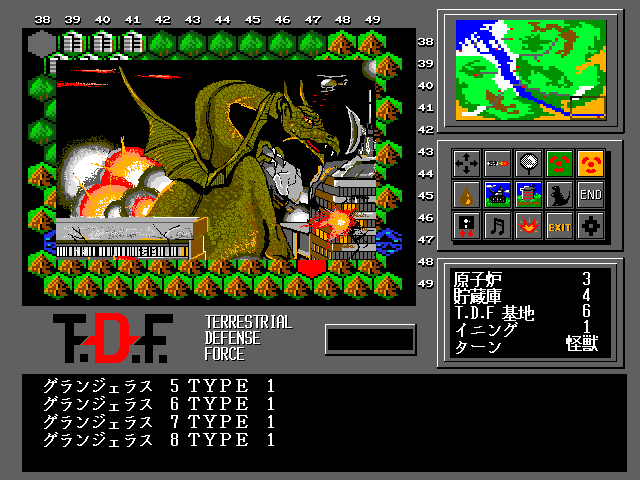
When combat triggers, the action shifts to a small animated strip in the lower part of the screen. The monsters are largely dragon-like, while your side fields a recognizable mix of aircraft, ships, trucks, and rocket launchers. It is a functional, compact way to show the clash without pulling focus from the map where the important decisions happen.
Story
This is a defense scenario first and a narrative second. Giant monsters are attacking populated areas, and the T.D.F. is tasked with stopping them before the situation worsens. That is enough context to make each map’s defensive problem immediately understandable.
The game finds its drama in the board state rather than in named characters or elaborate plot turns. A monster nearing an important stretch of territory, a base that is too far from the front, or a fuel supply that needs protecting creates its own small disaster-movie tension.
That lean approach works because it does not slow the strategy down. You are not waiting for a story beat to tell you what matters; the enemy’s route and the territory you must defend do that job. Anyone hoping for a richly told kaijū tale may find it sparse, but the premise gives the tactical battles a clear purpose.
Overall Experience
T.D.F. Kaijū daisensō kesshi no genshiro bōei sakusen is a focused turn-based defense game with an enjoyably specific monster-movie hook. Its best quality is how naturally its constraints create decisions: bases limit deployment, plants underpin the war effort, and automatic combat makes range and placement impossible to ignore.
It asks for patience. You need to be comfortable reading a hex map, considering the next few turns, and accepting that battles resolve on their own once opposing forces are in range. The tension comes from whether your plan was sound, not from quick reactions during an attack.
Give it a chance if you like compact tactical games and the idea of defending cities from kaijū with a conventional military force sounds more interesting than controlling the monsters yourself. The maps and terrain variations keep its central puzzle from going stale too quickly, and a well-managed defense has a sturdy, old-fashioned strategic satisfaction.



Reviews
There are no reviews yet.