 Retro Replay Retro Gaming History, Reviews & Emulation

Retro Replay Review
Gameplay
A treasure chest in Verlies comes with an awkward question: how much of this run are you prepared to risk reaching it? The dungeon is randomly generated, and its enemies and traps sit between a developing hero and the next useful find. Learning one layout will not make the next descent safe. Permanent death gives even a modest expedition something to lose.
The character systems offer reasons to become attached to that hero. There are 12 jobs, while experience contributes to abilities and further development. That gives the crawl more direction than gathering treasure alone. Losing a character also means losing time spent developing it, which is a powerful incentive to be cautious and an obvious drawback for players who prefer to recover quickly from a mistake.
Helpful NPCs interrupt the danger with practical services. They can sell goods, heal the hero, or repair weapons. Those encounters make supplies and equipment part of the expedition rather than background numbers. The relief of finding help belongs to the same loop as the threat of the next trap: survival depends on more than deciding which chest looks tempting.
Players familiar with NetHack will recognize the broad appeal of changing dungeons and permanent consequences. That comparison is about the pressure of a run, not a claim that Verlies reproduces NetHack’s many individual systems. Jobs, abilities, and occasional NPC assistance give this crawl its own set of decisions.
Graphics
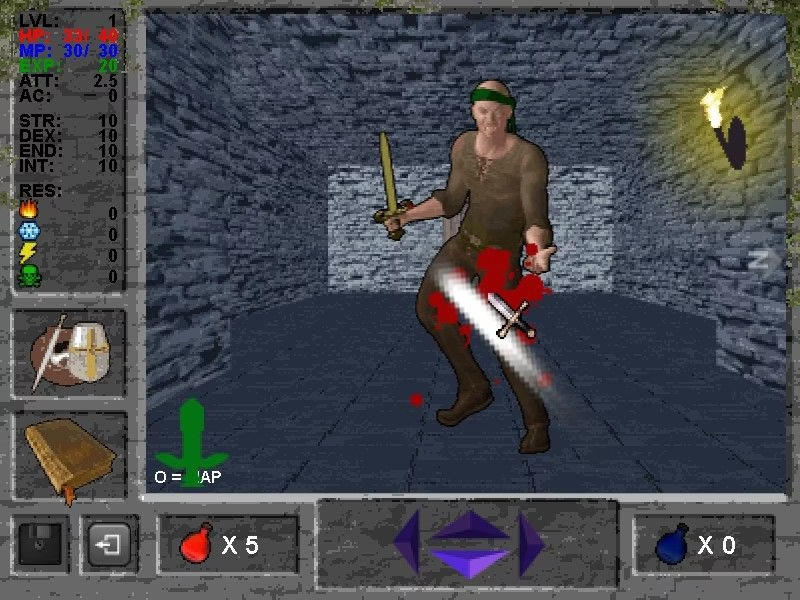
Verlies has a plainly homemade look. In the dungeon, a large human swordsman in brown clothes and a green headband stands against coarse gray rectangular masonry, while a yellow wall torch breaks up the dim corridor. The cramped chamber reads clearly, but the character edges and wall textures are rough enough that you will notice the low-fi construction immediately.
Story
The premise sends a hero into a mysterious dungeon containing enemies, traps, and treasure. It is a straightforward invitation to explore a dangerous place, with the unknown layout supplying the immediate question of what lies ahead.
NPC assistance gives the setting a little everyday activity alongside its hazards. Selling goods, restoring health, and repairing weapons are useful interruptions to a journey otherwise dominated by survival. The hero is not dealing only with hostile creatures.
The character’s progress gives the expedition its personal stakes. Experience and abilities matter because death can end the run. For players drawn to that structure, a promising character is enough reason to care about getting out of the next encounter intact.
Overall Experience
The strongest attraction is the combination of uncertainty and investment. A changing dungeon prevents a completely familiar route, while jobs and abilities give the hero something to develop. That is a solid foundation for players who enjoy committing to a run without knowing how far it will go.
Permanent death is also the clearest reason to hesitate. Healing and repairs provide support, but they do not remove the central penalty. Someone looking for relaxed exploration can reasonably find that loss more discouraging than exciting, especially after spending time on a character.
Verlies is worth considering for dungeon-crawling fans who put consequential exploration ahead of polished presentation. Its rough visual style and demanding failure rule narrow the audience. If risking a developing hero for one more discovery is the attraction, though, its familiar roguelike ingredients have a clear purpose.


Reviews
There are no reviews yet.