 Retro Replay Retro Gaming History, Reviews & Emulation
Retro Replay Review
Gameplay
Crackdown 2 starts strong because it understands the simple pleasure of handing you a superhuman cop, a city full of vertical routes, and far too many things that can explode. You can roam Pacific City at your own pace, take to the streets, scramble up onto rooftops, descend underground, drive vehicles, and pilot helicopters. The first stretch is fueled by possibility: every high ledge looks like a route to test, and every crowded fight can become an excuse to see how much damage you can cause.
Agility Orbs are still the backbone of that loop. Chasing them raises your mobility, letting the Agent jump higher, run faster, and glide farther; those upgrades in turn open routes that were previously out of reach. It is a clean reward cycle, and the radar ping for orb locations removes some of the blind searching. Renegade Orbs add a moving target to the hunt, while Live Orbs give co-op groups something extra to pursue together.
Combat upgrades are split among Agility, Firearms, Strength, Explosives, and Driving, so your rampage has a sense of progression even when you are simply wandering. New vehicles arrive with new levels rather than transforming a fixed set of cars as in the first game. The action is deliberately excessive—large explosions, huge enemy groups, and the ability to juggle cars are the point—but repetition can set in once the missions settle into holding ground and clearing opponents.
The day-and-night structure gives the city a useful change of enemy pressure. The Cell fights during the day, while mutant Freaks emerge at night. Underground lairs ask you to recover Cell-guarded absorption units, collect sunlight, and power beacons that direct it into darkness where the mutants hide. It is a memorable objective because it turns sunlight into a weapon, though it cannot fully disguise how often the campaign returns to another combat zone.
Co-op is where the chaos has the most room to breathe. Up to four people can tackle the city together, making orb hunts, vehicle stunts, and overwhelming battles feel less like chores and more like a shared wrecking session. Competitive modes support up to sixteen players in closed-off parts of the city, and Rocket Tag’s hunt for a grenade-armed lone player sounds appropriately unruly. If you are playing alone, the campaign’s repetition is much harder to ignore.
Graphics
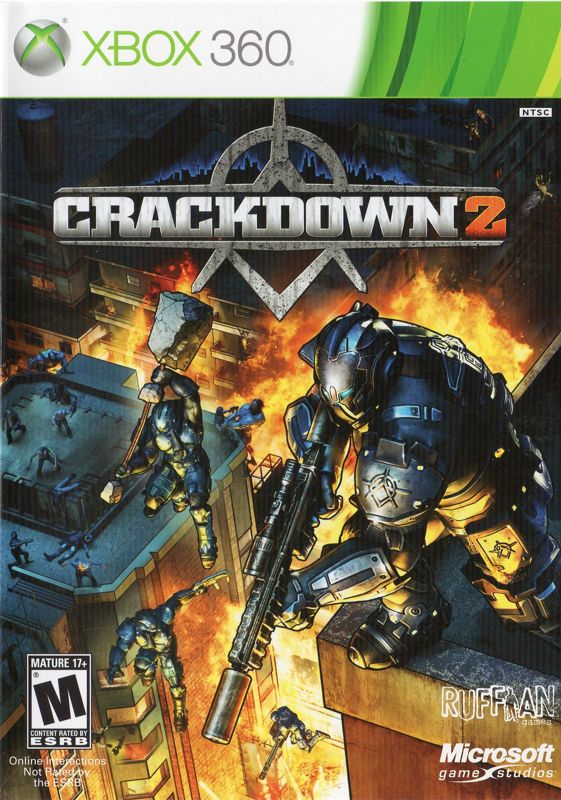
Pacific City is a ruined urban playground viewed from behind the Agent, with streets, rooftops, underground Freak lairs, and enough vehicles to make constant movement part of the scenery. The clearest visual contrast comes from the campaign’s rhythm: daylight battles against heavily armed Cell forces give way to nighttime fights with mutant Freaks, while the underground sections center on beams of collected sunlight cutting into their dark hiding places.
Story
Set ten years after Crackdown, the sequel returns to a Pacific City that has fallen apart. The Agency sends its Agent to restore order while the Freaks overrun the city and the anti-Agency Cell becomes a heavily armed terrorist threat. It is a serviceable setup for open-world destruction, not a story that demands close attention.
The campaign’s structure tells you more through action than character drama: defend territory, fight the Cell by day, confront Freaks at night, and purge the lairs below the city. That gives your violence a clear target, but the conflict stays broad. You are mainly here to reclaim space and become stronger while doing it.
Story details are delivered through audio logs scattered around the city, so exploration is also how you piece together what happened. That approach fits a game built around roaming, but it also means the narrative can easily fade into the background if you are focused on orbs, vehicles, and the next explosion. Treat the plot as flavor for the sandbox rather than the reason to push forward.
Overall Experience
Crackdown 2 is most fun when you stop treating Pacific City like a checklist and start treating it like a stunt park with hostile occupants. The movement progression makes a real difference: the Agent begins capable, then gradually becomes fast and airborne enough that simply crossing the city feels like a reward. Few open-world action games make collecting upgrades so naturally tied to enjoying the map.
Its shortcomings are equally easy to see. The campaign leans hard on repeated fights over ground, and the story is too lightly delivered to carry the stretches between big acts of mayhem. If you need every mission to feel distinct or want a strong narrative hook, the novelty can wear off before the credits matter.
Even so, there is a specific kind of pleasure here that the sequel still captures: escalating into a walking disaster while a city becomes easier and more entertaining to traverse. Give it a chance if you enjoy open-world shooters where mobility, collection, and gleeful collateral damage matter more than careful mission design. It is a better co-op romp than solo campaign, and a worthwhile one when you want loud, uncomplicated action with a tangible sense of growth.


Reviews
There are no reviews yet.