 Retro Replay Retro Gaming History, Reviews & Emulation



Retro Replay Review
Gameplay
The first few screens of Devils of the Deep put you in the mindset of a proper salvage diver: you are not simply charging toward treasure, because oxygen, strength, equipment, and dangerous wildlife all matter. The 100-screen seabed is connected horizontally, with impassable deep-water trenches marking the limits. That makes exploration feel less like a series of isolated rooms and more like a place you need to learn, screen by screen.
Its strongest idea is how each useful object changes what you can do. An oxygen cylinder extends your time underwater; the knife lets you cut seaweed, which can be eaten to maintain strength; a spade is needed for excavation; and the harpoon gives you a way to deal with the giant electric eels. You are constantly looking at the immediate screen and thinking ahead: do you carry an item now, use it now, or risk pushing onward without it?
That careful planning comes with some rough edges. Keyboard-controlled movement, separate keys for collecting items and checking inventory, and a speed-up function limited to carrying fewer than three items make the game deliberately fussy. The restriction gives inventory management real bite, but it can also turn a simple return trip into a test of patience. This is the kind of game that rewards taking notes and accepting that early runs are partly reconnaissance.
Once you understand that rhythm, the pressure becomes the point. Treasure is not just a pickup; it is another thing you need to get back to the salvage vessel while preserving your resources and keeping threats under control. The game asks you to earn progress through familiarity, not handholding, and its appeal rises sharply if that sounds satisfying rather than exhausting.

Graphics
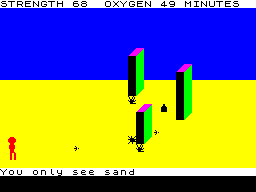
The action is shown from a side-on, fixed-screen view of the seabed. Crabs, seaweed, treasure, tools, and electric eels give each screen clear hazards and targets to look out for, while the flip-screen structure keeps the focus tight on the stretch of ocean floor immediately around your diver.

Story
The story is lean but appropriate: you are an explorer sent into Atlantis to recover treasure and return it to a salvage vessel. It is a clean motivation that puts the emphasis where it belongs, on the hazardous work of getting in, finding valuables, and getting back out.
Atlantis functions more as a destination than a heavily developed setting. There is no need for elaborate narrative detours when the basic objective already gives every oxygen cylinder, tool, and buried find a practical purpose.
That stripped-down approach suits the game’s era and structure. The sense of adventure comes from the distance between you and a safe return, and from gradually making the dangerous seabed feel navigable through experience.
Overall Experience
Devils of the Deep is at its best when you treat it as an underwater expedition rather than a straightforward action game. The eels and the need to maintain oxygen add urgency, but the real challenge is carrying the right gear and remembering the route through its many screens.
Its demands are unapologetically old-fashioned. You will need patience for the keyboard commands, cautious movement, and the way its inventory rules slow you down precisely when you would prefer to hurry. That friction is not incidental; it is central to the game’s survival-and-salvage tension.
Give it a chance if you enjoy Spectrum games that make knowledge your most valuable resource. The payoff is a compact but unusually involved exploration game, one that turns a simple treasure hunt into a sustained exercise in preparation, navigation, and nerve. It is more compelling than immediately comfortable, but that is exactly why its dive can linger.



Reviews
There are no reviews yet.