 Retro Replay Retro Gaming History, Reviews & Emulation
Retro Replay Review
Gameplay
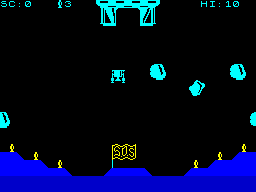
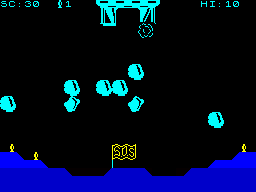
The first descent is immediately legible: your rescue pod leaves the mothership at the top of the screen, and you need to guide it through an asteroid field toward one of three platforms on the moon. You can move left and right, while thrust slows your speed. That limited control set is exactly why the game works. You are not wrestling with a pile of commands; you are judging space, speed, and whether you have waited one heartbeat too long to brake.
Landing is only half the job. Once a scientist climbs into the pod, you have to lift off and navigate the asteroid field again to return home. That return journey gives each successful touchdown a nice jolt of anxiety: relief lasts for about a second before you remember that the dangerous part is not over. The pod carries only one scientist, so rescuing all six means repeating the trip six times, and the repetition becomes a test of consistency rather than mere survival.
That is also where frustration can set in. Lunar Rescue is unforgiving by design, and a mistake in a sparse arcade game has nowhere to hide. Still, the loop has a clean “one more try” quality. After all six rescues, the game starts over with more asteroids, turning early success into preparation for a tougher round. Give it a chance if you like old-school games where improvement comes from learning momentum and staying calm under pressure.
Graphics
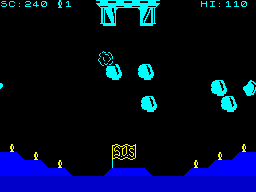
The action is shown in a fixed side-view playfield, with the mothership overhead, the moon and its three landing platforms below, and asteroids filling the dangerous space between them. The strongest visual idea is practical and clear: you can see the entire route your pod must travel, which makes every descent and ascent easy to judge at a glance.
Story
There is barely a story to slow the arcade action down: scientists are stranded on the lunar surface, and you are the pilot sent to bring them back one at a time. For this kind of game, that is enough. The rescue objective gives the repeated flights a little more purpose than simply chasing a score.
This ZX Spectrum version removes the aliens found in the original arcade game, leaving the asteroid field as the sole threat. That makes the mission feel more focused, if less varied: the drama comes from piloting well, not from reacting to a changing cast of enemies.
Each scientist safely loaded into the pod marks tangible progress toward the six-person evacuation. It is a small framework, but it makes a successful run feel like a completed mission rather than a random sequence of landings. For background on the arcade original, the history of Lunar Rescue is useful context.
Overall Experience
Lunar Rescue is at its best when you stop treating it as a simple landing game and start respecting both halves of every rescue. The descent asks for precision; the ascent asks you to preserve that precision when the stakes feel higher. Its rules are spare, but the back-and-forth flight pattern gives the game a surprisingly sharp tension.
It does not offer much variety beyond increasingly crowded asteroid fields, so the payoff depends on whether you enjoy refining the same skill under harsher conditions. If that sounds tiring, the six trips can feel repetitive. If it sounds like a proper arcade challenge, the escalating difficulty is the point.
This is an easy recommendation for a short session when you want a direct test of timing and control. You will know quickly whether its austere rhythm has you: land cleanly, collect one scientist, and then try not to throw away the return flight. That compact pressure is Lunar Rescue’s lasting strength.


Reviews
There are no reviews yet.