 Retro Replay Retro Gaming History, Reviews & Emulation

When Capcom prepared to bring the blue bomber from Japan to the American market, the character went through one of the most famous name changes in gaming history. In Japan he was known as Rockman, a name tied to the playful music pun with his sister Roll, as in Rock and Roll. Yet when he arrived in the United States he was suddenly Mega Man. For decades the official explanation has always been the same. Executives at Capcom USA felt that Rockman did not sound powerful or marketable enough, so they swapped it for a name that sounded bigger, stronger, and more exciting.

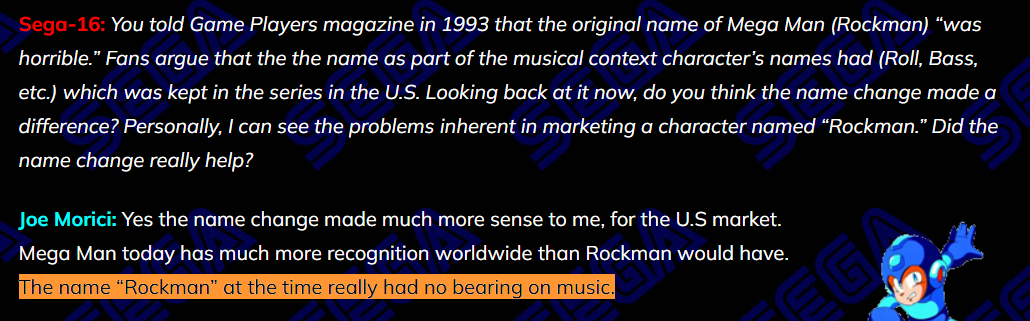
The problem with that explanation is that it glosses over a revealing quote from Capcom USA’s own Joe Morici, the man who changed the name. In an interview with Sega-16 in 2011, Morici said that “the name Rockman at the time really had no bearing on music.” That is a strange statement if we accept the official version. In Japan the whole point was that Rockman’s name was a direct play on music, tied into a larger naming theme that included Roll, Bass, and others. To claim that the name had no bearing on music in the early 90s is only true if you put yourself in the position of an American marketer at the height of the crack epidemic.
Joe Morici: Yes the name change made much more sense to me, for the U.S market. Mega Man today has much more recognition worldwide than Rockman would have. The name “Rockman” at the time really had no bearing on music.
Anyone who lived through that period knows there were only two cultural meanings for the word “rock.” Either it referred to rock music or it referred to crack cocaine. There was no third option. By saying Rockman had no bearing on music, Morici was acknowledging, intentionally or not, that the name Rockman sounded too close to the drug slang that dominated American headlines at the time. Politicians, school boards, and nightly news anchors were consumed with fighting the crack crisis. The word “rock” was synonymous with a dangerous drug that parents were being told to fear. Imagine trying to market a new children’s video game mascot under that name. The cultural climate alone would have made it a hard sell.
Other accounts, such as the explanations offered in GoNintendo’s feature, or Engadget’s retrospective, lean heavily on the branding argument. They describe the American team’s desire for something flashier and more appealing to kids. Those accounts are safe, and they are not wrong in a superficial sense. But branding does not exist in isolation from culture. What executives decide is “appealing” is often shaped by what they fear will hurt sales or attract controversy. Still, Joe Morici has never said anything as close as this one statement given to Sega-16. And it is worthy of our interpretation.
The Sega-16 interview gives us a clue that the story may be more complicated. When Joe Morici dismissed Rockman as having no connection to music, he unintentionally confirmed the other cultural meaning of the word rock. If it was not music, it was drugs. If Capcom USA wanted to avoid the possibility of kids begging their parents for Rockman toys or Rockman lunchboxes during the crack scare, the safer path was to cut the word entirely. Mega Man was not only a stronger sounding name, it was a name free of controversy.
Until Morici himself or the Sega-16 interviewer clarifies otherwise, I will continue to interpret that statement as proof that Capcom wanted distance from drug slang. At the height of the epidemic, “rock” meant crack cocaine to millions of Americans. That context cannot be ignored. The official explanation of a simple branding change may still hold some truth, but to those of us who lived in the 90s, the word rock carried an unavoidable weight. Rockman might have worked in Japan, but in America he could not escape the shadow of crack. Fin.


Very interesting article! the terrible ai art makes me never want to come back to this site though
Well I sure am not going to commission an artist a few thousand dollars to create an image of Mega Man as a junkie, for an article that is only made for fun. I did check to see if an image as this already existed, and sadly it did not. This is not a business for me. Just fun my man. Glad you enjoyed the read though. Ttyl man.