 Retro Replay Retro Gaming History, Reviews & Emulation
Retro Replay Review
Gameplay
Star Control II starts with a terrific feeling of being underprepared in a very large galaxy. You have a powerful Precursor vessel, but fuel, crew, minerals, and useful information are all limited enough that every early trip carries some tension. Setting a course for a new star can lead to a valuable discovery, an unpleasant alien encounter, or a wasted detour that leaves you calculating whether you can afford the trip back.
The central loop clicks because exploration has consequences. You scan planets and moons, send down a lander to collect raw materials and biological samples, then turn those resources into fuel, crew, ships, and upgrades at the starbase. The planetary runs can become a grind, particularly when hazards such as lightning, earthquakes, and lava wreck a profitable visit. Still, the risk makes a rich world feel like a find rather than just another box to check.
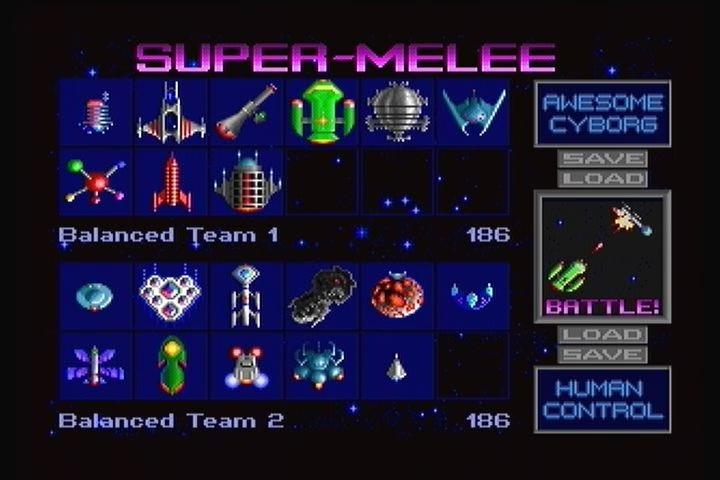
Combat is a sharp change of pace: close, top-down duels where ships maneuver around a planet’s gravity and every alien craft behaves differently. Winning is less about blindly fielding the strongest fleet than learning which ship counters a particular opponent. If that sounds intimidating, the cyborg option can handle battles for you, while Super-Melee lets you enjoy the ship matchups as a separate arcade-style contest. The direct fights are simple to understand and often surprisingly tense.
Graphics
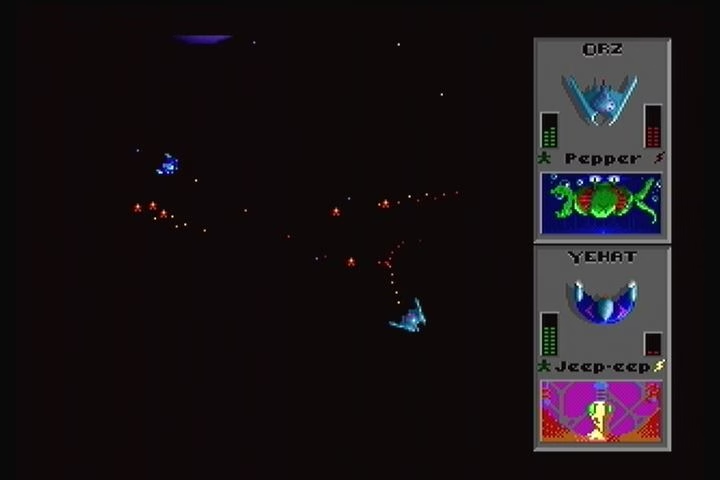
The 3DO battle screens are clean but plainly dated, with small, colorful ship sprites drifting through a mostly black starfield. Bright weapon trails make the action easier to track, and the nearby planet gives each duel a useful visual landmark as ships loop and slingshot around it.
Ship art has personality despite the limited detail. The Super-Melee screen shows an appealingly odd assortment of saucers, spined craft, insect-like shapes, and chunky machines, while the in-battle portraits give each side more character than the tiny sprites can manage alone.
Story
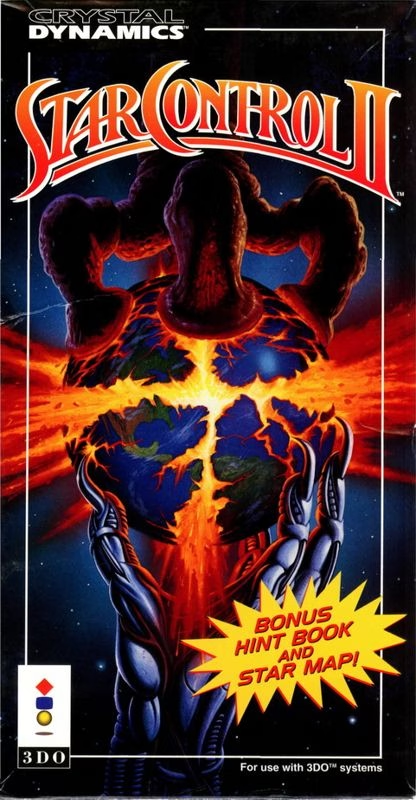
You are not just roaming space for loot. Earth has been reduced to a slave planet under the Ur-Quan, and the task of building a resistance gives every conversation and distant lead a real sense of purpose. The stakes are clear from the outset, but the game wisely makes the route forward depend on what you learn rather than marching you through a straight sequence of missions.
Its best storytelling tool is its alien civilizations. Different species have their own priorities and personalities, so diplomacy becomes a process of listening, choosing responses carefully, and finding the task or leverage that matters to a particular race. You are encouraged to treat dialogue as exploration, not as a formality between fights.
That structure makes the galaxy feel less like a backdrop and more like a web of competing interests. Only a few alliances are necessary to finish the game, which gives you room to find your own path instead of demanding that every thread be completed. Curious, patient gamers will get far more out of it than anyone rushing solely toward the ending.
Overall Experience
Star Control II earns its reputation because it keeps several very different activities connected. Mining matters because it funds travel and ship improvements. Travel matters because it uncovers rumors, artifacts, and potential allies. Allies matter because they expand your options in combat and push the larger struggle forward. Few games make a galaxy feel so invitingly full of possibilities.
It is also willing to make you work. You can lose time to hazardous planets, burn resources on a bad expedition, or hit a wall against an enemy ship before you understand the matchup. That friction will test anyone who wants a streamlined space adventure, but it also gives discoveries weight. Progress feels earned because you pieced it together.
Give it a chance if you enjoy old-school games that reward note-taking, detours, and experimentation as much as reflexes. Its rough edges are inseparable from its ambition, yet the payoff is a space adventure with more curiosity and personality than most games that offer a much smoother ride.


Reviews
There are no reviews yet.