 Retro Replay Retro Gaming History, Reviews & Emulation

Retro Replay Review
Gameplay
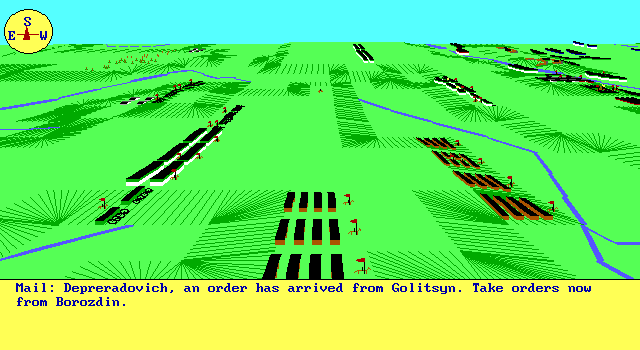
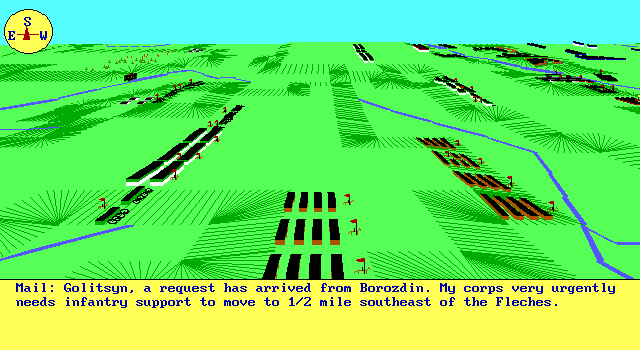
Borodino asks you to think like a commander who cannot simply grab a unit and drag it into position. You view the battle from a 3D perspective and issue orders by typing predefined text commands, combining the relevant commander, place, and time of execution. The first hour can feel forbidding because the game makes you learn its language before you can feel fluent in its battlefield decisions. If that sounds laborious, it probably will be; Borodino puts procedure between you and action on purpose.
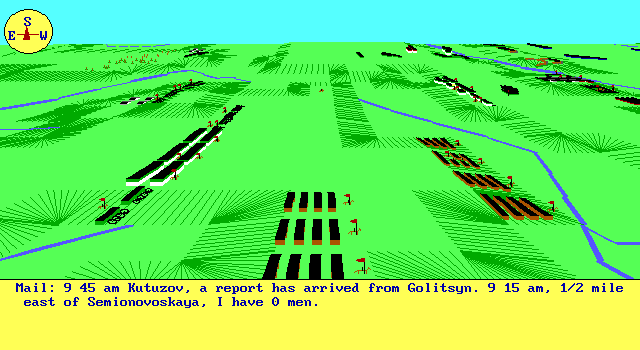
Once the command structure starts to click, though, the delay becomes much of the point. An order is not merely a button press with an immediate result. You send it out, then receive reports from officers on whether it was followed exactly. That creates tension in a way a more immediate strategy interface cannot: you are making a plan, committing to it, and waiting to learn whether the chain of command held up.
The downside is that the same idea can make frustration set in quickly. Typing formal commands is slower and less forgiving than direct control, and the need to specify people, locations, and timing means every instruction carries some mental overhead. Borodino rewards patience and attention, not improvisation. Give it a chance if you enjoy historical strategy as a problem of communication and planning; skip it if you want fast, tactile control over every movement.

Graphics
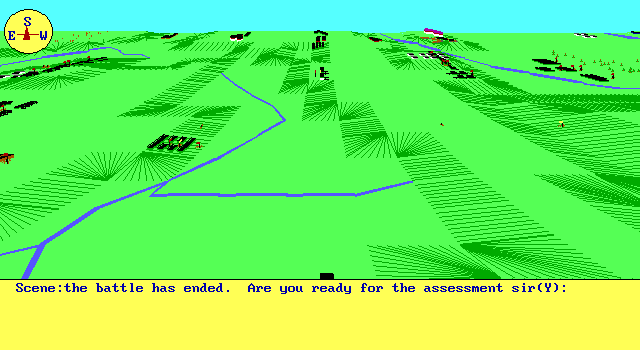
The battlefield is shown from a 3D perspective, giving Borodino a more grounded view than a purely abstract map. Its visuals are there to let you observe the fighting area while you command from a distance, with the typed orders and officer reports taking as much importance as the battlefield view itself.
Story
Borodino returns to the approach of 1989’s Waterloo and moves the action to the village of Borodino on September 7, 1812, during Napoleon’s invasion of Russia. It is historical framing rather than a character-led tale, and that suits the game’s detached command perspective. You are not pushed toward a personal drama; you are placed above a major battle and asked to deal with its scale through orders.
That focus gives the setting weight. The game’s interest lies in putting you in the uncomfortable gap between issuing an instruction and knowing how faithfully it was carried out. Officer reports become the closest thing Borodino has to narrative momentum, because each one tells you whether your intentions survived contact with the command structure.
Anyone hoping for a richly dramatized campaign may find this thin. But for a historical strategy game built around one consequential engagement, the restrained approach is fitting. Borodino treats the battle as the subject, not a backdrop for invented personalities or cinematic detours.
Overall Experience
Borodino is a demanding and distinctive strategy simulation whose strongest idea is also the reason it remains a niche taste. Typing orders to named commanders for named places at specified times makes you work for every decision. That can feel archaic and cumbersome, yet it also creates a genuine sense of command that more convenient interfaces often smooth away.
The payoff is worth it when you stop fighting the input method and begin planning around it. Reports from officers turn execution into an uncertainty rather than a certainty, so success feels earned through foresight instead of mere speed. The game is at its best when you accept that you are directing a battle through a chain of command, not personally steering every element on the field.
At 6.8, Borodino lands as a respectable but specialized follow-up to Waterloo. It is worth your time if you can enjoy an old-school historical simulation that demands careful wording, patience, and a tolerance for delayed feedback. Most strategy fans will find its interface a hurdle; the right kind of history-minded player may find that hurdle inseparable from its charm.


Reviews
There are no reviews yet.