 Retro Replay Retro Gaming History, Reviews & Emulation
Retro Replay Review
Gameplay
Gettysburg begins with a useful shift in mindset: you are not expected to micromanage a battlefield by grabbing units and pushing them around. Instead, you command one side of the Battle of Gettysburg—Union or Confederate—from a raised battlefield view, then send instructions through predefined text commands. The first hour is spent learning to phrase orders with the right commander, place, and time of execution. That can feel stiff at first, especially if you arrive expecting the direct manipulation common to strategy games.
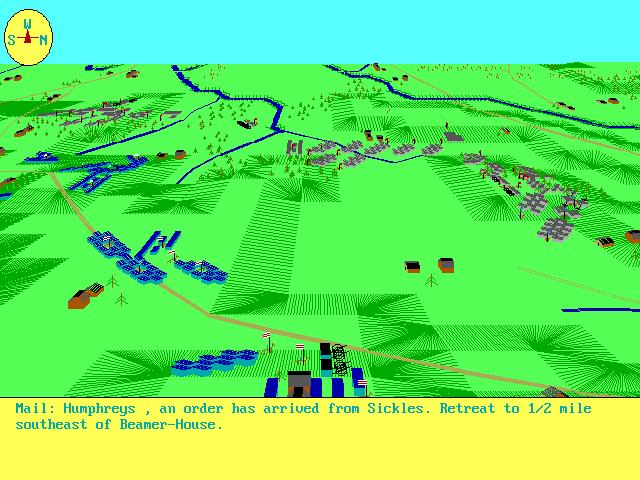
Give it some patience, though, and the command system starts to make sense as more than a period quirk. You are forming an intention, putting it into an order, and waiting to hear back from officers. Reports tell you whether those orders were carried out exactly, making every instruction feel like something that has to survive interpretation rather than an instant button press. That distance is the game’s strongest idea. It asks you to plan ahead and accept that command is not the same thing as perfect control.
There is real friction here. Typing structured orders is slower than acting through a straightforward interface, and a bad or poorly considered instruction is not rescued by quick reflexes. Yet that same restraint gives the battle a thoughtful pace. You can play against the computer, take either command, let the computer run both armies, or play with another person. The two-player option is especially fitting, since the game’s careful, order-driven pace favors deliberate opponents over frantic execution.
Graphics
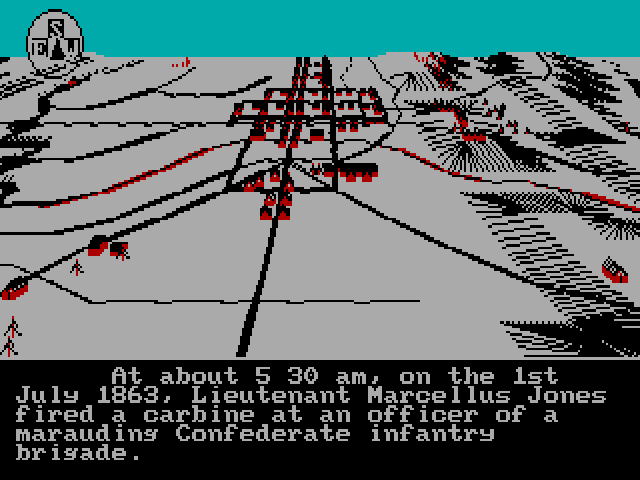
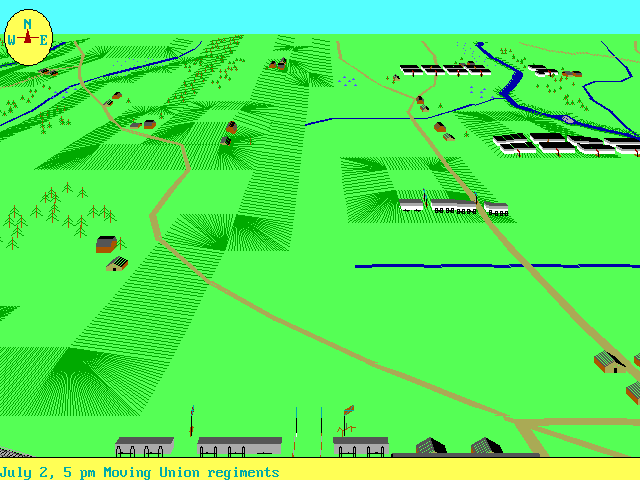
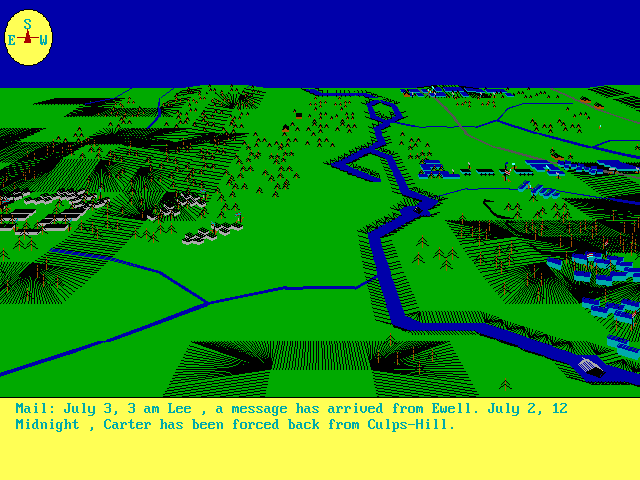
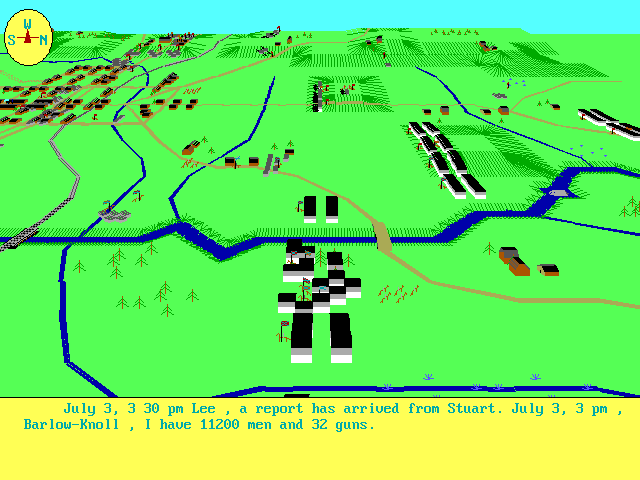
The battlefield is shown from a 3D, angled overhead perspective. That view keeps your attention on the layout of the fighting area and the positions you are trying to command, rather than putting you at ground level. It is functional war-room viewing: you survey the battle, issue instructions, then rely on officer reports to learn how closely events matched your plan.
Story
This is not a character-led Civil War drama. Its story is the Battle of Gettysburg itself, fought across July 1 through 3, 1863, and framed as one of the war’s bloodiest turning points. Choosing Union or Confederate command gives the same historical conflict two different responsibilities, with your decisions determining how you engage with the battle rather than sending you through a scripted adventure.
The strongest narrative texture comes from the gap between an order and its execution. Officer reports are not decorative flavor; they are how the game tells you whether your command translated cleanly into action. That creates a restrained but effective sense of uncertainty, because your role is to direct the battle through other people instead of treating the entire army as an extension of a cursor.
Anyone after dramatic scenes or a heavily written campaign will find the historical framing sparse. Gettysburg puts its energy into the tension of command, not into personal stories. For a player who enjoys history as a problem to be studied and tested, that is enough: the battle’s significance gives the decisions weight without burying them in exposition.
Overall Experience
Gettysburg is a good wargame with a very specific temperament. It wants you to slow down, consider what an order actually says, and live with the fact that commanding an army is indirect. The payoff is not flashy action; it is the satisfaction of seeing a plan communicated properly and understanding where it failed when it did not.
Its age shows most clearly in the text-command interface, which is both the central attraction and the likely deal-breaker. If you enjoy old-school simulations that make you meet them on their own terms, the interface becomes a focused tactical language. If you need immediate control and rapid feedback, the same system can turn an interesting historical battle into an exercise in patience.
At a 7, Gettysburg earns its recommendation for dedicated historical strategy fans. Play it for the unusual act of giving orders through commanders and reading the consequences in their reports, not for a fast or effortless retelling of Gettysburg. It is demanding, a little austere, and genuinely distinctive when its command structure clicks.


Reviews
There are no reviews yet.