 Retro Replay Retro Replay gaming reviews, news, emulation, geek stuff and more!
Retro Replay Review
Gameplay
The first hour is about learning to think like the leader of a very small, vulnerable force. You are not simply marching toward La Paz; you are deciding whether the group can afford to move, whether it needs rest, and whether spending time training or scouting is worth the risk of standing still. That pressure gives the campaign its character.
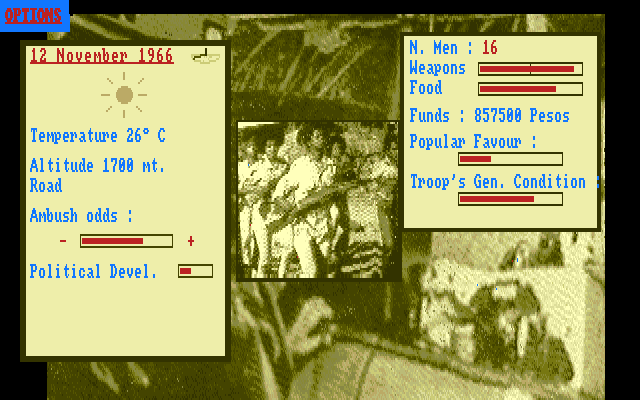
Food is the system that ties everything together. You can buy supplies in villages or hunt, with hunting success dependent on the region, and rationing stretches a dwindling stock at the cost of combat performance. It is a straightforward trade-off, but a nasty one: the choice that keeps the group alive today can make an attack tomorrow much harder. When the campaign clicks, every map consultation feels less like busywork and more like a decision with consequences.
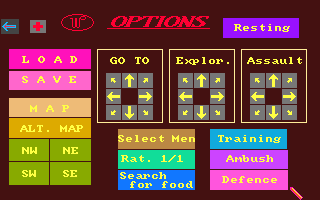
The strategy is largely menu driven, so patience matters. Defending improves the odds when government forces attack, and scouts offer useful caution before you commit to a route, but this is not a game built around lavish battlefield maneuvering. It is about managing a precarious expedition. If you enjoy old-school strategy where planning, supplies, and bad odds do most of the talking, there is real tension here.
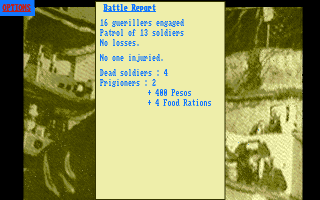
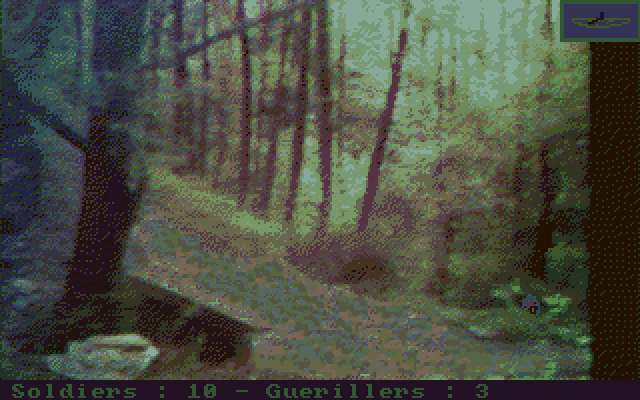
Ambushes add the game’s oddest change of pace. They can be resolved automatically, or, when Guevara leads one, played as a first-person shooting sequence in which you move a crosshair and fire on enemies as they pop out. The switch is memorable, but it sits apart from the measured campaign game rather than deepening its strategic decisions. Automatic resolution may be the better fit if you are invested in the larger campaign rhythm.
Graphics
Most of the game is built around menus and maps, with digitised pictures breaking up the interface. The first-person ambush scenes replace that view with a crosshair aimed at enemies appearing on screen, making them visually distinct from the rest of the game even if they are a simple diversion.
Story
Ché: Guerilla in Bolivia places you in the role of Ché Guevara during the Bolivian civil war of 1966 and 1967, with La Paz as the objective. The story is expressed through the campaign situation rather than through a heavily narrated drama: a small revolutionary group must cross difficult ground, sustain itself, and survive pressure from government troops.
That framing gives mundane decisions some weight. Buying food in a village, choosing where to travel, or cutting rations is not merely an abstract resource exercise when the entire effort depends on keeping fifteen people functional. The game’s historical subject makes the stakes feel more grounded than a generic conquest scenario.
Still, do not come expecting a richly told biography or a dramatic sequence of scripted events. The narrative payoff comes from the campaign you manage: whether your group reaches its goal through disciplined preparation or unravels under hunger and conflict. It is a spare approach, but it matches the game’s severe, operational focus.
Overall Experience
This is a fascinatingly austere strategy game. Its best quality is the way simple options—rest, move, train, defend, scout, hunt, buy, ration—form a web of uncomfortable decisions. You feel the fragility of the expedition, and that is more compelling than the basic menu format initially suggests.
Frustration can set in if you want detailed battlefield tactics or a brisk pace. Much of the work happens through choices in menus, while combat may resolve without your direct involvement. The first-person ambush option supplies a burst of action, yet it does not turn the game into a more rounded combat experience.
Give it a chance if you can appreciate historical strategy built around logistics and endurance, and if the idea of nursing a tiny force across Bolivia sounds absorbing rather than laborious. The payoff is a taut campaign of resource pressure and calculated risk. For everyone else, its period-specific interface and limited action may feel like a long march with too little variety.


Reviews
There are no reviews yet.