 Retro Replay Retro Gaming History, Reviews & Emulation
Retro Replay Review
Gameplay
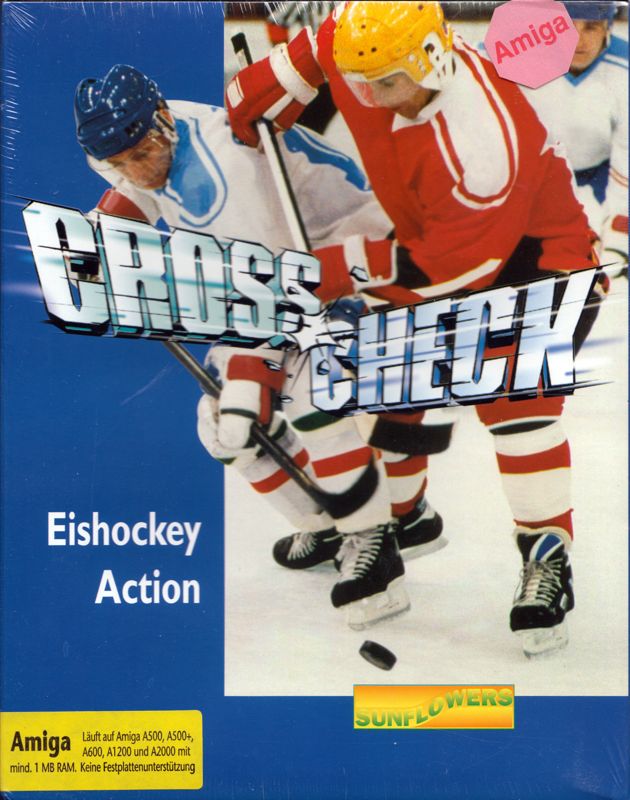
CrossCheck is most convincing when the puck is loose and both sides are scrambling for it. The top-down viewpoint turns hockey into a quick positioning game: get a skater near the action, win the puck, and turn that small opening into an attack. Since you control whoever is nearest to the puck, you are not carefully directing a single star; you are constantly reacting to where the play is about to go.
That approach makes the first few matches easy to understand but not necessarily easy to master. You can jump into a friendly without much ceremony, while the league gives you a clearer reason to keep playing. Ten national teams are split into two divisions of five, and the teams are not simply interchangeable names: each athlete has three performance-influencing stats. Taking a moment to inspect your lineup matters more once you notice that the roster itself can shape how a match feels.
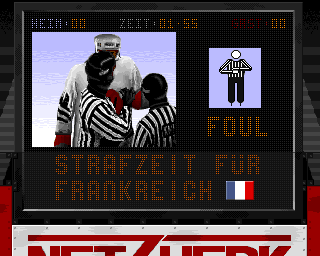
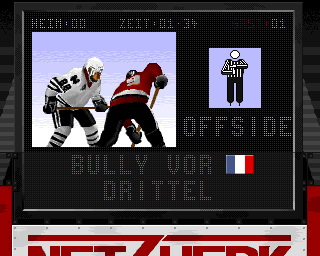
Substitutions and lineup changes keep CrossCheck from being pure button-mashing ice chaos. They are modest management tools, but useful ones, especially if you want to treat a league match differently from a quick exhibition. Match length can be adjusted, and the options concerning fouls and avenging offsets let you tune how rough you want the contest to become. That flexibility is welcome because the core action is so immediate; you can set up a fast, sharp game instead of committing to more hockey than you want.
The trade-off is that nearest-player control can make you feel one step removed from the skater you wish you were controlling. Success comes from anticipating the puck rather than expecting perfect direct command over every player. If that sounds like an interesting challenge, CrossCheck has a lively tactical rhythm. If you want a hockey game centered on individual-player control, its control scheme may become the point of friction.
Graphics
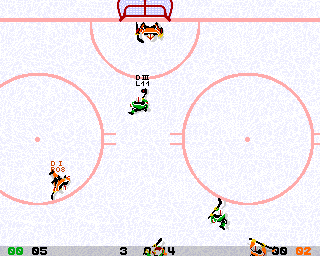
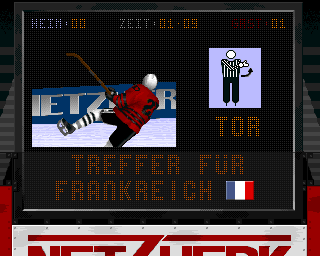
CrossCheck shows the ice from above, putting both teams and the puck into a compact match view. That camera is a practical fit for its quick exchanges, letting you follow the movement of play across the rink without a more dramatic rink-side angle.
Story
There is no story campaign pulling you through CrossCheck. Its context is competition: choose a national team, play a one-off friendly, or take that team into league play.
The league structure supplies the closest thing to a continuing arc. Two divisions of five teams give repeated matches a framework, while lineup choices and player stats make your selected side feel like more than a shirt color.
That stripped-back approach suits a game built for fast matches. You are here to chase results and adjust a hockey team, not to follow characters or dramatic events. It is functional rather than memorable, but it does not get in the way of the sport.
Overall Experience
CrossCheck is a focused Amiga hockey game with a better grasp of match customization and roster management than its straightforward premise initially suggests. The ability to alter match length, decide how the game handles fouls and retaliation, and make changes during play gives you reasons to experiment after the first friendly.
Its strongest quality is also its dividing line. The nearest-puck-player system creates frantic, collective hockey rather than a star-player fantasy, and it rewards reading the flow of the puck. Once that starts to click, the game’s fast pace has a real pull. Before it clicks, the same system can feel as though it is denying you the exact skater you want.
Give CrossCheck a chance if you enjoy old-school sports games that put the match first and let a few well-chosen options shape the rules. It is not a deep simulation, but it has enough team selection, player variation, league structure, and on-ice adjustment to make a compact hockey session worth revisiting. The payoff is modest but genuine: a quick, competitive puck chase with just enough tactical control to reward sticking with it.


Reviews
There are no reviews yet.