 Retro Replay Retro Gaming History, Reviews & Emulation
Retro Replay Review
Gameplay
Ditris opens with no warm-up act. A shaped block drops from the top, you steer it left or right, turn it into position, and immediately begin making the little decisions that define a good falling-block game. Do you lay a piece safely across the bottom, or leave a narrow gap in hope of a bigger line clear later? That familiar tension arrives fast, and the next-piece preview means your best moves come from planning one step ahead rather than merely reacting.
Its scoring rewards clearing multiple lines at once, so tidy play has a real pull. A single completed row can rescue a cluttered board, but setting up several at once is where the score chase becomes exciting. The catch is equally classic: one awkward hole can linger beneath every later block, and the board can go from manageable to doomed when you start stacking too high. When a block can no longer fall without leaving the top of the screen, the run ends; there is no softer interpretation of a bad recovery.
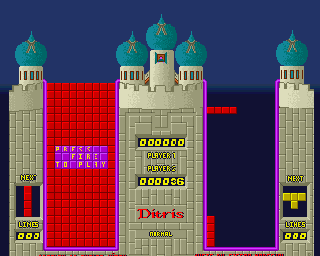
What distinguishes Ditris from a solitary score attack is split-screen multiplayer. Having another person build beside you turns an old routine into a quick competitive session, even without changing the basic rules. It is a modest addition, but a sensible one: the game’s simple controls and immediate objectives make it easy for two people to start a match without explanation.
There is little padding around the central loop, which cuts both ways. If you want new twists layered onto the falling-block formula, Ditris will feel extremely plain. If you want a direct test of placement, rotation, foresight, and nerve, its refusal to complicate matters is part of the charm.
Graphics
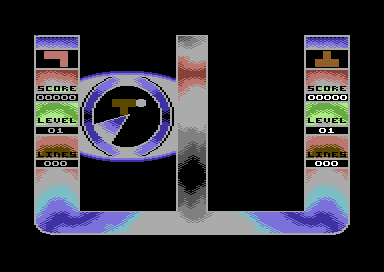
The action is shown from the side-view playfield, with differently shaped blocks descending from the top toward the growing stack below. A separate preview area shows the next block, keeping the important information close at hand while you decide where the current piece belongs. In split-screen play, each competitor gets a board, making the race easy to follow at a glance.
Story
Ditris does not build a story around its puzzle matches. Your “plot” is the board in front of you: a clean base, a looming mistake, and the chance to erase a dangerous stretch of stacked blocks before it reaches the top.
That absence of narrative is not a problem for this kind of game. The pressure comes from the changing shape of the pile and the knowledge that every careless placement can become a problem several pieces later.
As a result, the memorable moments are personal rather than scripted. You remember the line clear that saved a run, the piece that arrived at exactly the wrong time, or the round where a friend kept their board under control while yours collapsed.
Overall Experience
Ditris is an unapologetically straight Tetris variant. Its best quality is that it understands the original loop needs very little help: falling pieces, line clears, a next-block preview, mounting danger, and a score worth improving. The game gets to that loop quickly and stays there.
That focus also defines the limitation. Beyond split-screen multiplayer, there are no gameplay additions to freshen the formula, so long sessions depend entirely on how much you enjoy traditional falling-block play. The frustration is the familiar, earned kind: you know why the stack is ugly, and you know the next few pieces may not forgive you for it.
Give Ditris a chance if you want a clean, no-nonsense puzzle game for a quick solo score run or a shared session with someone nearby. The payoff is not novelty; it is the durable satisfaction of turning a bad board into a good one, then trying to do it again with a higher score.



Reviews
There are no reviews yet.