 Retro Replay Retro Gaming History, Reviews & Emulation
Retro Replay Review
Gameplay
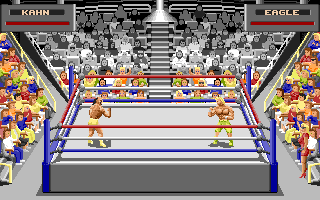
The first few minutes of ICW Wrestling can feel more like a joystick experiment than a wrestling match. You choose Lance DoGood, Ivan Trotsky, or Kai-Leung Kahn, then head into a three-fight competition with The Bruiser waiting at the end. The immediate challenge is understanding that the game does not want you to treat every moment alike: boxing and wrestling are separate modes, and success depends on using each at the right time.
Boxing is the workmanlike part of the bout. You use its standard attacks to reduce the other wrestler’s energy, then switch your thinking once they are vulnerable. Wrestling moves such as suplexes and powerslams are the reward for doing that preparatory work rather than blindly trying for high-impact offense from the opening bell. When the rhythm clicks, ICW Wrestling has a decent little push-and-pull: soften someone up, look for your moment, then go for a proper wrestling move.
That structure gives the game more purpose than a button-mashing brawl, but it also leaves little room for surprise. The roster is tiny, only three wrestlers are playable, and the whole campaign is built around three fights. Repeating the same basic process can become frustrating once you have grasped the intended approach, because there simply is not much more to uncover. Still, if you enjoy learning old joystick-driven systems, the two-mode design is the reason to stick with it for a while.
Graphics
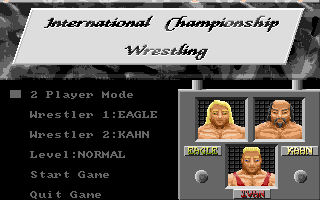
ICW Wrestling centers its action on fictional ring competitors—Lance DoGood, Ivan Trotsky, Kai-Leung Kahn, and the imposing final opponent, The Bruiser. The limited cast means the visuals have to carry the personality of those individual combatants rather than a large promotion full of varied faces.
Story
There is no elaborate wrestling-world drama here. ICW Wrestling gives you a direct competitive frame: select a fighter, win three bouts, and reach The Bruiser as the final obstacle. That is enough to create a clear finish line, even if it never turns the tournament into a larger tale.
The wrestlers’ names do much of the character work. Lance DoGood, Ivan Trotsky, and Kai-Leung Kahn immediately sound like deliberately broad wrestling personas, while “The Bruiser” is an appropriately blunt name for the man positioned as the last test. It is lightweight, but the game does not waste time pretending to be anything else.
That stripped-back setup suits a game focused on individual matches. You are not here to follow rivalries or make choices between narrative branches; you are here to clear the bracket. The final-fight framing at least gives your wins a destination and makes the short competition feel more purposeful than a disconnected sequence of exhibition matches.
Overall Experience
ICW Wrestling has one respectable idea at its center: boxing is not just another set of attacks, but the route to making an opponent vulnerable enough for wrestling offense. For a 1989 Amiga wrestling game, that distinction gives the fights a little tactical shape. You can feel the intended escalation from wearing somebody down to landing a more decisive throw.
Its problem is scale. Four wrestlers, three fights, and a single final boss leave the experience thin, while the small number of available competitors makes it hard for the tournament to feel like a living wrestling card. Once you understand how boxing and wrestling fit together, the game has already shown most of its hand.
At 4.4, this is difficult to recommend beyond curiosity value. Give it a chance if you have affection for early Amiga sports games and want to see a rudimentary attempt at making ring psychology matter. Everyone else will likely find that the best idea arrives quickly, then has too little material around it to turn a brief bout into a lasting main event.


Reviews
There are no reviews yet.