 Retro Replay Retro Gaming History, Reviews & Emulation

Retro Replay Review
Gameplay
The first few turns feel reassuringly familiar. You place an alien beside the existing position, trap hostile aliens between your new piece and another of your own, and flip the line. If you know Othello, Kengi wastes no time teaching you a new language; the basic act of finding brackets remains the heart of every decision.
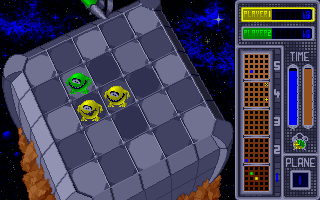
Then the five boards begin to matter. A move cannot be judged only by the number of aliens it converts on the current 8×8 grid, because the same placement logic carries through the boards in vertical order. That turns ordinary-looking moves into commitments. A generous flip can be a poor choice if it leaves an inviting response on another board, and the game rewards stopping to inspect the larger arrangement before acting.
There is a real tension in the fact that only one board is shown at full size. The panel on the right offers miniature previews of the others, which helps, but it does not remove the mental bookkeeping. That friction is part of Kengi’s challenge rather than a thrill in itself. If you enjoy mapping several consequences before you commit, the expanded structure starts to click. If you want Othello as a fast, clean head-to-head game, it can feel like the game is making a simple rule set harder to read.
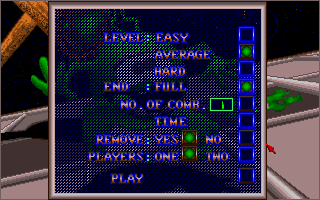
The three difficulty levels are welcome, and the optional per-turn time limit lets you decide whether this is a measured puzzle or a pressure game. Leave the timer off while learning how the boards interact; turn it on later if you want to force sharper instincts. Kengi has enough variation to keep an Othello veteran thinking, but its extra complexity is more cerebral than immediately elegant.
Graphics
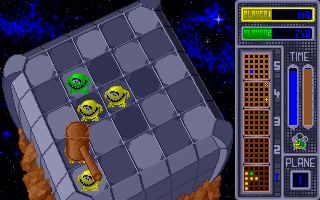
Kengi replaces Othello stones with little aliens, giving its boards a more playful look than the traditional black-and-white discs. One board occupies the main view, while the panel on the right holds small previews of the other four and keeps the multi-board match within reach.
Story
There is no story campaign pulling you from match to match. Kengi is built around abstract board-game competition, and the aliens serve as a theme for the pieces rather than characters with a larger conflict to follow.
That is not a problem for this kind of game, but it does make the tactical hook carry everything. You sit down for the satisfaction of turning a line and wrestling with five connected boards, not for a reason to care who these aliens are or where they came from.
As a result, the game lives or dies on your appetite for repeated matches. The lack of narrative clutter keeps the focus clean, yet it also means there is little to soften the blow when a complicated position starts to feel like work.
Overall Experience
Kengi is a respectable Othello mutation that earns its place by changing the shape of your thinking rather than rewriting the rules. The five-board idea creates more chances for foresight, traps, and regret, and that makes a familiar game feel more substantial once you understand how the boards influence one another.
Its biggest drawback is also its defining trait: you must constantly consult small board previews while playing on only one full board. That can make the game feel less immediate than standard Othello, especially early on, when you are still learning which consequences matter. Patience is required before the puzzle becomes satisfying.
Give Kengi a chance if regular Othello has become too comfortable and you want a denser solo challenge against adjustable opposition. Skip it if you mainly value the original’s instant clarity and brisk flow. For the right strategy fan, the payoff is a thoughtful variation with enough moving parts to make every placement worth a second look.


Reviews
There are no reviews yet.