 Retro Replay Retro Replay gaming reviews, news, emulation, geek stuff and more!
Retro Replay Review
Gameplay
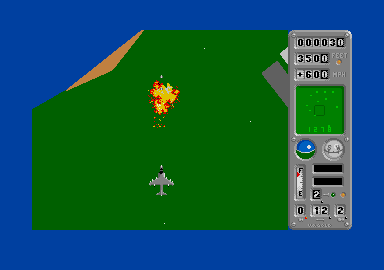
The first few minutes of Operation Harrier can feel like learning to fly while someone spins the table beneath your hands. Your Harrier stays at the center of the action as the polygonal ground rotates when you turn, so conventional top-down shooter instincts do not immediately apply. Once you stop fighting that viewpoint, though, it becomes the game’s strongest idea. Turning toward a target has a physical, committed feel, and lining up an attack run carries more tension than simply drifting across a scrolling map.
This is not a mindless blast-fest. Missions ask you to destroy particular targets, such as a cruiser or power plant, or defend an airfield from enemy fighters. That structure gives each sortie a job beyond staying alive, and the pre-mission weapon selection matters. Air-to-air missiles, air-to-ground missiles, and two bomb types let you prepare for the objective instead of relying entirely on the unlimited forward cannon. Choosing poorly can leave you doing more work than necessary, while choosing well makes a mission feel satisfyingly controlled.
Altitude adds another useful layer to the Harrier fantasy. You are not only steering and firing; you are managing your position in the airspace while trying to locate and engage the right threat. The map and radar are essential rather than decorative. Use them early and often, because wandering around looking for an objective burns the resource that most often creates pressure: fuel.
That fuel limit gives the missions a welcome edge, although it can also be where frustration sets in. Some sorties allow in-air refueling, and friendly bases can sometimes offer a mid-mission landing for supplies. Those opportunities reward restraint and route planning. The Harrier can take a few hits and is repaired and refueled after a completed mission, so the game is demanding without treating every mistake as instant disaster. Still, you need to stay focused; careless navigation can be as costly as poor shooting.
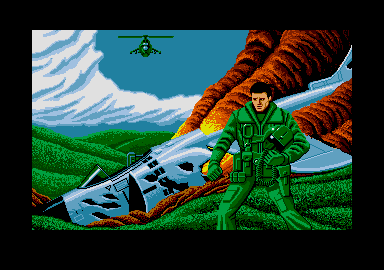
Graphics
The game’s standout image is its top-down Harrier centered over a polygonally rendered landscape that rotates around the aircraft as you steer. It is an unusual look for a 1990 action game, and that motion is tightly tied to how you judge direction during combat. Radar and map displays give you the practical information needed to make sense of the surrounding airspace.
Story
Operation Harrier is built around military sorties rather than a character-driven tale. You fly Britain’s famous VTOL aircraft through a sequence of operations with concrete objectives: sink an enemy cruiser, destroy a power plant, or keep hostile fighters away from an airfield. The premise gets out of the way quickly and lets the mission briefing define the stakes.
That spare approach suits the game. You are not asked to invest in a dramatic campaign; you are asked to take an armed Harrier, assess the assigned task, and come home with enough fuel and airframe left to prepare for the next one. The changing objectives do more for the sense of progression than any elaborate narrative would.
The result is a straightforward combat-fiction frame that works because it makes each loadout and flight path feel purposeful. A bomber-oriented mission and a fighter-defense mission naturally ask for different priorities, so the story is told through the changing demands of the operation rather than through lengthy exposition.
Overall Experience
Operation Harrier is a curious, deliberate aviation shooter whose central camera trick asks for an adjustment period but earns its place. The rotating terrain can initially make orientation awkward, especially if you arrive expecting a conventional top-down game. Give it an hour, however, and the interaction between turning, altitude, radar use, target selection, and fuel management begins to click.
Its best moments come when a mission becomes a small plan you are actively trying to hold together: arm the aircraft for the job, find the objective, make your pass, and decide whether you can press on or need supplies. The ability to survive several hits softens the harsher edges, while limited fuel prevents you from lazily circling until every problem disappears.
At 6.7, it lands as a solid but specialized recommendation. You should give it a chance if you enjoy older action games that make navigation and preparation part of the challenge, and if the idea of piloting a Harrier through objective-based sorties sounds more exciting than chasing a high score. Anyone wanting immediate, frictionless arcade shooting may find the rotating viewpoint and resource pressure more bothersome than thrilling, but there is real tactical texture here for the patient pilot.


Reviews
There are no reviews yet.