 Retro Replay Retro Gaming History, Reviews & Emulation
Retro Replay Review
Gameplay
Skyblaster starts as a brisk helicopter shooting game, then reveals why it is more interesting than a straightforward high-score chase. Enemies do not merely fly or roll toward you; they can threaten your home bases as well. That small strategic wrinkle changes the mood of every encounter. It is hard to relax when an enemy base is still standing and hostile units are moving across the map toward something you need to protect.
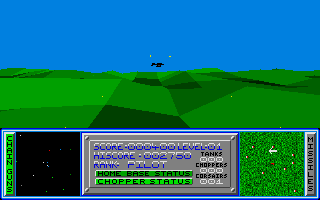
The radar is the heart of that tension. Different colors distinguish the faster and slower versions of each enemy type, so you need to keep checking it rather than fixating on the action in front of you. A fast threat heading for a base can demand attention before a slow tank close to your helicopter does. That creates a satisfying, slightly frazzled rhythm of scanning, intercepting, and deciding when an attack run is worth the risk.
Its weapons encourage sensible priorities. Missiles are the stronger answer to enemy bases, while the machine gun is better for hitting moving enemy vehicles. You are not juggling a huge arsenal, but the division is clear enough to make your decisions matter. Restoring your helicopter at friendly bases, and restoring those bases by destroying enemy installations, gives the back-and-forth a real sense of recovery rather than turning damage into a one-way slide toward failure.
The dual-control option is an especially smart fit. With two players, or two joysticks, one person can fly while the other directs the weapons; alternatively, one player can divide those jobs between both controllers. That is a focused twist on the usual shooter arrangement, and it should make coordinated base attacks and emergency defense much more engaging. The 20 difficulty settings also let you choose whether you want a manageable patrol or a punishing radar-monitoring test.
Graphics
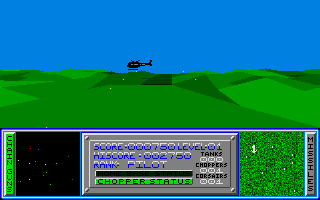
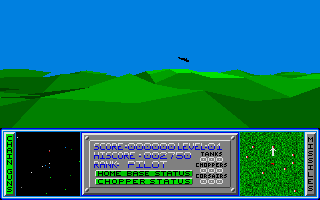
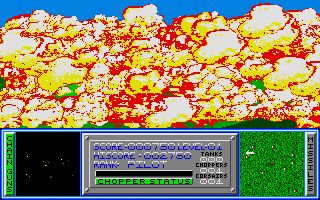
You fly over a filled-polygon 3D landscape, watching helicopters, tanks, and planes move through a world that still plays on a fundamentally flat plane. The view allows rotation around a single axis, so you can turn across the battlefield but cannot pitch upward or downward or roll the horizon. It is a restrained kind of 3D, yet it gives the fighting a more spatial feel than a purely top-down battlefield.
Story
There is no elaborate narrative carrying Skyblaster from one battle to the next. Its story is the immediate military situation: enemy forces are attacking, their bases need to be destroyed, and your own bases must survive.
That bare setup works because the objectives create their own drama. A base under attack gives you a concrete reason to break off an offensive run, while an enemy installation becomes more than scenery because destroying it helps restore your side’s defenses.
Do not come here for characters or plot turns. Come for a clean conflict that feeds directly into the action, where every decision has a recognizable purpose: protect your territory, weaken theirs, and stay alive long enough to do both.
Overall Experience
Skyblaster is at its best when the battlefield becomes crowded with competing priorities. You may be lining up missiles on an enemy base, spot a fast contact on the radar, and have to abandon the attack to save a friendly installation. That push and pull gives the game a sharper edge than a shooter built entirely around clearing whatever appears on screen.
The limitation is also part of its character: this is a focused game, built around helicopter combat, radar awareness, two weapon roles, and base defense rather than a constantly expanding set of ideas. If that loop clicks, the changing speed of enemy variants and broad difficulty selection should keep it demanding. If you want elaborate progression or a story campaign, it will feel spare.
Give Skyblaster a chance if you enjoy older shooters that ask you to think while you shoot. The payoff is not in spectacle; it is in learning to read the radar, use each weapon with purpose, and rescue a defense that looked lost moments earlier. The two-player or two-joystick control option is the standout reason to revisit it with company.


Reviews
There are no reviews yet.