 Retro Replay Retro Gaming History, Reviews & Emulation
Retro Replay Review
Gameplay
Steel begins with the kind of clean arcade objective that makes you want to push farther into its ship: find eight cartridges and bring them back to the main control panel. The wrinkle is that you can carry only three at once, so this is not just a straight scavenger hunt. Before long, you are thinking about return trips, which rooms are safe enough to revisit, and whether it is smarter to bank what you have than risk another screen full of hostile robots.
The ship is built from fixed, non-scrolling screens, and that gives exploration a brisk, room-by-room rhythm. You move through a maze rather than across a grand continuous world, learning where danger tends to sit and where a route leads after a few wrong turns. That structure can be satisfying once the layout starts sticking in your head, but it also means early progress depends on patience. If you dislike mapping spaces mentally or retracing your steps, Steel can turn into a tiring search.
Combat is direct: blast robots with your laser and avoid contact, because collisions drain energy. The pressure comes from the fact that energy stations are not free. Refilling keeps you alive, but it costs high-score points, forcing an old-fashioned risk calculation between survival and a cleaner run. That is a good fit for score-minded arcade fans, though anyone playing only for forward momentum may find the penalty irritating.
Some terminals interrupt the wandering with a timed shooting challenge: destroy a wall while dodging incoming bullets. These moments add urgency and ask for sharper aim than the ship navigation does. They are not a deep change of pace, but they do prevent the cartridge hunt from becoming completely repetitive.
Graphics
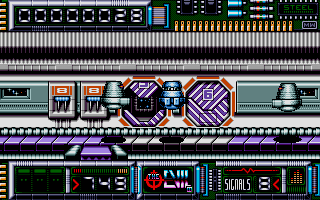
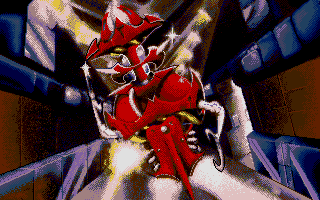
Steel uses side-view, flip-screen rooms inside a spaceship maze. The most important thing the visuals do is separate the ship into discrete areas you can learn and revisit while keeping enemy robots and laser fire in view during confrontations.
Story
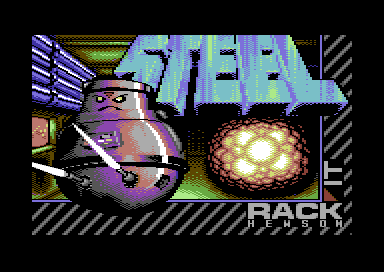
The setup is pure late-1980s sci-fi pulp: an advanced spaceship runs entirely on robots, the robots have gone out of control, and you board the vessel to shut down its security system. Your robot disguise is a nice hook, even if it offers no safety once the shooting begins.
There is not much narrative weight beyond that mission, and Steel does not need much to get moving. The story mainly gives its maze, cartridges, terminals, and attacking machines a shared purpose. You are not exploring for lore; you are trying to regain control of a dangerous ship before its defenses wear you down.
That narrow focus works better if you treat Steel as an arcade mission rather than a character-driven sci-fi adventure. Its stakes are immediate and mechanical: carry the cartridges, survive the robot resistance, and reach the control panel often enough to make the whole operation count.
Overall Experience
Steel is a modest but focused maze shooter whose best moments come from turning unfamiliar rooms into a workable route. The first hour is likely to be more about getting lost and spending energy than feeling heroic, but there is a genuine pull in gradually understanding how to collect cartridges efficiently while keeping enough power to escape trouble.
Its frustrations are inseparable from its design. Limited carrying capacity means repeated trips, enemy contact punishes careless movement, and healing dents the score you may be trying to protect. For some, that is disciplined arcade tension; for others, it is a lot of friction around a very simple objective.
Give Steel a chance if you enjoy compact 8-bit and 16-bit action games that reward memorization, route planning, and score-conscious play. The payoff is not an elaborate finale or sprawling adventure, but the satisfaction of mastering a hostile little spaceship well enough to finish the job on your own terms.


Reviews
There are no reviews yet.