 Retro Replay Retro Gaming History, Reviews & Emulation
Retro Replay Review
Gameplay
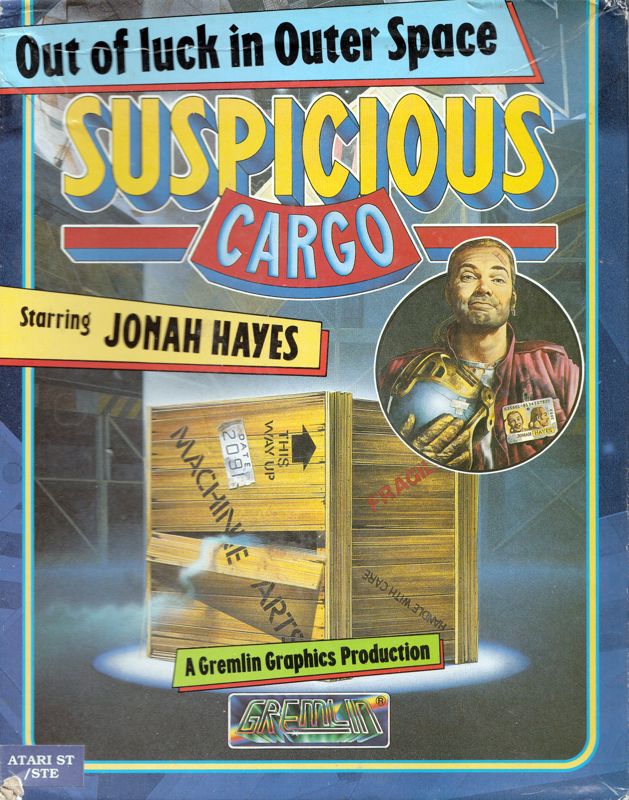
The first hour of Suspicious Cargo pulls you in through its job-gone-wrong setup. Jonah Hayes is not presented as a grand savior; he is a smuggler caught in a corporate conflict and ordered to get a living piece of genetic engineering to Earth. That gives the usual adventure-game business of poking at obstacles a useful sense of urgency. You are not wandering just to see what the game will let you touch. You are trying to keep a dangerous delivery moving while rival companies interfere.
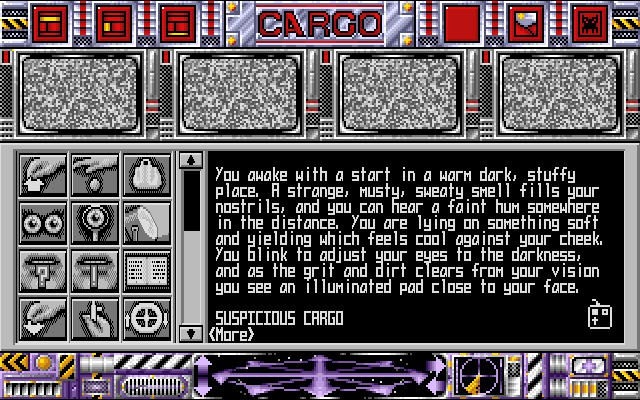
Its most welcoming decision is the graphical command interface. Rather than demanding that you discover and type the exact verb a designer had in mind, it lets you construct commands by clicking symbols. Conversations are similarly direct: choose from a list of topics instead of guessing what wording will advance an exchange. You can hide the symbol bars if you prefer the cleaner feel of a pure text adventure, but the default setup makes this far less forbidding than many games of its era.
The puzzles largely come from obstacles between Jonah and Earth, including sabotage by competing corporations. That focus helps the game feel cohesive: problems arise from the journey and the people invested in stopping it, rather than arriving as detached brainteasers. A ship map also allows quick travel, which is especially welcome in an adventure built around navigating a spacecraft. It keeps routine movement from taking over the experience.
There are action interruptions, such as opening a lock or landing on a moon, but their optional status is a smart compromise. If you want a little extra tension, they are there. If you are here for the writing and puzzle-solving, they do not get to hold the story hostage. The result is a game that understands its strongest material is the adventure itself, not proving your reflexes.
Graphics
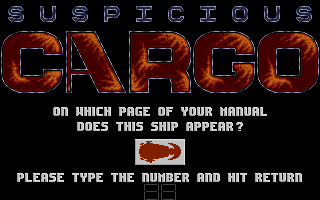
Suspicious Cargo is chiefly text-led, but it can open full-screen illustrations for key situations. Those images give the journey occasional visual punctuation rather than replacing the prose-driven format. The interface is the more important part of what you see day to day: symbol bars handle actions, while the ship map gives you a quick way to move around.
Story
The setting is blunt, bleak, and effective. Humanity is living under the shadow of a deadly virus, and the sole antidote has become something corporations exploit like an addictive drug. With no meaningful oversight, those companies have escalated into open armed conflict. It is a sharp foundation for a sci-fi adventure because every inconvenience on Jonah’s route can plausibly feel tied to a larger, merciless system.
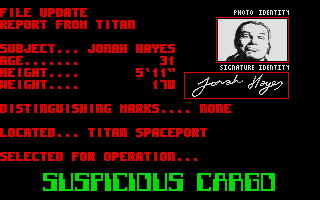
Jonah is a good fit for that world precisely because he begins outside its grand struggle. He has no reason to be a corporate warrior until one corporation force-employs him. Making the cargo a living genetically engineered product adds an uncomfortable edge to the assignment: this is not simply contraband in a crate. The story has the kind of pulpy, cynical premise that invites you to keep going just to see how ugly the delivery becomes.
That premise also gives the sabotage a stronger purpose than standard adventure-game obstruction. Rival companies are not merely present to pad out a voyage; they have a direct reason to interfere with Jonah’s cargo reaching Earth. If you enjoy science fiction where commercial power has curdled into outright cruelty, Suspicious Cargo has a compelling lane of its own.
Overall Experience
Suspicious Cargo earns its reputation as a good, approachable piece of early-’90s interactive fiction. The interface does not erase the need to think, but it removes much of the friction that can make older text adventures feel like an argument with a parser. Once you settle into its rhythm, the voyage becomes a focused chain of travel problems, corporate interference, and conversation-driven progress.
Its biggest strength is that the mechanics and premise point in the same direction. You are a smuggler trying to complete a coerced run through a hostile corporate future, and the obstacles consistently feed that pressure. The optional action moments are a sensible extra rather than a threat to the puzzle adventure at the center.
Give it a chance if you like classic science-fiction adventures and want one that respects your time enough to offer clickable commands, topic lists, and quick ship travel. It will especially suit you if you enjoy reading your way through a tense journey rather than chasing constant action. The payoff is a compact, cynical spacefaring adventure with enough user-friendly thinking to make its old-school format easier to enjoy.

Reviews
There are no reviews yet.