 Retro Replay Retro Gaming History, Reviews & Emulation
Retro Replay Review
Gameplay
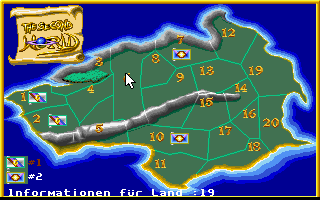
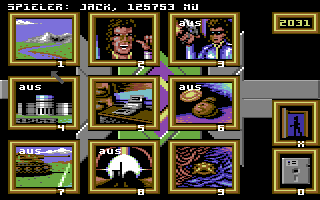
The first hour is about getting comfortable with how many levers The Second World puts in front of you. Each turn covers three months, and you are not simply moving troops toward a border: you are hiring agents, trading goods, dealing in stocks, setting tax levels, and deciding where buildings such as hospitals and plants belong. It feels closer to running a hostile little state corporation than commanding an army, which is exactly where its character comes from.
What starts to click is the way those decisions feed a country’s numbers. Productivity, prosperity, and death rate are not background trivia when the goal is to control 15 of the 25 countries, eliminate rivals, or build enough victory points through economic and military success. Buying influence can be as important as taking it by force, so a careful player has more than one route to the top. That breadth makes each round worth considering rather than treating it as a routine income collection.
There is also a satisfyingly cruel edge to the competition. Agents can undertake missions including assassinating an opponent, and a killed ruler may be replaced by an available offspring. With four rivals—and the option to put human hands behind all of them—the game is built for grudges, reversals, and trying to wreck somebody’s plans before they become uncatchable.
Frustration will set in if you need strategy games to make their decisions feel immediate. The Second World is explicitly menu-based outside its smaller action sequences, and much of the work is adjusting figures and issuing orders rather than enjoying constant battlefield drama. But if you can settle into its slower rhythm, the amount of economic and political mischief packed into a turn gives it a stronger hook than a simple land-grab game.
Graphics
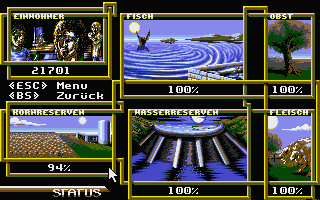
Most of The Second World is seen through menus and country statistics, fitting its numbers-first approach. Smaller action sequences break up that administrative view, but the game’s visual focus is clearly on letting you inspect and alter a nation’s condition rather than lingering on combat imagery.
Story
This is not a story-led science-fiction game so much as a competitive political scenario. Its future setting supplies a world divided into 25 countries and turns you loose to become the dominant force, whether through purchase, force, or a stronger economy.
The useful drama comes from what your match creates. A rival’s ruler can die, an offspring can take over, an agent can interfere, and a peaceful commercial contest can become a war. That gives the game a cold, opportunistic tone: nobody is waiting to hand you a heroic narrative, because you are writing it through expansion and sabotage.
That sparse approach suits the design. You are meant to think about states as assets, rivals as threats, and victory as a matter of leverage. Gamers looking for characters and scripted plot turns will find little to hold onto, but the open-ended rivalry can generate its own memorable stories.
Overall Experience
The Second World is an unusually broad strategy game for its era, and its best quality is that it refuses to make military conquest the only interesting answer. You can cultivate countries, manipulate markets, build infrastructure, and turn to violence when the arithmetic says it is time. That blend gives patient sessions a distinct sense of escalation.
It is not an easy recommendation for everyone. The menu-heavy structure and constant attention to national statistics demand patience, and the smaller action sequences are not the main draw. You need to enjoy planning several turns ahead and accepting that a good move may look like a hospital, a tax change, or a trade rather than an attack.
For a gamer who enjoys Kaiser-style economic strategy but wants more room for espionage, war, and multiplayer rivalry, The Second World is worth the effort. Its payoff is the moment a collection of dry national figures becomes a competitive web of allies, targets, and vulnerable holdings—and you realize every country is another way to win or lose.


Reviews
There are no reviews yet.