 Retro Replay Retro Gaming History, Reviews & Emulation
Retro Replay Review
Gameplay
The first hour asks you to settle into a very particular rhythm: read a substantial block of text, study the accompanying image, and pick from a handful of responses when the story hands you a decision. You play D’Artagnan as he joins Athos, Portos, and Aramis in the race to recover the queen’s necklace, but your involvement is mostly cerebral. This is closer to steering a serialized adventure novel than inhabiting a lively version of seventeenth-century France.
That can work when the game puts a clock on a choice. Time pressure gives the otherwise text-led format a welcome jolt, forcing you to commit rather than endlessly weigh every response. Directional navigation also changes the pace in maze sections, where choosing north, south, east, or west becomes its own problem. Neither approach is deep on its own, yet both break up the reading enough to make progress feel earned.
The rough edge is its all-or-nothing logic: only the correct choice moves the game forward. That makes success satisfying when you have followed the writing closely, but it can also turn a dramatic scene into trial and error when the intended answer is not obvious. Give it a chance if you enjoy old interactive fiction’s stern attitude toward mistakes. Go in expecting to reread and retry, not to improvise your way through a flexible adventure.
Graphics
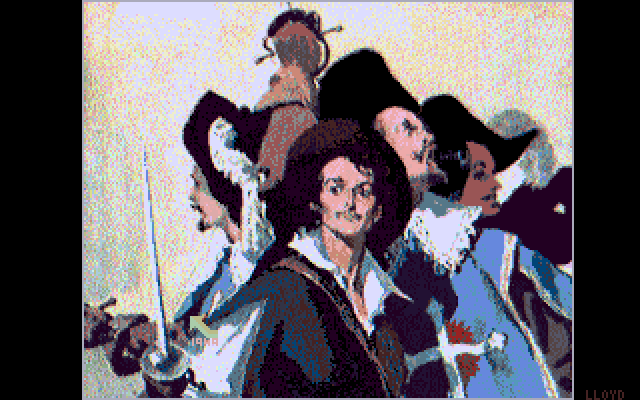
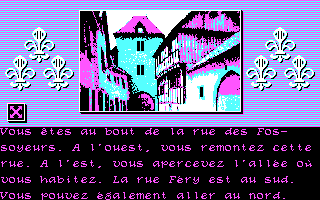
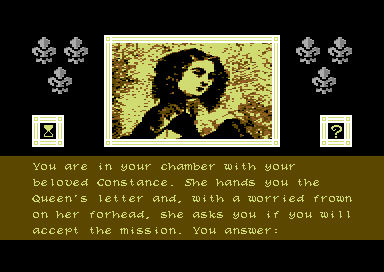
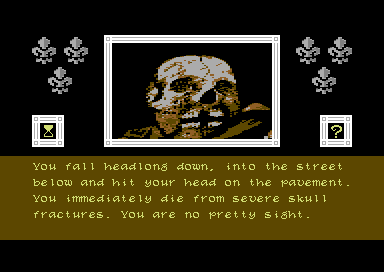
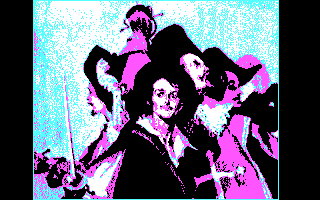
Static pictures accompany the long passages of text, serving as scene illustrations rather than animated action. The view stays rooted in that illustrated, page-by-page format, so the images help place the characters and situations but do not provide the momentum; the writing and your choices have to carry that.
Story
The game has a solid piece of classic intrigue to work with. Anne of Austria has sent her diamond necklace to the Duke of Buckingham, Cardinal Richelieu sees a chance to damage her standing with Louis XIII, and the musketeers must retrieve the jewels before an important ball. It is immediately understandable stakes, with a built-in deadline that suits a choice-driven format.
Playing as D’Artagnan is the right angle for this material. He is the newcomer traveling alongside the established trio, which gives the player a natural place in the group without asking the game to rewrite the novel around a blank-slate hero. Athos, Portos, and Aramis are present as companions in a story whose main burden falls on your decisions.
The adaptation’s commitment to verbose prose is both its strength and limitation. If you came for the political pressure and romantic scandal behind the necklace, there is enough narrative meat to keep you turning pages. If your affection for The Three Musketeers begins with duels and dashing movement, the text-heavy delivery can feel more dutiful than thrilling.
Overall Experience
The Three Musketeers is a narrow recommendation, but not an empty one. It understands that Dumas’s plot is driven by urgent errands, dangerous information, and decisions made before time runs out. When its branching prompts line up with that tension, you can feel like you are helping push a literary adventure toward its crucial deadline.
Its age shows most in the rigid progression. A wrong answer does not become an interesting detour; it is simply a barrier between you and the next page. That structure rewards patience and close reading, while making the game a frustrating fit for anyone who wants an adventure to acknowledge unusual choices or let mistakes create new outcomes.
At a 5.6, this lands as a curiosity for fans of vintage computer adventures and the source novel rather than a broadly essential Musketeers game. If you want another take on the same banner, The Three Musketeers: The Game is a related published game worth comparing. For this 1987 adaptation, bring patience, read carefully, and let the deadline-driven passages do their work.


Reviews
There are no reviews yet.