 Retro Replay Retro Gaming History, Reviews & Emulation
Retro Replay Review
Gameplay
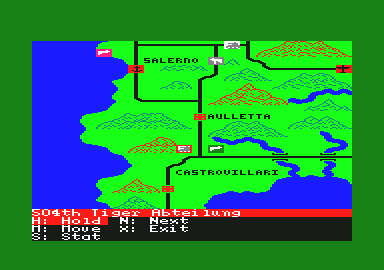
The first turns put the important question plainly: can you turn a landing into a sustainable foothold before the other side closes the gap? Avalanche keeps that question on one scrolling map, which gives the campaign a concentrated feel instead of spreading your attention across a huge war. You spend your time reading the position, preparing orders, and deciding where a limited push is worth the risk.
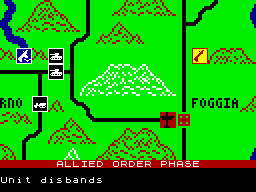
Its turn structure is methodical. Air activity covers reconnaissance and attacks, the order phase handles actions such as movement, and combat then calculates the outcome of engagements. That separation makes you think ahead rather than reacting after every move. Reconnaissance has a natural place in the plan because information arrives before you commit to movement and fighting; combat is the moment when those earlier choices are tested.
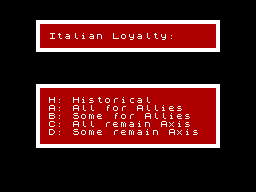
The adjustable command options add real replay value to a scenario with a fixed historical subject. Letting the computer run the Allied side, the German side, or neither means you can approach the map from different angles, while settings around historical circumstances—Italian allegiance among them—can alter the situation you are trying to solve. This is the sort of design that rewards a second attempt because a changed assumption can force a different plan.
Frustration will set in if you want unit counters to tell you exactly what they are at a glance. A tank icon may stand for a division or a brigade, so the symbols are not a consistent scale model of the forces involved. Accept the icons as shorthand for formations rather than literal counters, and the game’s phase-based planning becomes easier to appreciate. Give it a chance if deliberate World War II command decisions matter more to you than quick tactical fireworks.
Graphics
You view the campaign on a single scrolling top-down map, with military units marked by icons. The imagery is functional rather than lavish: tank symbols make the board-game roots obvious, even when their scale can vary from brigade to division. The map-centered view keeps the focus on where formations stand and where the next clash may develop.
Story
Avalanche draws its tension from a real military operation rather than from character drama. The subject is Operation Avalanche, the 1943 Allied landing on Italy’s west coast, and the game stays fixed on that campaign. That narrow framing works in its favor: every decision belongs to the same hard problem of establishing, defending, or crushing the invasion.
The historical options give the scenario some useful uncertainty without abandoning its period focus. Italian forces can have different loyalties depending on the selected circumstances, so history is not merely a label pasted onto a generic map. You are engaging with a situation whose political and military assumptions can shift under your plan.
Do not expect a narrated war story or a cast of personalities. The drama comes from the operational picture: whether reconnaissance is good enough, whether orders create an opening, and whether combat validates the gamble. For a wargame about a specific landing, that is the right kind of story—one written through changing lines and difficult commitments.
Overall Experience
Avalanche: The Struggle for Italy is a focused historical wargame with a pleasingly stern pace. It does not try to cover every front of World War II; it stays with one Italian operation and gets mileage from phases, computer-side choices, and adjustable historical conditions. That concentration makes it easier to settle into the command problem than into a sprawling grand campaign.
Its main compromise is clarity at the unit level. Because identical-looking tank icons can represent formations of different sizes, you need to learn the game’s own shorthand instead of relying on a clean visual scale. That is an old-fashioned inconvenience, but not a deal-breaker if you already enjoy games that expect you to study a map before acting.
For you, the payoff depends on whether planning itself is the attraction. If you enjoy taking reconnaissance, movement, and combat as linked stages of a larger operation, Avalanche offers a compact and replayable trip to 1943 Italy. If you need immediate action or highly literal unit depiction, its patient structure and loose icon scale will feel dry. The right audience will find a purposeful campaign in its narrow battlefield.

Reviews
There are no reviews yet.