 Retro Replay Retro Gaming History, Reviews & Emulation


Retro Replay Review
Gameplay
Chimera starts with a wonderfully unfriendly proposition: you are inside an empty alien spacecraft whose weapons threaten Earth, and all you can do is move around and interact with what you encounter. That limitation is not a flaw; it is the whole source of the game’s tension. With no combat system or long list of commands to hide behind, every decision comes down to whether you understand the room, the object in it, and the item you are carrying.
The ship is arranged as a grid of maze-like rooms, so progress comes from building a mental map and working out how its dangers connect. Food and water are not decorative pickups. They are survival tools, and radiators can rapidly drain your water while you remain in the same room. That creates a useful urgency: you cannot casually linger forever while considering every possibility. When the game’s logic starts clicking, a route through the ship feels earned rather than handed to you.
Its harsher side is that Chimera expects careful observation and a willingness to learn through failure. Electric fences, radiators, and other objects can kill you unless you have the right item, and the correct sequence for the four-stage self-destruct must be discovered and followed. Frustration can set in when a bad interaction costs a run, especially if you were carrying a promising item. Still, the game is at its strongest when you treat each death or setback as a piece of information and return with a better plan.
The scrolling status message at the bottom is more important than it first appears. Watch it. In a game this stripped down, feedback about your condition and surroundings is valuable evidence. Chimera rewards note-taking, deliberate routes, and patience far more than reflexes, making it a good fit if you enjoy old-school puzzle adventures that ask you to pay attention rather than merely push forward.

Graphics
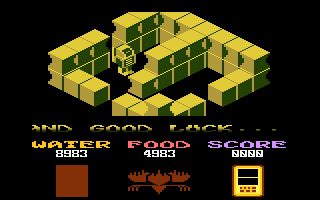
The action is shown in isometric rooms aboard the alien craft, with the camera framing each area as a compact space to inspect and navigate. The fixed or flipping room structure suits the game’s maze design: you are repeatedly reading a room for exits, objects, and hazards rather than taking in sweeping space vistas.
Story
The story is lean but effective because it puts a clear deadline over everything you do. An alien spacecraft is orbiting Earth, its weapons are ready, and you must infiltrate it, shut the threat down, trigger its destruction, and get out alive. There is no need for a sprawling cast or detours when the ship itself supplies the mystery.
That setup gives even small discoveries a practical dramatic weight. An item is rarely just treasure; it may preserve your water, protect you from a deadly object, or unlock one more piece of the destruction sequence. The empty, uninhabited setting also makes the ship feel like a puzzle box left behind by something dangerous, which is a stronger hook than a pile of exposition would have been.
Do not come to Chimera for character drama or a heavily narrated science-fiction tale. Come for a clean mission premise that stays tightly tied to the puzzles. The story’s payoff is the feeling of turning an incomprehensible hostile structure into a solvable plan, then escaping after you have put its self-destruct chain in motion.
Overall Experience
Chimera is a stern, focused adventure that gets a lot out of a small command set. The combination of room-by-room exploration, survival resources, deadly objects, and ordered objectives makes the ship feel more threatening than a simple item hunt. You are not just searching for four switches; you are trying to survive long enough to understand how the ship wants to be solved.
Its 7.1 score feels fair. The game has a real sense of purpose and an enjoyably hostile puzzle-box structure, but its trial-and-error danger and strict reliance on correct items will test your patience. If you want constant action or generous guidance, it will likely feel more punishing than exciting.
Give Chimera a chance if you like mapping spaces, recording clues, and gradually mastering a hostile environment. Set aside time to learn rather than rush, keep an eye on your supplies and status messages, and accept that caution is part of the game’s rhythm. For the right kind of puzzle-adventure fan, reaching the self-destruct sequence is a satisfying payoff precisely because the ship has made you work for every step.



Reviews
There are no reviews yet.