 Retro Replay Retro Gaming History, Reviews & Emulation
Retro Replay Review
Gameplay
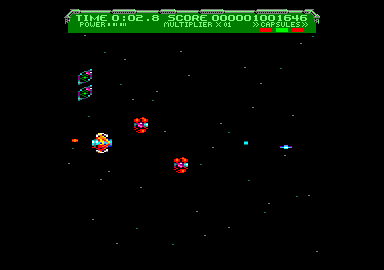
Dead on Time opens with the kind of arcade demand that is easy to understand and hard to relax around: shoot anything moving before it reaches you. Enemy ships arrive from all directions and can appear in formations of up to four, so you are constantly choosing whether to chase a clean kill or turn away before a ram costs you. Since the enemies do not fire back, the game’s danger comes from positioning and quick reactions rather than dodging walls of bullets.
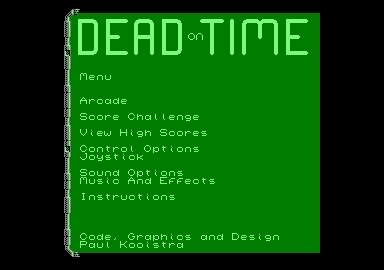
Arcade mode gives that basic loop a sharp clock-driven rhythm. Clear an entire formation and it leaves capsules behind; grab them and you gain extra time, making a complete clear more satisfying than simply picking off whatever happens to cross your path. Collecting three capsules of one color earns the bullet field, a temporary layer of protection that can absorb enemy impacts. That small reward chain gives you a reason to play aggressively even when the timer makes caution feel safer.
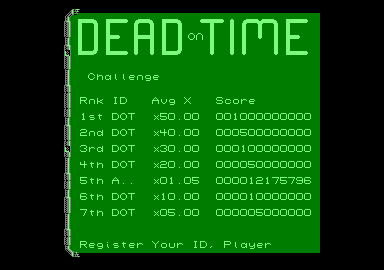
Score Challenge is the better fit if you want to settle into the scoring game without watching a countdown. There is no time limit, but impacts accumulate until the run ends, so careless contact still catches up with you. Capsules and the bullet field remain important, turning survival into a question of how efficiently you clear formations and protect your run. If you enjoy replaying a simple shooter to improve a score, the rules are focused enough to support that urge.
Graphics
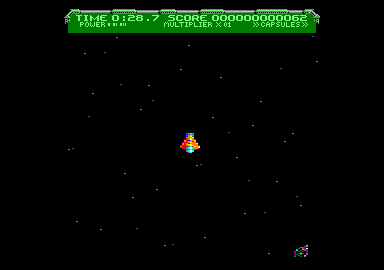
The action is framed as a 2D scrolling, top-down sci-fi shooter: your ship shares the field with incoming enemy craft and the capsules dropped by defeated formations. That overhead view suits the threat pattern well, since danger can arrive from any side and you need to spot an approaching ram quickly.
Story
Dead on Time’s story is its immediate arcade situation: you are in a ship, hostile craft keep coming, and staying alive means shooting first. The sci-fi framing is direct and functional, putting all attention on the next formation rather than asking you to follow a larger plot.
That stripped-back approach fits the game’s pressure. A timer in Arcade mode creates its own momentum, while Score Challenge turns the same conflict into a longer test of endurance. Your run supplies the drama: a capsule appears, you decide whether to risk collecting it, and one badly judged impact can change the outcome.
If you want character-driven stakes or a narrative hook between battles, this is not the reason to play. The satisfaction comes from making a clean sweep, extending the clock, and surviving long enough to better your last score.
Overall Experience
Dead on Time is a lean arcade shooter that understands the value of getting you back into the action. Its first minutes are immediately legible, but the capsule system starts to matter once you realize that clearing formations is not merely about points; it is how you earn time and temporary protection. That is enough to make repeated attempts feel purposeful rather than random.
The frustration comes from its central constraint: enemies can ram from any direction, and a moment spent chasing a capsule or finishing a formation can leave you exposed. That tension is the point. Arcade mode asks you to turn speed into survival, while Score Challenge asks whether you can remain disciplined once the clock is gone.
Give it a chance if you like old-school score-chasing shooters with a clean rule set and no wasted setup. It will not suit anyone wanting a broad campaign or a combat system full of moving parts, but its two modes and meaningful pickup chase make a solid case for another run after a close failure.

Reviews
There are no reviews yet.