 Retro Replay Retro Gaming History, Reviews & Emulation
Retro Replay Review
Gameplay
Don Juan begins with an unusually direct challenge: turn a starting bankroll and an empty lovometer into enough points to win over one of five women. You type infinitive verbs as single-keyword commands, hoping they will land as a compliment, a self-description, or a suggestion that suits her particular character. The immediate feedback is clear enough to be compelling. A favorable facial reaction tells you that you have found a productive line of approach; an unfavorable one tells you to rethink it.
The best part is the resource pressure around that word guessing. Some successful words open follow-up menus, such as a trip with several destinations at different prices, so a good idea can become a spending decision. HELP and WORDS can rescue you from total confusion, but they cost money. That is a smart bit of friction: asking for the vocabulary is useful, yet you are trading wealth that may be needed for a more effective gesture later.
Its limits are severe, though. Successful words cannot be reused more than three times, and submenu visits are similarly capped, which prevents easy repetition but also makes experimentation feel constricted. Failed words can work later, adding uncertainty rather than clean logic to the puzzle. Rivals and sudden misfortunes—anything from a toothache to losing a job—demand the right comforting keyword at the right time. When you decode that response, it feels clever; when you do not, the game can feel like you are throwing verbs at a locked door.
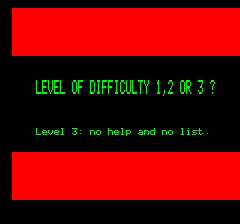
Three difficulty levels and escalating targets of 500, 700, and 800 lovometer points give determined players something to master. Still, this is strategy in a very narrow sense: less about long-range planning than memorizing reactions, managing cash, and preserving options. Give it a chance if obscure word-based systems delight you. Do not expect the game to meet you halfway.
Graphics
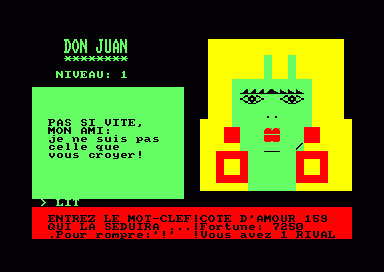
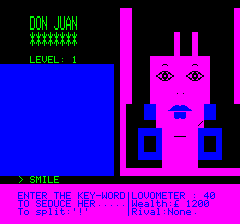
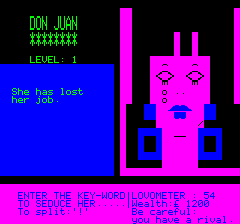
The clearest visual feedback comes from the women’s faces. Smiles, winks, kisses, and other reactions turn each typed keyword into an immediate verdict, which is much more useful than a wall of text would be. Menus also surface the more detailed choices behind certain ideas, including differently priced trip locations.
Story
There is barely a conventional story to carry you through Don Juan. Instead, each woman is defined by a broad personality label—a dynamic redhead, several differently characterized brunettes, and a voluptuous blonde—and the game asks you to tailor your words to that label. The narrative is therefore whatever pattern you infer from her responses.
That structure can create small moments of improvisation. A rival may intervene, or a woman may be hit with an absurdly unfortunate event, and you need to find a response that cheers her up. These interruptions stop the routine from becoming entirely mechanical, even if they are still solved through the same keyword hunt.
The larger premise has not aged gracefully. Treating women as a set of targets to be optimized through the right verbal inputs makes the whole exercise feel transactional, and the character descriptions are thin stereotypes rather than people you come to know. The game is more interesting as an odd period puzzle about conversational rules than as a romance.
Overall Experience
Don Juan has the kind of antique design that can be fascinating for an hour: type a word, study a face, revise your theory, and hope you have not spent too much on help. There is genuine tension in trying to raise the lovometer while every clue, repeat use, and expensive outing eats into a finite pool of opportunities.
But the payoff depends almost entirely on your patience for opaque trial and error. The game gives you hints and a vocabulary list, yet charges for both, while its restrictions can make a wrong early approach feel costly. That is a defensible challenge in a compact strategy game, but it is not especially forgiving or expressive.
For curious retro fans, Don Juan is worth a look as an unusual blend of parser-style input and turn-based resource management. Everyone else will likely find the premise dated and the word puzzle too arbitrary to sustain. Its interesting ideas are real; they are just buried under a game that asks you to accept a lot of repetition and discomfort.


Reviews
There are no reviews yet.