 Retro Replay Retro Gaming History, Reviews & Emulation
Retro Replay Review
Gameplay
The first few minutes of Evening Star have a pleasingly intimidating quality. You begin stopped in a station, seated in the cab with levers and gauges in front of you, and the job is not simply to point a train down the line. You have to get a heavy steam locomotive under way, settle into the permitted speed, watch the signals, and keep the timetable in mind. That immediate pressure gives the simulator a stronger hook than its premise might suggest.
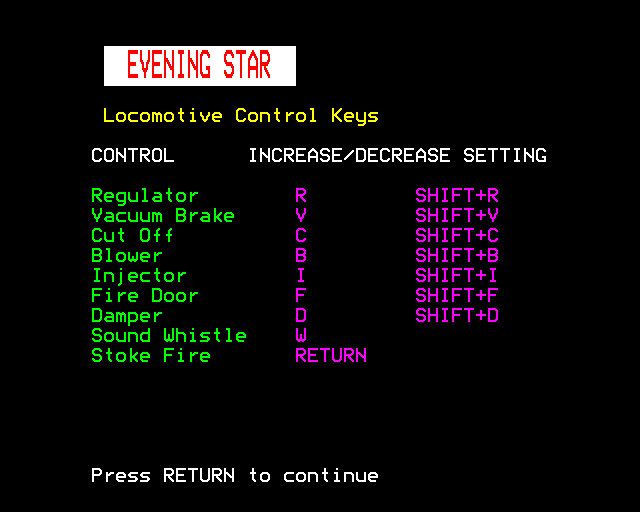
What starts to click is the relationship between all the things demanding your attention. Speed cannot be treated as an isolated number when gradients, water, coal, steam, signals, and the clock are all part of the same journey. The game asks you to think ahead rather than merely react. A slope matters because it changes how you handle the locomotive; a signal matters because the line will not forgive blind momentum; the whistle has to be used correctly. That interconnected workload is where Evening Star earns its name as a simulator.
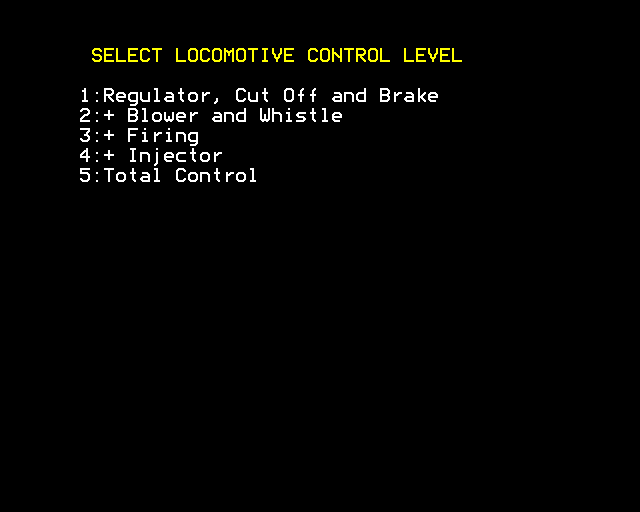
The scenario structure is a smart fit for that learning curve. A demonstration mode and seven increasingly difficult scenarios give you somewhere to start before the most involved setting asks for full train control, additional problems, and a random timetable. You are not expected to understand every dial at once. Still, patience is essential. The challenge comes from sustained concentration, and frustration can set in when one neglected resource or missed limit spoils an otherwise careful run.
There is a particular kind of satisfaction in maintaining discipline for long enough that the cab stops feeling like a panel of obstacles and starts feeling like a workplace. Evening Star will reward you if you enjoy procedure, planning, and the tension of keeping a large machine on schedule. It has little interest in flattering impatient play, but that severity is also its strongest argument.
Graphics
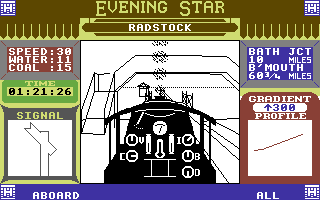
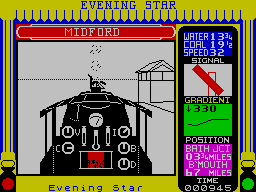
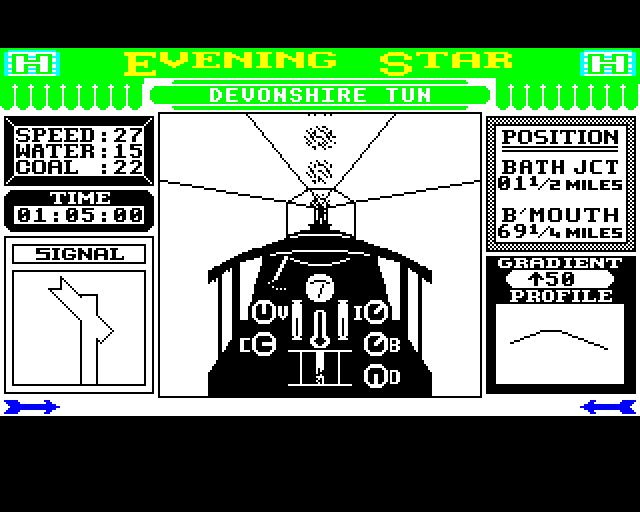
The first-person cab view keeps the important hardware directly in front of you: levers and gauges fill the working area, while the route can be seen ahead and to either side. Separate readouts show speed, water, coal, signals, gradient, and time, making the information you need easy to locate while driving.
Its most memorable image is therefore not a grand exterior shot but the crowded locomotive cab itself. You spend the journey looking through the front and side views, then back to the instruments that decide whether the run stays under control.
Story
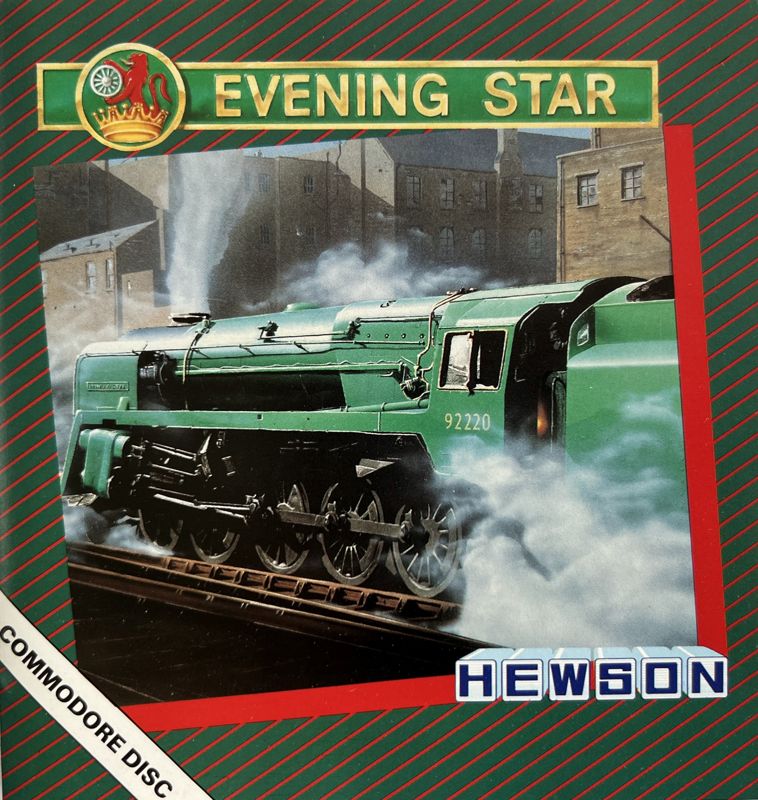
Evening Star does not lean on a conventional plot. Its story is the working fiction of a railway duty: you are at the controls of the last British steam locomotive built, BR Standard Class 9F No. 92220, hauling the Pines Express from Bath toward Bournemouth on the early-1960s Somerset and Dorset line.
That framing is enough because the timetable supplies the drama. A departure begins at a standstill, then every signal, speed restriction, and changing gradient becomes part of a journey with consequences. You are not pushed through scenes or dialogue; you create the shape of the run through competent—or careless—driving.
The historical specificity gives the simulation some welcome character. Taking responsibility for Evening Star rather than an anonymous engine makes the demanding procedures feel less like abstract numbers. The game trusts the route, the locomotive, and the task to carry the atmosphere, and for a train enthusiast that is a sensible choice.
Overall Experience
Evening Star is demanding in a focused, old-school way. It turns steam operation into a chain of practical decisions, then refuses to let you forget any of them for long. The random timetable on the highest difficulty is an especially fitting escalation: once you understand the basics, the game can stop feeling like a rehearsed exercise and make you manage the job under less predictable conditions.
Give it a chance if you like simulations that expect you to learn systems and take pride in a clean, punctual run. The seven-scenario climb means there is a route into its complexity, but the payoff is still reserved for anyone willing to pay close attention. You will spend more time reading gauges and respecting limits than chasing spectacle.
For everyone else, Evening Star can feel dry and unforgiving. Its pace is deliberate, its pleasures are procedural, and a successful journey may look uneventful from the outside. But if the thought of nursing a steam locomotive over a scheduled route sounds absorbing rather than tedious, this is a sturdy simulation with a satisfying sense of responsibility.



Reviews
There are no reviews yet.