 Retro Replay Retro Gaming History, Reviews & Emulation
Retro Replay Review
Gameplay
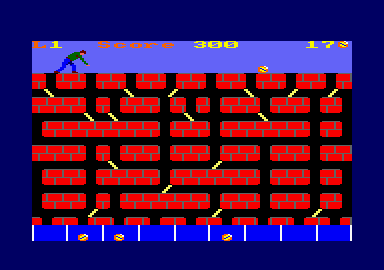
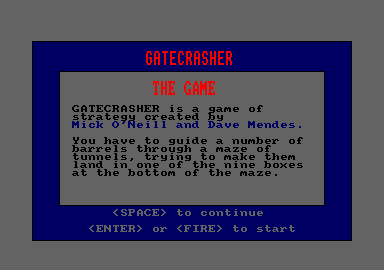
Gatecrasher starts with an immediately understandable challenge and then makes it far more demanding than it first appears. You stand above a side-on maze, choose where to release a barrel, and follow its path through tunnels and gates toward one of nine boxes below. That simple drop becomes a small act of prediction: every gate redirects the barrel, and the right opening is only right if you have read the entire route correctly.
The limited supply of 20 barrels gives every experiment some weight. Filling every box is the goal on several levels, but putting two barrels in one box removes them both, so a careless success can become a damaging mistake. That rule gives the game a stern, old-school edge. You will likely spend the early levels mapping routes in your head, make a confident drop, and then watch the barrel expose the one turn you misunderstood.
Changing the maze’s vertical position adds a useful layer beyond simply selecting a hole. The earthquake option, which shakes the gates randomly, is a more reckless tool: it can alter a troublesome arrangement, but it asks you to accept chance in a puzzle built around careful observation. Whether that feels like a clever emergency lever or needless disruption will depend on your tolerance for uncertainty.
The changing objectives help Gatecrasher avoid becoming nine-box busywork. Levels five and six turn the boxes into a number-sorting problem, with each barrel swapping a box’s contents with the box to its right. Level eight asks you to repeat a sequence. These shifts force you to reconsider the same maze-and-barrel language rather than simply solve larger versions of the opening exercise.
Graphics
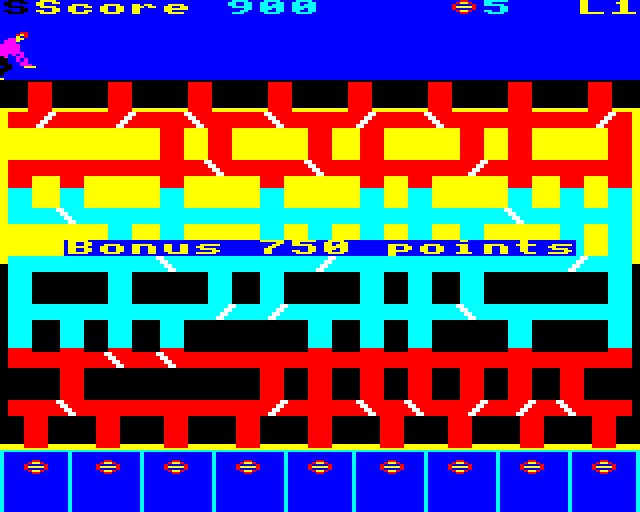
The side-view maze keeps the important information in front of you: a character stands at the top, barrels travel through the tunnels and gates, and the row of boxes waits below. It is a functional layout for a puzzle that depends on tracing routes and checking where each barrel can land.
Story
Gatecrasher is driven by puzzle progression rather than a narrative journey. Your motivation is the board in front of you: understand its gates, occupy the required boxes, and conserve enough barrels to finish.
That stripped-back approach suits the game. A clear objective gives each level its own little dramatic arc, from the first calculated drop to the relief of seeing a planned route land correctly.
The later number-ordering and sequence-repetition tasks provide the closest thing to escalation. Instead of a plot changing the stakes, the rules change what a successful barrel placement means, which is enough to keep the progression from feeling entirely static.
Overall Experience
Gatecrasher is the kind of puzzle game that rewards stopping for a minute before touching anything. If you enjoy route-planning problems where one action has consequences several turns later, its gates and limited barrel count create a satisfying knot to untangle. The payoff is the moment a route you have mentally rehearsed actually works.
It can be frustrating when a barrel vanishes because it shares a box with another, especially after you have spent time studying the maze. The random earthquake function may sharpen that frustration for anyone who wants every outcome to remain fully controllable. Still, the game earns its severity because its core rules are direct and its failures point back to a route you need to read more carefully.
Give Gatecrasher a chance if you like compact, cerebral puzzles with a slightly unforgiving streak. It does not need a complicated framework to stay interesting: the route changes, the shifting maze, and the altered level objectives keep asking you to think one drop ahead. For the right kind of puzzle fan, that is more than enough.


Reviews
There are no reviews yet.