 Retro Replay Retro Gaming History, Reviews & Emulation
Retro Replay Review
Gameplay
Ghost Hunters wastes no time putting you under pressure. Hunk Studbuckle enters Nightmare Mansion looking for his brother Chuck, and each new flick-screen room immediately starts building the Terrormeter. As that meter rises, Macho Energy falls. You need to clear out the spirits or get back out before Hunk runs dry, which gives even small rooms a nervous, time-sensitive edge.
The Phantom Splatterer is the game’s defining wrinkle. You move Hunk with the joystick, but holding fire controls the weapon sight rather than simply firing in the direction you are travelling. That makes shooting a more deliberate task than you might expect from a side-view platformer. You have to decide when it is safe to stop concentrating on movement and start lining up a spirit. When the timing clicks, the mansion feels like a chain of quick, dangerous little clean-up jobs.
It is also where frustration can creep in. The same pressure that creates urgency leaves little room to relax and learn a screen at your own pace. Magic potions can restore lost energy, but they are a recovery tool, not permission to ignore the Terrormeter. If you enjoy old games that demand brisk decisions and accept a few rough attempts as part of the deal, that tension is the point. If you want forgiving platform action, Ghost Hunters can feel relentlessly abrasive.
Two-player mode is the most distinctive way to play. One person controls Hunk while the other controls the gun sight, turning the odd control scheme into a proper division of labour. It can become a lively exercise in communication: one player keeps the hero alive while the other tries to remove the threat quickly enough. Solo play is more self-contained, but the cooperative option gives the game a personality many similar 8-bit platformers lack.
Graphics
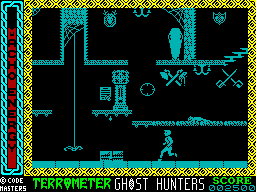
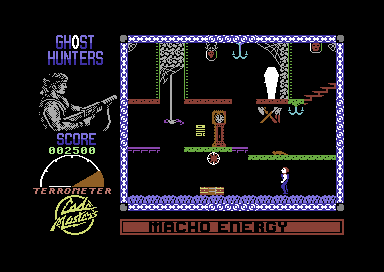
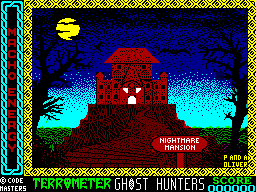
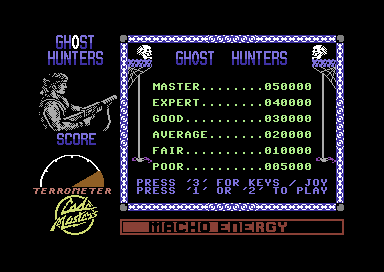
The action is shown from the side in single-screen mansion rooms, with the Macho Energy bar, Terrormeter, and score visible alongside the play area. That constant readout suits a game built around rapidly worsening danger: you can see the cost of lingering even while you are dealing with ghosts.
Story
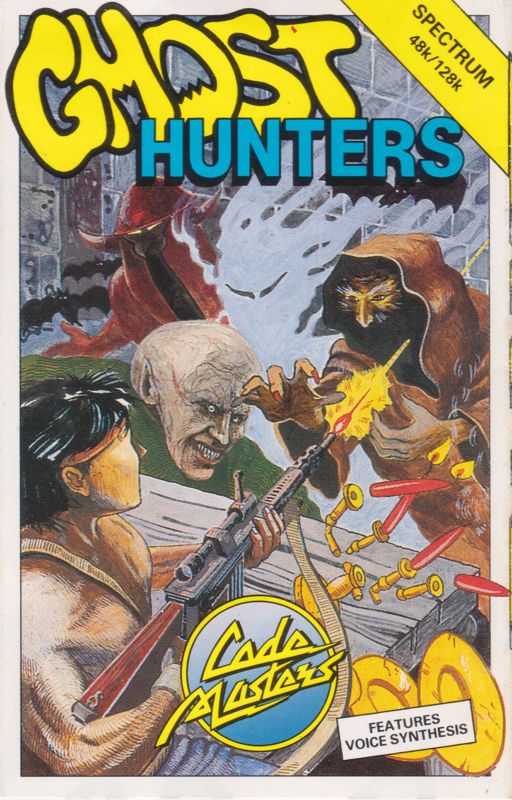
The story is simple and appropriately pulpy. Chuck Studbuckle went into Nightmare Mansion to clear out its ghosts and ghouls, vanished for three days, and left Hunk to bring him back. It is a clean excuse to enter a hostile house armed with something called a Sub-Compact Anti-Matter Phantom Splatterer.
That knowingly overblown naming gives Ghost Hunters some welcome charm. Hunk’s Macho Energy and the Terrormeter suggest a horror game with its tongue at least partly in its cheek, rather than an attempt at serious supernatural dread. The setup does not need much more detail because the game’s real story is the immediate one you make room by room: enter, survive the rising panic, and push farther into the mansion.
Do not come expecting a plot-heavy rescue adventure. The missing-brother hook does its job, then steps aside for arcade pressure. For a 1987 action game, that is enough motivation, and the ridiculous weapon name is more memorable than a page of extra backstory would have been.
Overall Experience
Ghost Hunters is a small, stern haunted-house platformer with one strong idea: fear is a resource drain, not just decoration. The Terrormeter gives every room a deadline, and that makes the game feel more urgent than a straightforward ghost-blasting romp. Its 5.8 score feels fair: there is a clever core here, but it is not smoothed out for anyone who dislikes rigid old-school pressure.
You should give it a chance if you like Commodore 64, ZX Spectrum, or Amstrad CPC action games that make a lot from a compact set of rules. The aiming system asks for patience, the flick-screen structure keeps progress stop-start, and the energy drain can turn mistakes into sharp setbacks. Still, that friction produces a distinct rhythm rather than generic platforming.
Bring a second player if you can, because splitting movement and aiming is where its strangest idea becomes its best one. Alone, Ghost Hunters is a decent, demanding period piece; together, it becomes a tense co-op oddity worth remembering. For another supernatural hunting game, see G.H.O.S.T. Hunters: The Haunting of Majesty Manor.


Reviews
There are no reviews yet.